Lake District Rampage 2020, days 1 & 2: towns, hiking the Old Man of Coniston, Grizedale MTB trail

Saturday 4th July – Windermere, Coniston

We woke up in a quiet layby near Kendal just east of the National Park, having made the 6-hour journey on Friday evening. We did the grocery run in Kendal Morrisons, giddy about the prospect of our first van trip since before lockdown, and drove to Windermere for a poke around.

Windermere was pretty and as we wandered through its neat streets lined with slate-grey buildings, it felt as if the world was tentatively waking up. The pubs and restaurants reopened post-covid for the first time today and there was a quiet bustle about the town, which I expect is usually a bit too touristy. It’s quite small so we weren’t there long before driving down the road to Bowness (definitely too touristy). We walked behind the shops and bars along the edge of Lake Windermere, where geese, pigeons, crows and other annoying types of bird congregated, and looked out over the misty grey water.

We nearly went into a bar for a drink but decided to carry on to Coniston. The half-hour drive via Ambleside (bustling outdoorsey town, will return) gave us our first taste of the narrow, winding Lake District roads, and we parked in our tucked-away camping spot early afternoon. Coniston is a lovely village set against the scenic backdrop of rugged, high fells and we spent the afternoon enjoying our first post-covid pub visit in The Crown, eating fajitas in the van and talking rubbish.

Sunday 5th July – Old Man of Coniston (hiking), Grizedale Forest (mountain biking)

We climbed the Old Man of Coniston (803m) – see a previous post about a previous (solo) hike here -, a lovely mountain which towers over a valley of old copper mines and overlooks a panorama of fells, forests and lakes, its steep, winding path made interesting by the ruins of old mining ruins, long, forearm-thick wire cables and a high, black tarn. The weather was surprisingly clear until about twenty minutes before the summit, when the clouds thickened and the wind picked up. It’s amazing how the weather can change in the mountains – we watched as thick white cloud rolled unstoppably over the summit ridge and down the escarpment, like the froth spilling over the edge of an overpoured pint. At the top Ryan actually grabbed me as a particularly strong gust of wind caught me off balance, sending us into fits of giggles.

It took us two and a half hours’ quick walking there and back along the same path from Coniston (including a couple of stops to snack on the summit, faff around the old slate ruins and scramble down to a crystal clear, waterfall-fed river) and we were pleased that contrary to the forecast, the weather had held up. It looked to worsen that afternoon so we’d planned to do the North Face mountain bike trail (graded red – advanced) at Grizedale Forest, twenty minutes from Coniston.

The bike trail was very technical and very different to others we’ve done. What seemed like more than the first half was uphill, on fairly gradual gradients made complicated by large, sharp rocks protruding at all angles and constantly threatening to throw wheels off the trail or bottom-out the chainring. There was no smooth, flowing downhill, real berms or jumps, but there were quick rocky sections towards the end and  it was really enjoyable in a different way – it felt much more “raw” and rugged, which was exacerbated by the fact that we didn’t see another person on the trail. Surrounded by an untamed melee of firs, ferns, grasses and foxgloves, with the occasional clearing showing off the magnificent mountainscape behind the dark, glassy Coniston Water, it felt like wild, “proper” mountain biking.

Soaked, muddied and elated, we loaded the van and drove an hour-and-a-half to Wasdale Head. That evening we planned a (really) long hike for the next day and went to bed blissfully unaware of the epic that was to follow. I’m still gathering up the energy to write about it…

Dartmoor, October ’19

We left for Devon on Friday evening, undeterred by the miserable forecast and keen to escape the week. After a drink in the Ring O’Bells at Chagford and a sketchy drive along some flooded back roads (sketchy because of the flooding, not the drink), we spent the night in an empty roadside car park on the moors near the Warren House Inn. The wind howled outside and sideways-rain thrashed relentlessly at the windows, making the van extra cosy and the thought of a Saturday hike extra unappealing.

Fortunately the 9am England vs New Zealand World Cup semi-final provided a watertight excuse to chill out in the van. That morning I discovered the best way to watch rugby: tucked in bed, coffee in hand, storm raging outside, on a phone held by two karabiners onto a bungee cord strung across the ceiling of the van. For those 80 minutes the world was perfect, and England’s 19-7 victory topped it off with icing and a cherry.

Reluctant to waste the day, we drove across the bleak, blustery moor. I’d hoped to wander over the old clapper bridge at Postbridge but it was flooded, so we went on to Princetown and went round Dartmoor Prison museum. The prison itself is a foreboding, horror film-esque building, but that morning it was swallowed and obscured by oppressive, thick grey fog. The museum was really interesting; highlights included escape stories, improvised weapons, cleverly concealed contraband and all sorts of prison-made matchstick models.

The weather was still grim so we wandered round the National Park visitor centre, turned down a (strangely?) friendly shopkeeper’s invite to a Halloween party, found a good overnight spot in Princetown, chilled out in the van for a while, planned Sunday’s hike and spent the evening eating and drinking in the cosy Plume of Feathers pub. I assume we had a good time as I don’t remember returning to the van.

We were up quite early on Sunday morning, thanks in part to the clocks going back. We watched South Africa beat Wales during breakfast at the Fox Tor café, a buzzing little outdoorsey hostel/café in Princetown, and plodded (mild hangovers prevented exuberant movement) out onto the moors to make the most of the dry weather.

I’d plotted a rough route by circling tors on the map and joining them up. We walked past the towering Princetown TV mast along a long stretch of bridleway, then scrambled down a rocky edge into disused Foggintor quarry. This is a big granite playground containing a lake, lots of bouldering/climbing/scrambling/camping potential and a few sheep bones. After messing around like children we carried on to King’s Tor as the crow flies, which involved scrambling down a huge pile of boulders and wading through knee-high tufts of boggy grass.

It was pleasantly dry at the top of the hill and we scrambled over the tor, admiring the view. Rugged moorland surrounded us on three sides, punctuated by granite tors which towered like huge stacks of elephant poo, and in front rolling countryside marked the edge of the National Park. We climbed down and carried on, following a curved track once used by quarry carts round to Ingra Tor. After a bit more scrambling we bore east and headed uphill past a group of hardy-looking Dartmoor ponies towards the scree-sided Sharpitor, but it was a little out the way and looked pretty similar to the other elephant poos so we turned left at the B3212 and headed back towards Princetown.

This section took us parallel to a slab-lined stream which we’ve decided to revisit in summer – it’s practically wasted as a water supply as it’d make a perfect lazy river. We walked along this low-lying bit of moor, past dark fir forest, reddish ferns and scrubby bushes, found a tucked-away spot by a waterfall for next time’s pre-lazy river camping, and climbed the gradual slope up to Hart Tor. Here the surrounding moorland is covered by rippling golden grass which touches the horizon on three sides, broken only by the blue haze silhouette of Sharpitor and Tryfan-shaped Leather Tor to the southwest. View admired and Hart Tor being our last circle on the map, we descended across the wild, yellowey moor and followed the road back into Princetown.

So far I’ve failed to mention my idiocy the previous afternoon, perhaps in the hope that anyone reading has got bored by now. I had been enjoying van’n’chill so much that time spent listening to music with the ignition on had flown by and drained the battery. We realised this on Saturday but prioritised the pub (which I do not regret), so we were left with the job of organising a jump start post-hike. I was devastated to find out that a) we couldn’t jump the main battery with the leisure one, and b) my breakdown cover doesn’t cover campervans, but found an alternative service (Kev from Plymouth) which arrived quickly and sorted the problem.*

And so we left Dartmoor, half ashamed, half amused, fully satisfied with a lovely weekend (despite the weather) and fully disappointed that it was over.

*NB – I’ve since written to the insurance provider and received a full refund plus the cost of Kev’s callout, so you can sleep tonight knowing that justice was served.

The Norfolk Broads for Adventure-Seekers: 10-point summary

This year’s family holiday took us to the Norfolk Broads for a week. I didn’t know what to expect  as I’ve never explored that part of England before; family holidays usually took us West to Wales or Devon/Cornwall, and I was a bit apprehensive at the lack of sea, hills and mountains.

Despite this we managed to fit in plenty of activities and do a fair bit of exploring. We travelled around on a boat and moored at a different place each night, so saw plenty of the National Park – I’ll write a brief journal in a separate post.

Here are some highlights and key observations from my Broads trip:

1. Flatness

It’s SO flat. I knew this before we left but didn’t appreciate just how un-flat everywhere else must be – previously I considered the New Forest the flattest place in the UK. It probably didn’t help that I was in the Lake District a few weeks ago.

The landscape and the skies are vast and open, which makes you feel really small in a similar-but-different way to hills and mountain ranges. The nights are dark (not much light pollution), quiet and still.

2. City, towns and villages

Norwich is great – it has a lively buzz, a cathedral, a castle, a nice bit of river, plenty of history and a good indoor climbing/bouldering place called Highball.

Wroxham is apparently seen as “the capital of the Broads” by some, but I wasn’t that impressed. Too many big shops, more zimmerframes and dentures than I’ve ever seen in one place before and a bit tired and scruffy.

Other towns and villages were okay but I wouldn’t say they were picture-postcard, although apparently Beccles in the South Broads is lovely. Ludham and Coltishall were probably the prettiest we stopped at.

The thing I didn’t expect was the “water streets” on the outskirts of towns and villages. Pretty houses of all shapes, sizes and styles were fronted by boats instead of cars, boathouses instead of garages and water instead of tarmac.

3. Wildlife

There are loads of birds – the more “exotic” (coming from a Hampshire girl) ones I saw include the great crested grebe, curlew and marsh harrier. Masses of reeds and foliage of every shade of green line the waterways, so it’s not surprising that it’s such a haven. I wish I’d looked out for more wildlife but I spent lots of time reading, painting and planning.

There are also lots of insects – dragonflies, damselflies, thunderbugs and funny little red things. Oh and midges and mosquitos, expect to be bitten – particularly around stagnant water. Luckily I don’t seem to taste as good as the rest of my family.

4. Wild swimming

90% of my research told me not to swim in the Broads because of a) toxic blue-green algae, b) human waste and c) 42lb pike (big teeth, bitey). I took heed of the other 10%.

Swimming probably won’t kill you, although I’d judge it on how the water looks. The blue-green algae can be irritant and toxic if ingested; it’s really thick in some places, particularly up creeks where the water is stagnant – there were parts of Barton Broad I definitely wouldn’t swim in. I wouldn’t worry about pike as it’s pretty unlikely you’ll get bitten, and re: human waste – avoid swimming where there are loads of boats and don’t swallow anything (particularly solids…). Around Salhouse Broad was a nice spot for a dip.

The thing you should be really aware of is boats, as it’s easy to miss swimmers. Bright colours, paying attention and avoiding busy areas should help you stay safe. A support boat is ideal.

5. Cycling

Don’t expect to go mountain biking – Rocky (my lovely old hardtail) had the gentlest ride of his life on the cycle path between Wroxham and Aylsham. The Broads offers easy, relaxing cycling which will give you a different perspective of the National Park.

6. Kayaking

As a National Park by virtue of its waterways, the Broads is perfect to explore by paddle. You can access creeks beyond the reach of boats, see loads of wildlife and get some exercise – see On Kayaking. I was surprised by how few other kayaks there were and couldn’t believe that I couldn’t hire a SUP anywhere!

I should probably say be careful of blue-green algae, which can be irritating to skin if flicked onto it by a paddle. However, I’ve been in contact with it several times and never suffered any ill-effects, so it’s your call.

7. On foot: running/walking

Plenty of footpaths allowed me to run or walk alongside the water when I got restless. I particularly enjoyed a 12k run between Stokesby and the edge of Great Yarmouth along the Weaver’s Way (and only passed one person), although it was a difficult surface to run on as it was soft, thick, dry grass. I also enjoyed a 5k at Norwich and Coltishall on more forgiving ground.

The terrain is so easy underfoot that it’s more gentle rambler’s territory than thrill seeker’s, and it doesn’t offer breathtaking views in the same way as hiking up mountains. However, I think it’s worth seeing for the novelty. The landscape is attractive, with pretty windmills dotted among swathes of reedbeds and golden fields. I enjoyed the bizarre sight of boat sails gliding across the fields, hulls just out of sight!

8. Fishing

I enjoy fishing but my catch rate is abysmal and wasn’t improved upon here. Apparently there’s plenty of freshwater species such as bream, perch, roach, tench, dace, rudd, trout and pike, but our maggots and sweetcorn failed to entice anything during the evenings. We saw other people haul in decent sized fish (annoyingly!).

You’ll need a rod licence to fish in the Broads (I paid £12 for an 8-day one, which covered two rods) and in a few areas you need extra permission.

9. History

The waterways were made by peat digging between the 12th and 14th centuries, until the ditches flooded and became used for commerce and communication. The landscape is dotted with pretty windmills, which were used to grind corn and drain excess water from the fields into the river system.

There are also lots of lovely churches, thatched rooves, the remote ruin of St Benet’s Abbey and a cute little museum at How Hill.

I could get geekier but basically the history is interesting, not least because this apparently natural landscape is actually man-made.

10. Pubs

Last but never, ever least, there are loads of pubs along the Broads. Most have free mooring and I found that (in comparison with Hampshire) drinks were cheap and portions were generous. Need I say more?

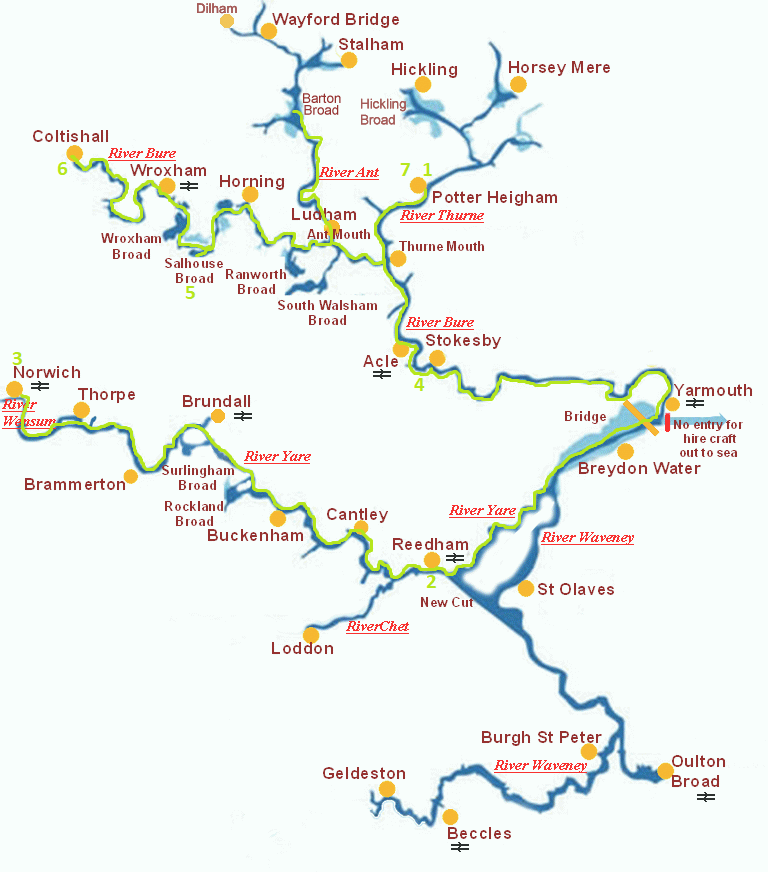
Norfolk Broads trip map

Green line shows our route, with each number corresponding to our overnight spots