Hiking the Black Forest’s highest mountain: The Feldberg

Thursday 12th September 2024

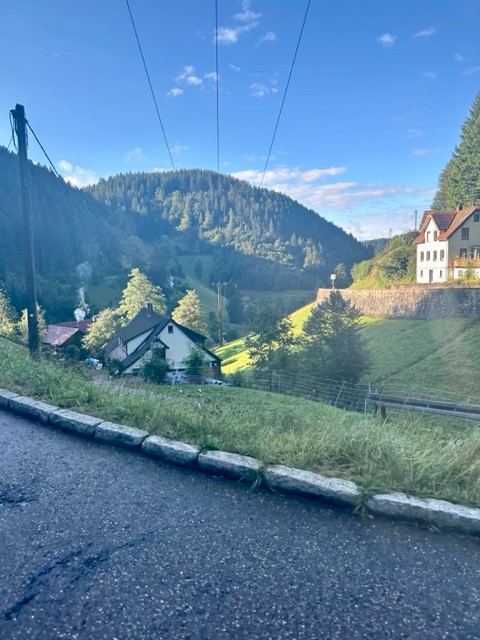
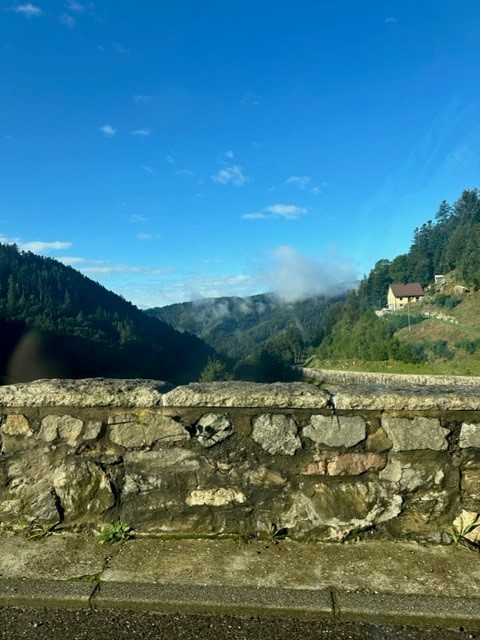
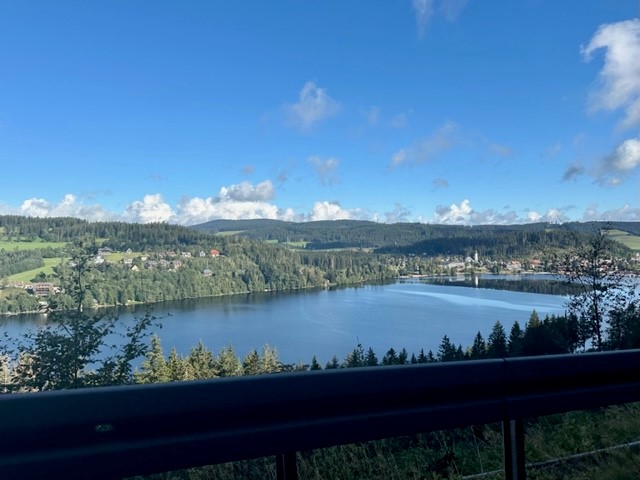
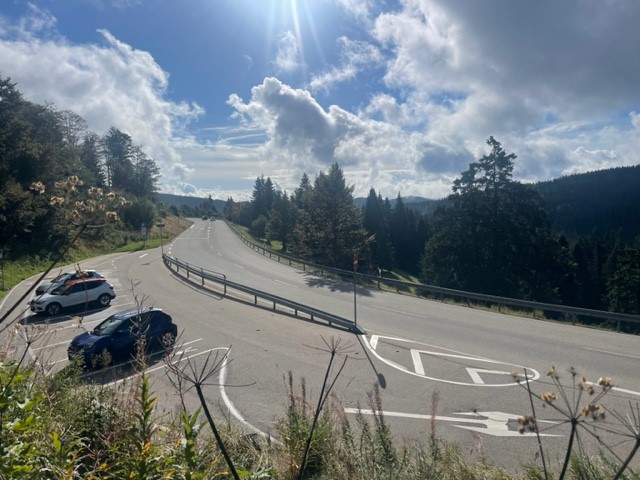
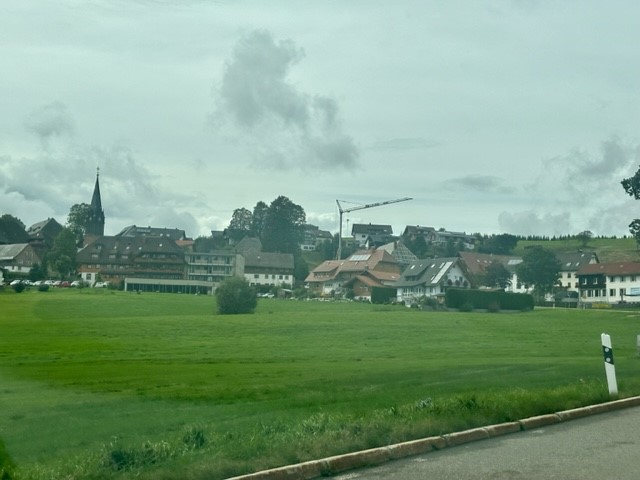
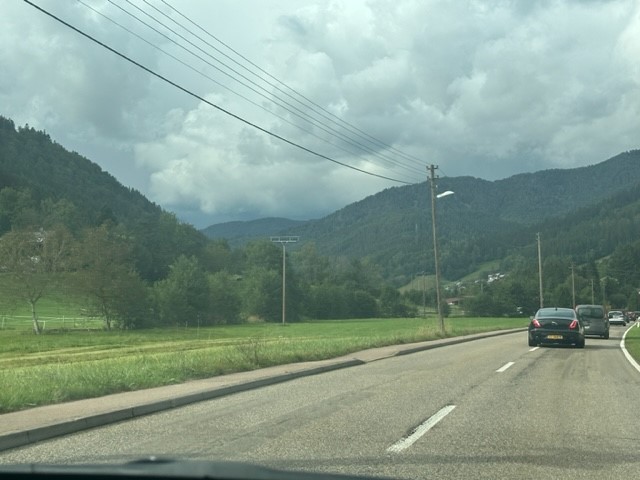
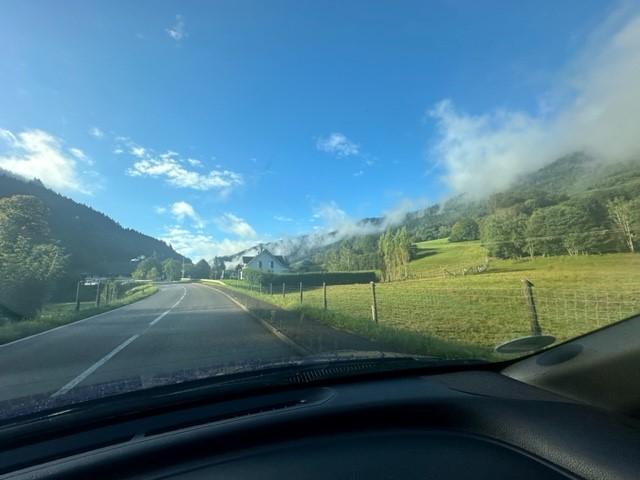
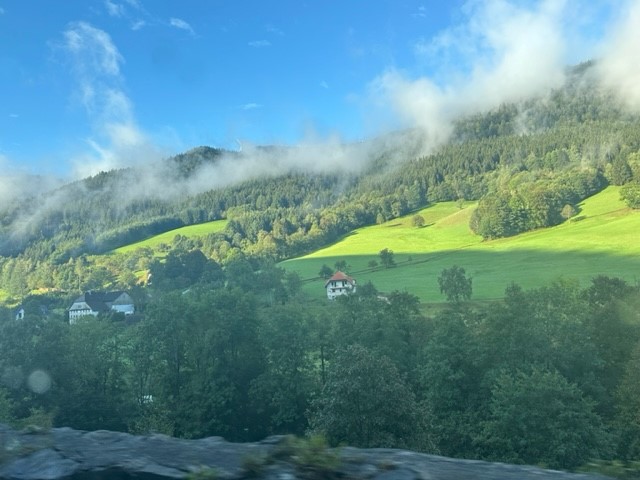
We’d kept a close eye on the forecast since arriving in Germany and today looked to be the first (and perhaps only) sunny day. Consequently we had reserved it for the main thing on our holiday to do list – a hike up Feldberg, the Black Forest’s highest mountain. We left the apartment at 8:30am and set off south in our little hire car, itching to explore the hills. Bright morning sunshine saturated the green fields that filled the valleys as we snaked through the vast landscape, lifting mist from dark, thickly forested hillsides in atmospheric veils. We navigated an unexpected road closure, passed high above the glassy surface of Lake Titisee and arrived in a small roadside car park at 10am.
The Feldbergsteig trail

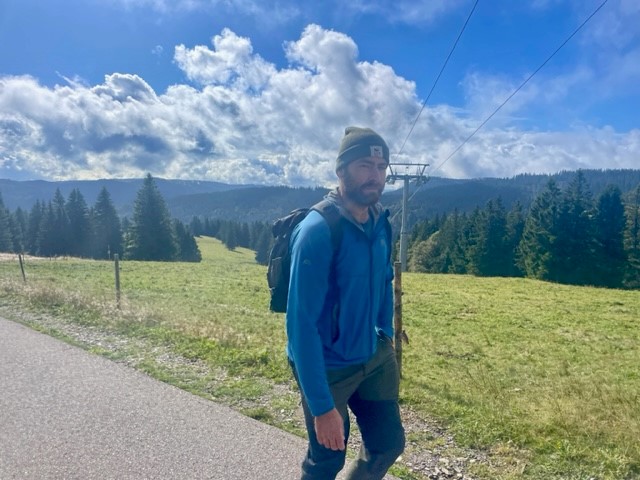
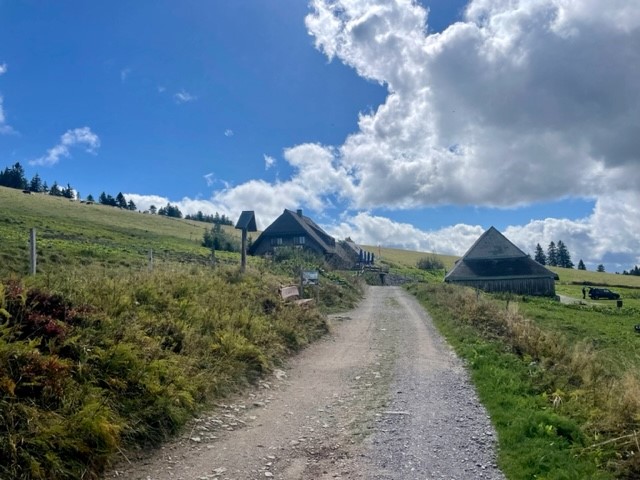
We set off uphill past a modern, sharp-angled church and found ourselves in an outdoorsey resort containing a large hotel, ski centre and cable car base. Eager to escape the tourist trap, we found an information board showing our intended route, the Feldbergsteig. We hadn’t appreciated that the trail starts at an elevation of 1,287m so it felt like cheating to say we were climbing a 1,493m peak, but nevertheless we were excited for a varied, circular hike in a new mountain range.

To the Bismarck memorial

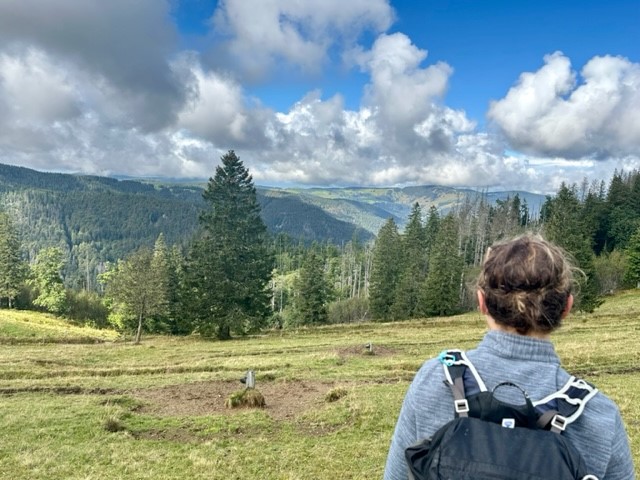
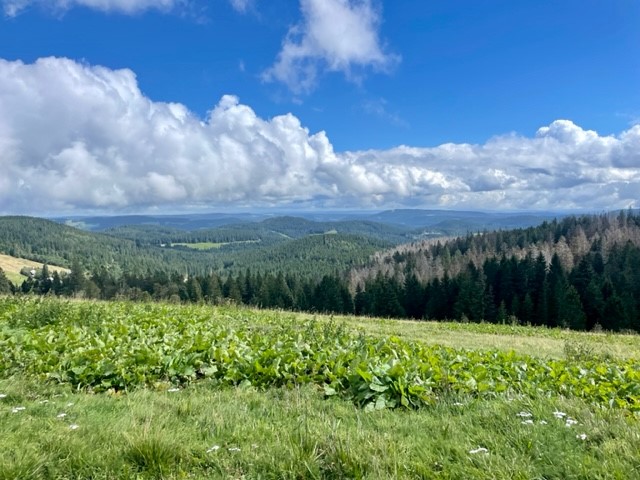
We headed northwest up a wide, gently inclining track that ran roughly parallel to the cable car line, passing several small groups who greeted us with a friendly “hallo”, and soon began soaking in the view. The surrounding yellow-green meadows melted into dark treelines formed by tall, deep green spruces, beyond which stretched endless forest spread thickly over distant, hazy blue ridges arranged in undulating layers. It was sunny, still and resoundingly quiet.

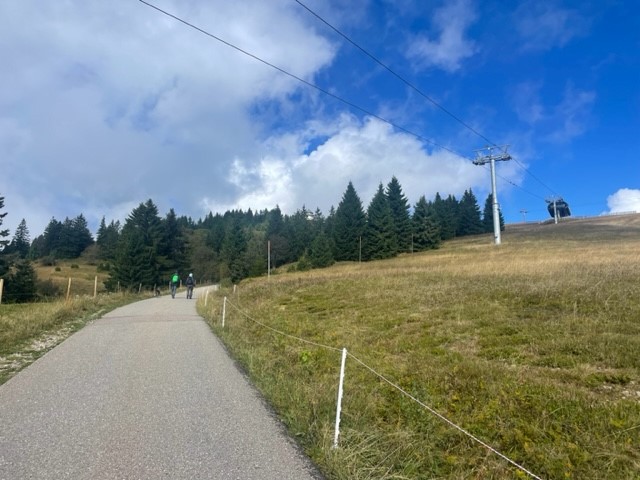
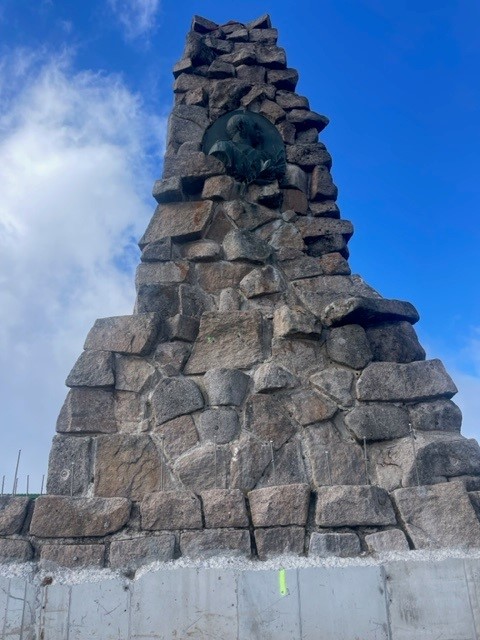
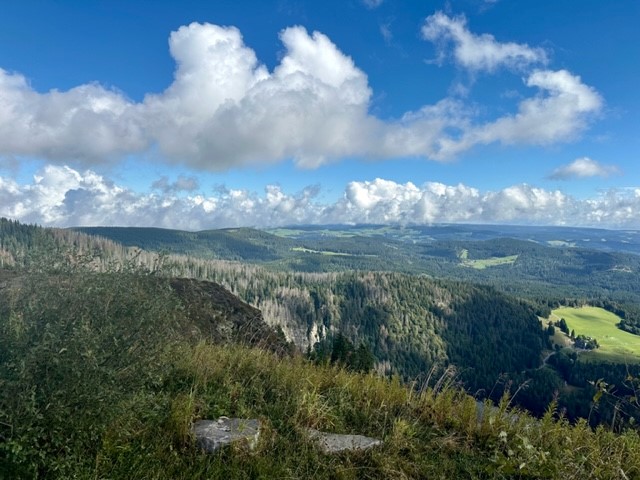
The track narrowed and took us into a verdant coppice, then continued through rugged meadows past a severe-looking concrete tower laden with satellite dishes. The first landmark we arrived at was the Bismarck memorial, a great stone pillar dedicated to the first Chancellor of the German empire. It was a wonderful viewpoint; a continuous swathe of forest covered the surrounding  hills and valleys like a dark green blanket stretching all the way to the distant horizon, broken only by occasional ragged-edged, grassy clearings.
Up Feldberg

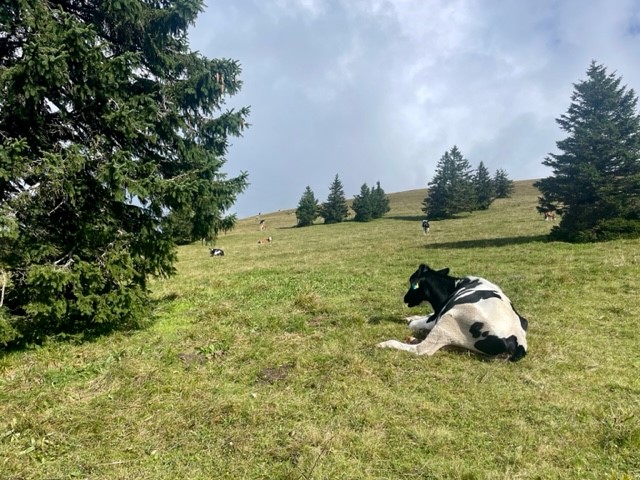
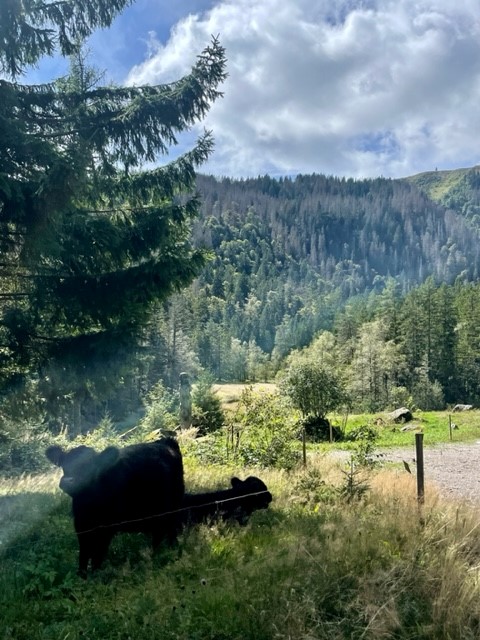
We left the memorial and headed down the side of the hill across open meadow. We went through a gate and followed a wide gravel path along the side of a ridge, which was covered in rough, yellowish grass and sloped gently downhill towards the endless forest. A strange, tinny sound tinkled across the valley and a thin curtain of fluffy cloud – which had drifted down the ridge and obscured the path ahead – cleared to reveal a small herd of Fresian cattle blocking the path. I’ve been averse to cows since getting charged by a bull a few years ago, so I gave them a wide berth and reached a gate with some relief.

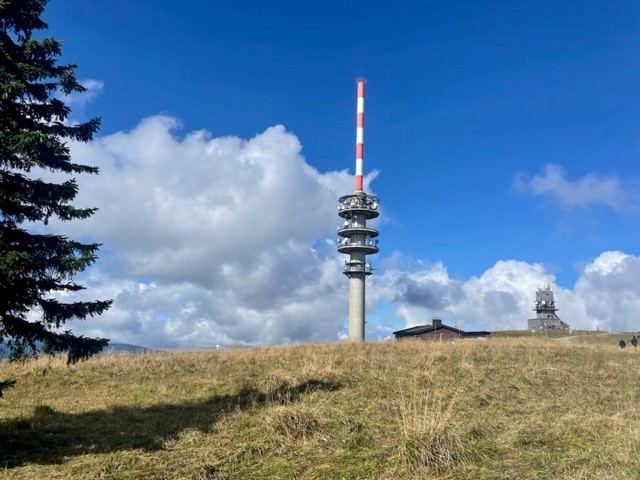
We gained the summit of Feldberg via a straight path up a gentle incline, the only drama being the loud and alarming receipt (on our phones) of Germany’s annual nationwide emergency alert test at 11am. It was a grassy and oddly subtle, unremarkable peak marked by a low, flattened mound topped with a trig point and a circle of benches, marred slightly by a tall communications tower and grim looking building a short distance away. We munched a sandwich with our backs to the tower and gazed across gently rolling, forest-carpeted hills, pondering on the ethics of saying we’d climbed a mountain.
Through field and forest

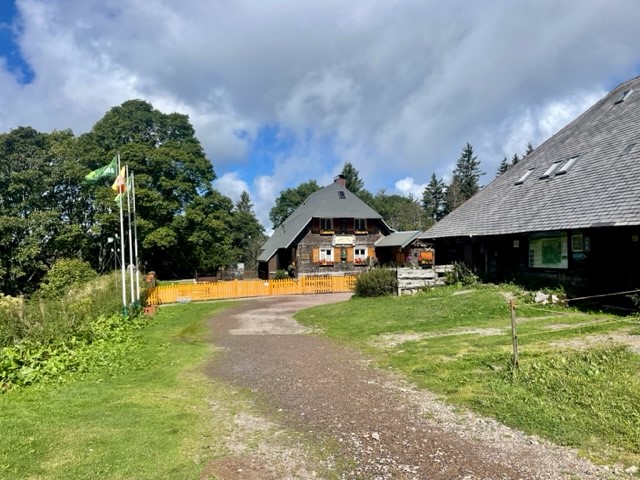
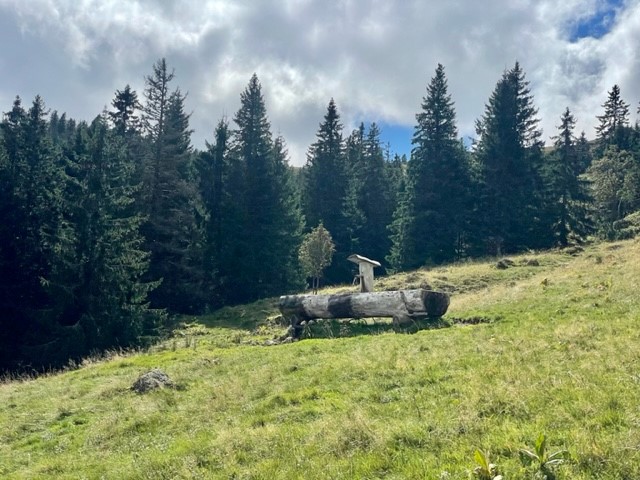
My doubts about the mountainous nature of the area were allayed once we left the summit and headed down a track that passed the ugly tower. The peaks ahead of us to the west were steeper, more undulating and completely forested compared to the gentler, grassier slopes to the east, and the horizon was formed by wide, hazy triangles of more mountain-shaped mountains. We headed downhill past a lush, green meadow dotted with fir trees and cattle, their cowbells tinkling whimsically in the breeze, and reached the first alpine hut along the route – a large, tiled, welcoming-looking building. Resisting the temptation to stop and grab a drink, we continued on the path, which flattened out and arced around Feldberg’s lower reaches in a smooth curve.
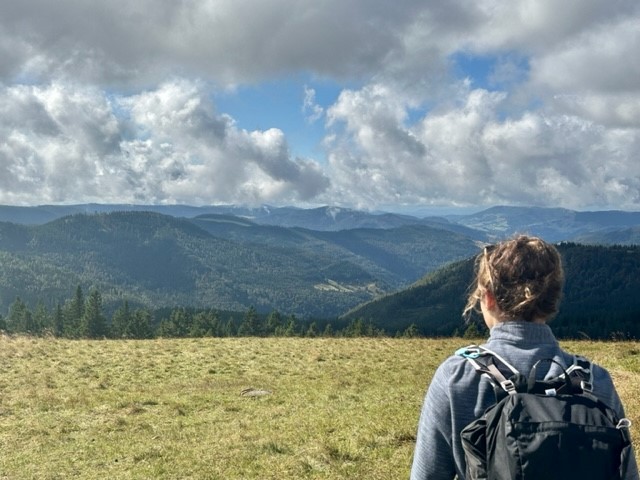
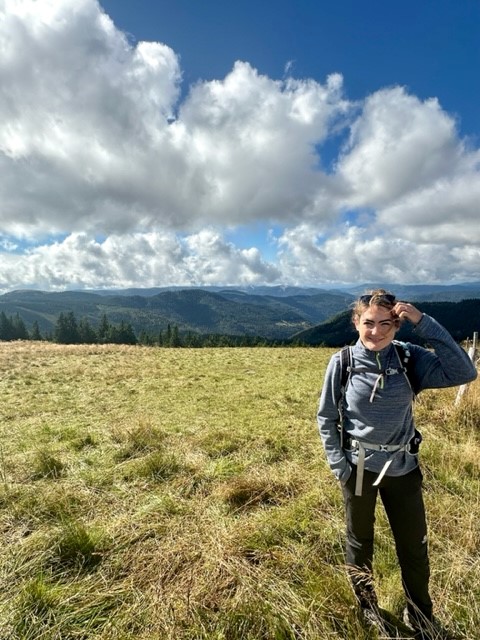
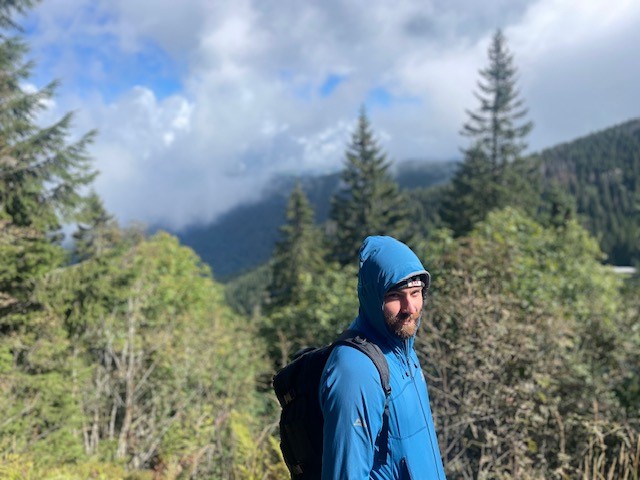
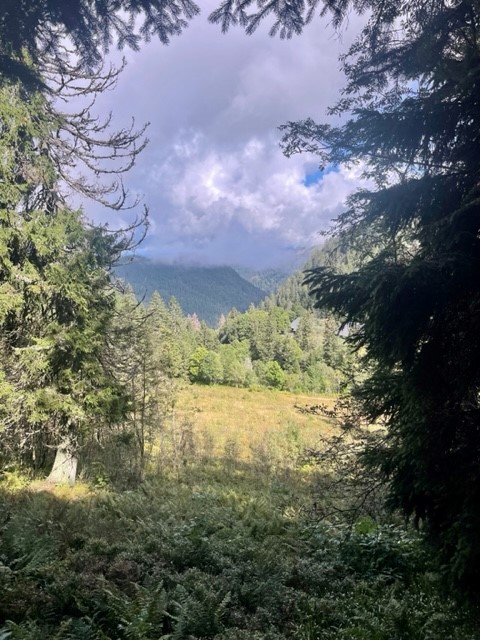
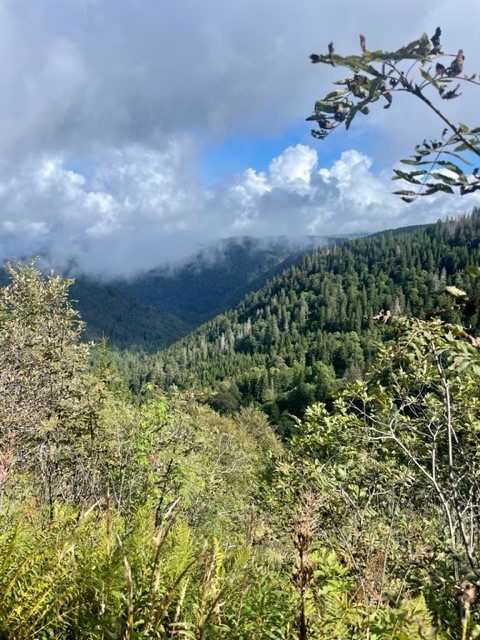
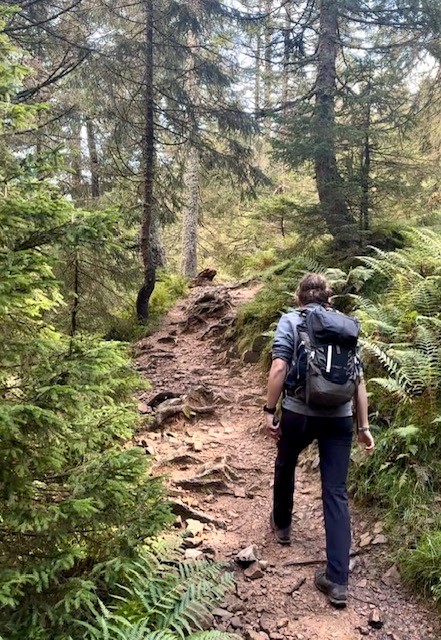
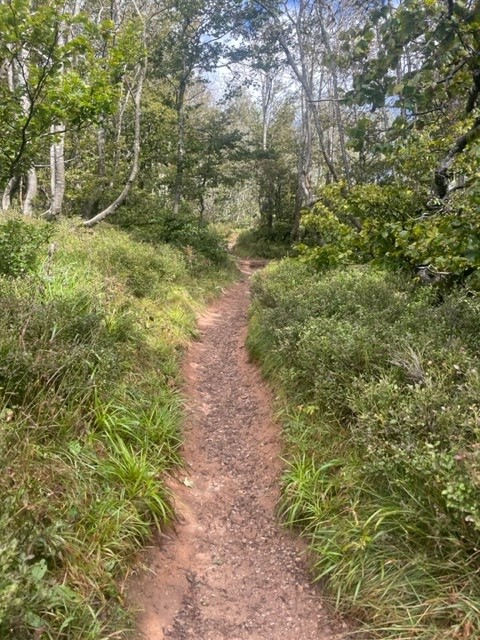
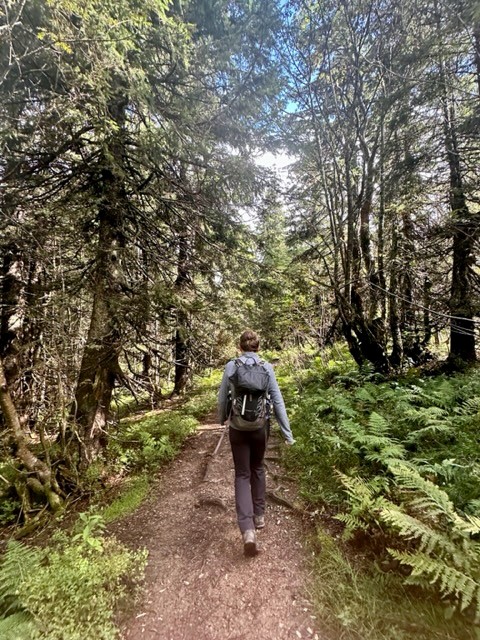
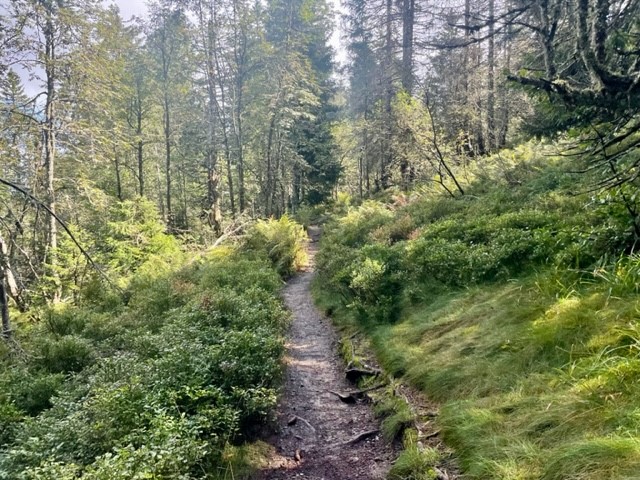
We tramped across charming, rugged meadows, then entered the thickly forested hillside to the north of Feldberg. A thousand shades of green emanated from ferns, shrubs, trees, grasses, mosses and lichens, which grew in Jurassic Park-like abundance on the steep slope. Shrubby clearings allowed us to gaze across a deep valley to opposite, equally living slopes, which were drenched in warm sunlight that slipped beneath thin clouds that drifted lackadaisically over the valley tops. It was incredibly tranquil, as if the rest of the world didn’t exist.
Past river and lake

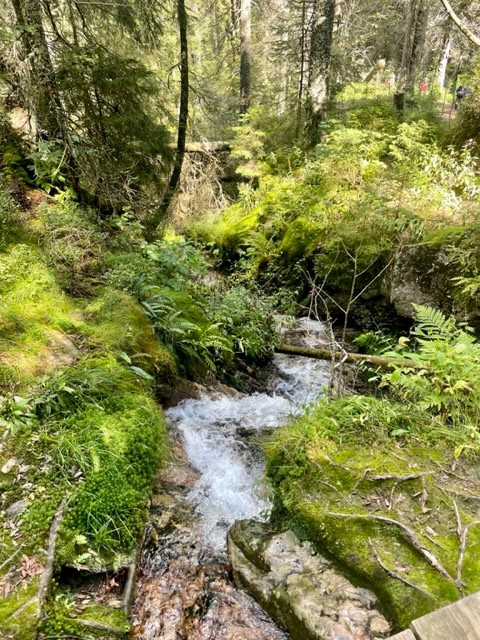
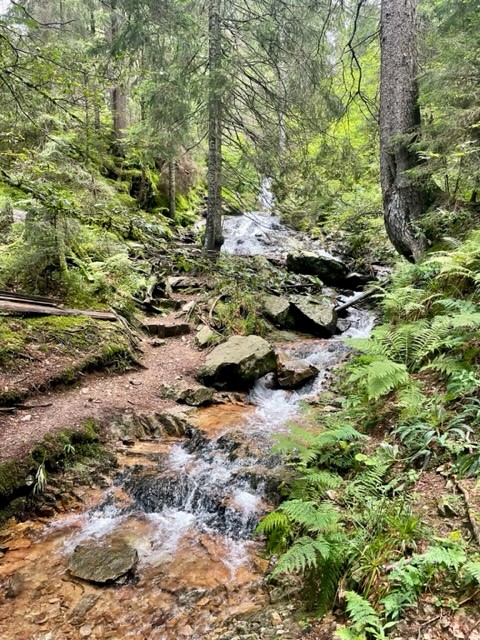
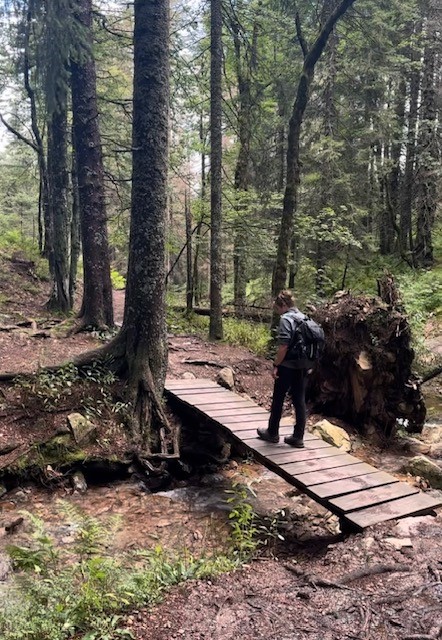
We followed the path diagonally down the hillside, crossed a marshy section via a boardwalk and found ourselves at another alpine hut. A steep climb through the forest took us up to another swathe of meadow on the east side of Feldberg’s neighbouring hill, which dropped gently down into more verdant forest. We crossed the narrow, crystal clear Sagenbach river and followed its wonderfully overgrown, mossy banks downstream, marvelling at several rocky waterfalls and – on seeing the many bridges made by fallen trunks – wondered what storm could possibly have touched this serene place.

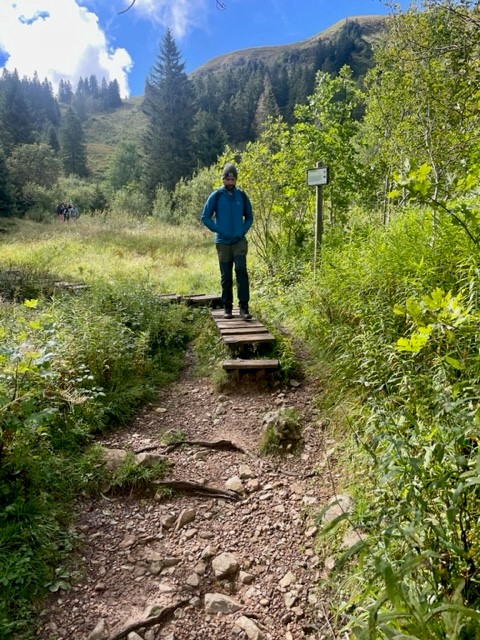
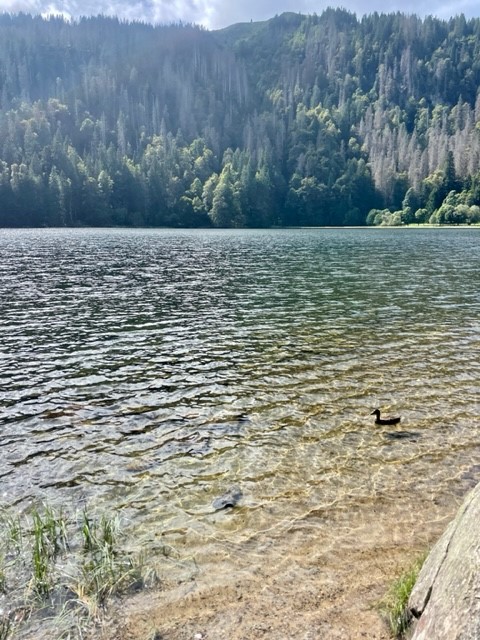
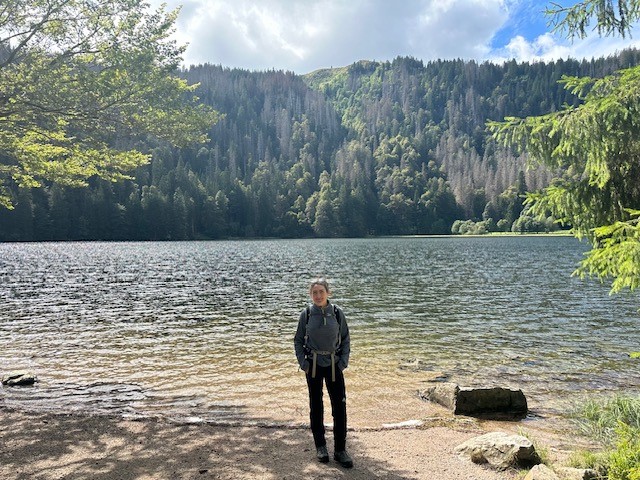
After winding down the river via bridges, steps and rocks, the route bore us east along a straight, flat track along the side of a hill between legions of tall pines. We stopped for another sandwich at a picnic table, then followed the arc of a spur to the edge of a valley clearing, where another large hut sat below us among cattle fields and meandering tributaries. We followed the treeline down into a peaceful wood, then came to the shores of the perfectly round, cwm-like Feldsee Lake. The clear, gently rippling water was surrounded on three sides by towering, green walls that looked too steep to accommodate the dense mass of huge trees that had somehow taken root. We stood on the “beach” for a moment, watching the ducks and listening to the silence, then set off on the final section of the route.

Last leg

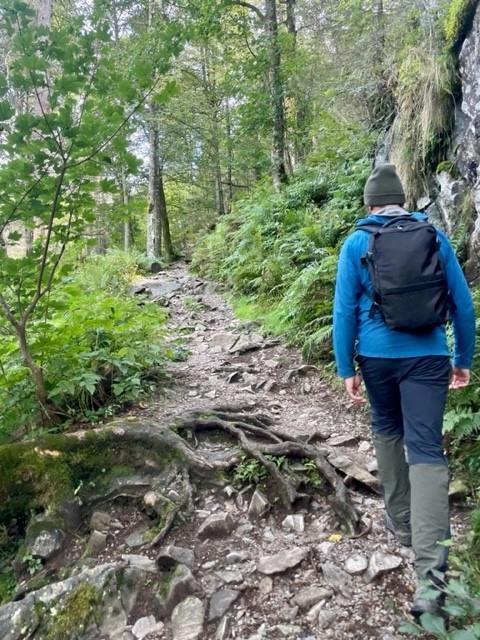
The path followed the east bank of the lake, then climbed steeply into the thicket of beech, sycamore, pine and spruce. We zigzagged up rocky sections until the ground levelled and we emerged from the trees quite suddenly at the cable car base. It felt slightly surreal to be back in the busy resort after the serenity of the hike, which had felt quite wild despite the clear, well-signposted trail. We headed straight back to the car and, after debating whether a trip to the city of Freiburg would be worth it at rush hour, left for home (via Lidl, of course).
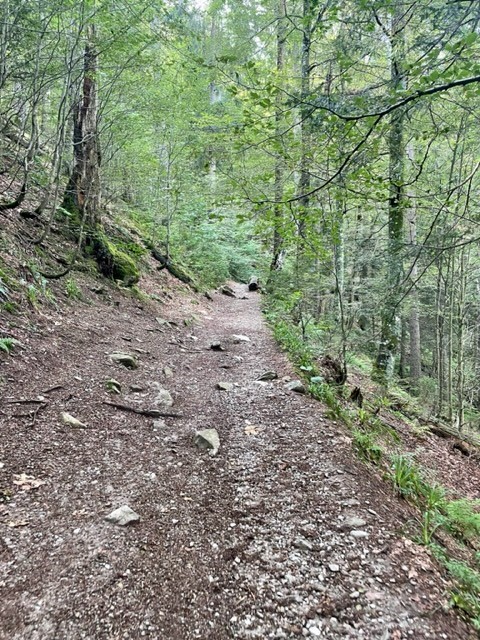
To summarise, it had been a lovely, varied hike with beautiful scenery that made us feel truly immersed in the Black Forest. The trail was very easy to follow (we barely used my guidebook map) and I just wish it had been longer than 8.5 miles. We came away feeling very refreshed, happy with a good day exploring a new mountain range.

Evening

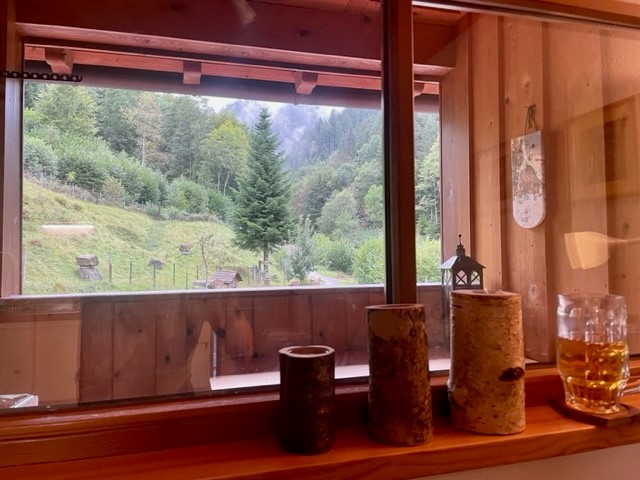
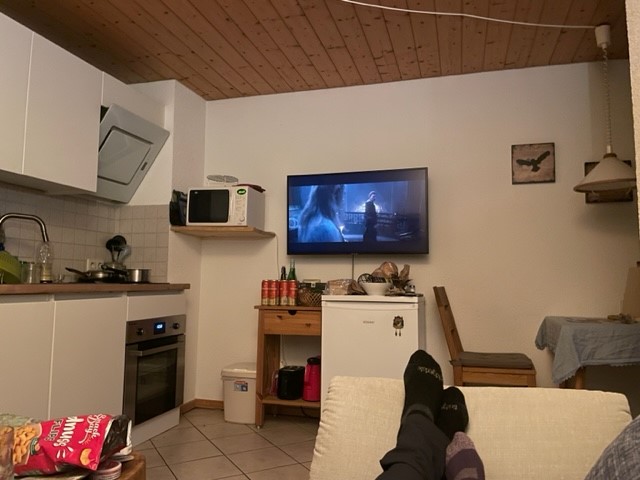
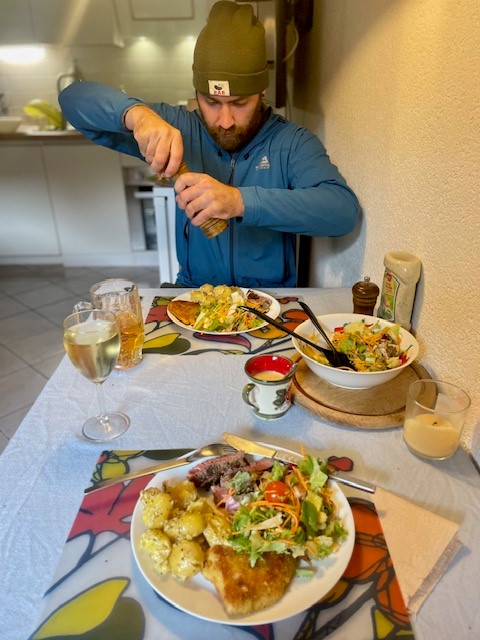
We got back at 4:30pm and spent the evening relaxing on the balcony, drinking wine/beer, watching Rings of Power on Netflix and playing with Kraut the cat. Ryan cooked a lovely dinner of homemade schnitzel with steak, salad and potatoes and I came up with a rough plan for another hike the next day, this time starting from our apartment. Three days in and we felt very at home in the Black Forest.

Returning from the Mountains: a stream of consciousness

Never is anything so mundane as on returning from the mountains.

Never is the sky so grey nor the land so flat.

Work doesn’t interest me. The dull documents and dull conversations I’m putting off. I’ve voluntarily shackled myself to this slow, safe life but the siren song of freedom pulls my attention to faraway, intangible landscapes. Imagine emancipation from expectations. Imagine aspirational certainty.

Perhaps the taste I had was too much. All I can think of is deep glens, ancient forests and mysterious peaks. I’m captivated and cursed by the bewitching majesty of a place remembered.

The sky tries pathetically to rain but gives up. It can’t be bothered either. It would have rained properly up there, savage, relentless and certain.

The sun tries to penetrate the cloud but can’t. It can’t be bothered either. There’s not much to look at down here anyway.

It’s too warm for February.

Time stopped for two weeks and waited for our return. I wish it hadn’t.

Working from home is deafeningly quiet. I wasn’t productive this morning, I just moped.

Amber asked for a walk at lunchtime as she always does. I took her. The path was muddier than before and nature seemed colourless. The road was too loud. I had to fabricate a smile for other dog walkers.

Things that should have brightened my mood only accentuated my absurd misery. Amber’s usually contagious happiness, the warm breeze, the abundant birdsong.

My despondence peaked when I walked over the bridge and looked for the trout who sits there waiting for me and Amber. He wasn’t there. Perhaps he thought I’d abandoned him.

Ryan’s text was a subtle turning point. There was a Twix next to the handbrake if I needed cheering up. I did, but the thought was enough. I’ll save the Twix for later as a reward for finishing work, although I’ll need to start first.

Crocuses, snowdrops and daffodils – nice, but it’s too early. Crows, collared doves, a robin, a blackbird, a dunnock. They’re okay.

I see the allotments and look forward to the house we’re buying. A glimmer, small but bright. Once that’s done we can go back to Scotland. I hope time hurries up for a while, then slows again.

I try to get over myself and decide to write down my gloom in the hope of some relief. I think it’s worked, a bit. My walk is over.

Later we need to empty the van and tackle the torrent of admin.

Now I need to do some work.

Acceptance is better than denial but worse than contentment. That’ll do me for now. The mountains will still be there.

Lochnagar, May ’19

Last time I went up Lochnagar I couldn’t see a thing for blinding snow, cloud and ice. No crampons, broken compass, zero visibility, precipitous ridge, 10/10 could have died. During a visit to the Cairngorms in May I went up again to see what it looks like.

We started at the Spittal of Glenmuick and went up the same route as last time, following a straightforward gravel track which goes through a greener-than-green wood and up a long, gentle incline. It cuts through a few sweeping miles of high, heather-covered moorland, then becomes a less gentle incline and turns into a slabby path. It gets steeper still and the slabs disappear, leaving hikers to carve their own routes up the scrambley, bouldery rocks. As we climbed snow appeared, thickened, and soon covered everything.

We hiked/scrambled our way along the long, icy, rocky ridge which curves in a C-shape around a bleak, high tarn. The ridge drops precipitously down to the still, black water, exposing an intimidatingly sheer, dark granite face, and as we followed it round I was struck by the distance around the top to the summit. I realised that it was quite a feat to have climbed this munro in the middle of winter with zero visibility and minimal gear.

Eventually we reached the trig point, which stands proudly on a high outcrop, and stopped to gaze dramatically into the distance. We watched the mountains’ reddish-brown heather carpets fade to hazy blues and lilacs as they stretched out to touch the 360degree horizons, interrupted only by snowy peaks, and we could see for tens of miles all round.

I can’t think of a comparable landscape – at least not one that I’ve seen. Mountains often seem to envelop everything, standing high and imposing, shouldering each other as if competing for space. This place is different; equally dramatic, but in an open, rolling, panoramic way. If Glencoe in the Highlands or the Southern Fells of the Lake District are great white sharks, the Cairngorns are blue whales. Majestically vast, gentle and quiet. On a clear day.

We indulged in a picnic of olives, houmous, pitta and other posh bits (I didn’t even have porridge) and a cup of tea at the summit, then headed down the path which rolls over the hump-like southeast side of the ridge and lies parallel to our route up. We headed in the right general direction, then followed the path down along a crystal clear river. The snow retreated as we descended past lush, green vegetation and rushing waterfalls, and we found ourselves in a wood carpeted and roofed with unbelievably bright green foliage on the edge of Loch Muick.

The walk back was long and pleasant, along the flat, birch-lined north bank of Loch Muick. The rich trills of birdsong and the crunch of our gravelly footsteps emphasised the absence of background noise, and if I didn’t have a flight to catch I’d have been lured in for a swim by the still, dark water. We saw a herd of red deer in the open moorland beyond the loch and failed to identify several birds before returning to the pine wood by the car park, de-kitting and driving off [very, very] reluctantly.

With equal reluctance I caught my flight back to Manchester, lungs longing for more mountain air but chest otherwise empty as, once again, I’d left my heart in Scotland.

The Old Man of Coniston (Lake District)

This was possibly the most heroic day of my life. It was an emotional rollercoaster that took me from 4am surrounded by wedding-drunk friends in a Blackpool kebab shop to three hours’ sleep in a hotel car park to 4pm alone at the top of a mountain.

Given the previous night’s antics, I never really expected to bag any summits that day. I left the wedding place around midday and headed to the Lakes, lonely and a little worse for wear. I had half-formed ideas about climbing the Old Man of Coniston and/or Great Gable before heading up to Scotland, so I found a quiet parking spot in Coniston and submitted to the pull of the mountain. Despite the dwindling day, hangover and rain, I couldn’t resist.

I chose a straightforward up-and-down route along the old miner’s track from Coniston, recommended by the internet. It started in an incredibly scenic valley; on my left was a hillside covered by a sea of bluebells which led steeply down to a stream flanked by bright, almost luminescent green oaks and birches. The water ran between rushing, white waterfalls and clear blue pools, and on another day I’d have jumped in like a graceful nymph gollum.

I crossed a bridge and continued along the valley, which opened up to form a wide U-shape backed by low, homely-looking ridges. An odd description but it fits – a few whitewashed miner’s cottages are nestled cosily in the low, flat plain in the middle, fronted by a wide, shallow, rocky river, and the peaks aren’t jagged or intimidating like some of the high fells. Because of this and its proximity to Coniston, this place feels wild without being isolated.

The track continued along the left bank of the valley, then got steeper, rockier and twistier as it curved around the side of a hill. Old machinery has been abandoned along the route, and the stone ruins of mining buildings remain overlooking the scrubby, heathery, rocky landscape in front of Coniston. It didn’t really feel like a proper mountain until I got to the tarn north of the summit, which the steep, long ridge loomed ominously over. From there the path got a bit more serious and it finally felt like I was climbing a mountain.

After a brief half-scramble I reached the plateau at the top and headed for a stone igloo-shaped thing. Then the Lake District repeated what it did when I summitted Helvellyn last year – caught me off guard and took my breath away. Layers of hazy blue mountains emerged from the horizon,  basking in the sultry glow coming from the moody, grey-gold sky. The view was panoramic, from the flat, glassy sea beyond wide salt plains to the west, through the rich, green pastures to the south to the mysterious, inviting mountains to the north east. The sheep were my only company and in that moment I was in heaven. The hangover was a distant memory.

After enjoying the lonely summit long enough to feel the cold, I defaulted to the Black Bull at Coniston. I flew back down the mountain, exhilarated to have defied the odds and made it up there, got the bed ready and wandered round the town before treating myself to a drink in the pub. I got funny looks from the locals but I’m used to that, and I set about planning the next day’s hike up Great Gable… Next post coming soon!

Endnote – I love all mountains but for some reason I particularly enjoyed this one. It could have been the fact that I had no expectations as I hadn’t expected to hike that day, the interesting and visible mining history, the variety of scenery, the fact I didn’t beast myself (for once) or the solitude, but I’d recommend this route to anyone and everyone – it’s beautiful, good fun and very do-able.