
Saturday 12 February
The weather was not on our side, so we planned some rest day activities. We left our little Fort William hotel room at 10am and drove southeast for 20 minutes to the car park for Steall waterfall and wire bridge, which we’d found in the Wild Guide. The drive took us on a winding road through high-sided, picturesque Glen Nevis, with Ben Nevis towering over our left side and the thickly forested slopes of lower, but no less wild, peaks on our right. We arrived at the small, dead-end car park and set off along the well-walked, rocky path for the waterfall.
An Steall waterfall walk
The path ran above and parallel to the Water of Nevis, which flowed fast and relentless along its rocky course. Little waterfalls fed it from all around, some flowing under wooden bridges built into the path. Our 150-200m elevation gave wonderful views over the rushing white river and the deep, dramatic glen, whose high, undulating sides were a colourful patchwork of yellow grass, green pines, lilac-pink birches and orange heather under a thick grey sky, which absorbed the snowy upper reaches of the steep slopes and made the valley feel very self-contained. The path ran for a mile through leafless trees connected by lush green mosses, then curved with the river and dropped down to just above river level, where the valley floor widened slightly into a grassy plain set in a long, steep-sided basin.
We turned a corner and An Steall waterfall, the third highest in Scotland, burst from the huge, craggy valley side ahead of us, a 30 foot high, furious deluge of charging white horses. A few minor falls sat thinly either side of it like veins, but An Steall was the queen of the valley, the magnificent, roaring centrepiece. She fed the Water of Nevis with an endless torrent, giving it the energy to push its way over the rocks and around the twists of Glen Nevis.


Steall wire bridge
Steall wire bridge was on our right just before the waterfall, suspended 10 feet over the river. We waited for a couple of others to cross, then approached the pebble river bank. The bridge consists of three thick steel cables about 20 feet long, two for hands and one for feet, held across the water by a sturdy metal frame at each end. We took turns to walk out over the bridge and back, placing our feet very carefully on the wobbly metal tightrope. It was more nerve-wracking than I expected as the wires move quite a lot and there is nothing below other than a substantial fall, the rushing white river and a lot of cold, hard, wet, uncomfortable-looking rocks, but that meant it was also a lot more fun than I expected.
More people turned up so we left the bridge and retraced our steps back to the van, through that almost lower Himalayan valley. We left Glen Nevis and went back to Fort William for fuel and snacks. At the petrol station the clouds unleashed a sudden deluge of rain, possibly the most savage I’ve ever seen, and we had to wait a few moments for it to ease as it was heavy enough to obliterate all visibility. Once we could see again (only just), we decided to head towards Glencoe via Kinlochleven to climb at Ice Factor, the National Ice Climbing centre. The ice wall was fully booked but we were quite happy to squeeze some indoor rock climbing into the trip and avoid the weather.


Ice Factor, Kinlochleven
The journey south along the bank of Loch Linnhe, then east along Loch Leven, took about 40 minutes, and although the clag obscured the mountains it was nice to get a good view of the lochs. Ice Factor is oddly situated in the quirky, remote village of Kinlochleven, nestled cosily at the head of Loch Leven and closely surrounded by mountains, in a high-ceilinged, old stone aluminium works building. It’s a buzzing, modern, warm place with an indoor ice wall, climbing and bouldering wall, outdoorsey shop, cosy café and soft play area.
The climbing area wasn’t huge but it was plenty big enough, and we led (up to 6b, notably on which I slipped off above a bolt and took a pleasant little fall), toproped and autobelayed some interesting routes. The natural, rock type feature walls were particularly fun as they enabled us to practise crack climbing, which is difficult to replicate with bolt-on holds. We stayed a good couple of hours, had a coffee in the café, snuck into the small bouldering room and left before we lingered long enough in the shop to buy something unnecessary.


Glencoe
We drove west along the south bank of Loch Leven and into Glencoe, my favourite place. Sandwiched between the distinctive, imposing Three Sisters to the south and the hulking ridge of Aonach Eagach to the north, the Pass of Glencoe snakes through the dramatic valley next to the rocky River Coe. Yellowish grass grows up the lower swathes of the mountains either side but the higher reaches deny it access, their harsh, dark faces being too steep and inhospitable for anything but bare rock and snow. As usual in that vast, wild place, I felt incredibly small.
We continued east, took a turn onto the small road to Glen Etive and parked in a quiet pull-in by a wooded stream below the impossibly triangular east face of Buachaille Etive Mor, whose four colossal summits we planned to take on the following day. Ryan cooked vegan burgers for tea (delicious) and we did some planning then had an early night, buzzing for the hike.


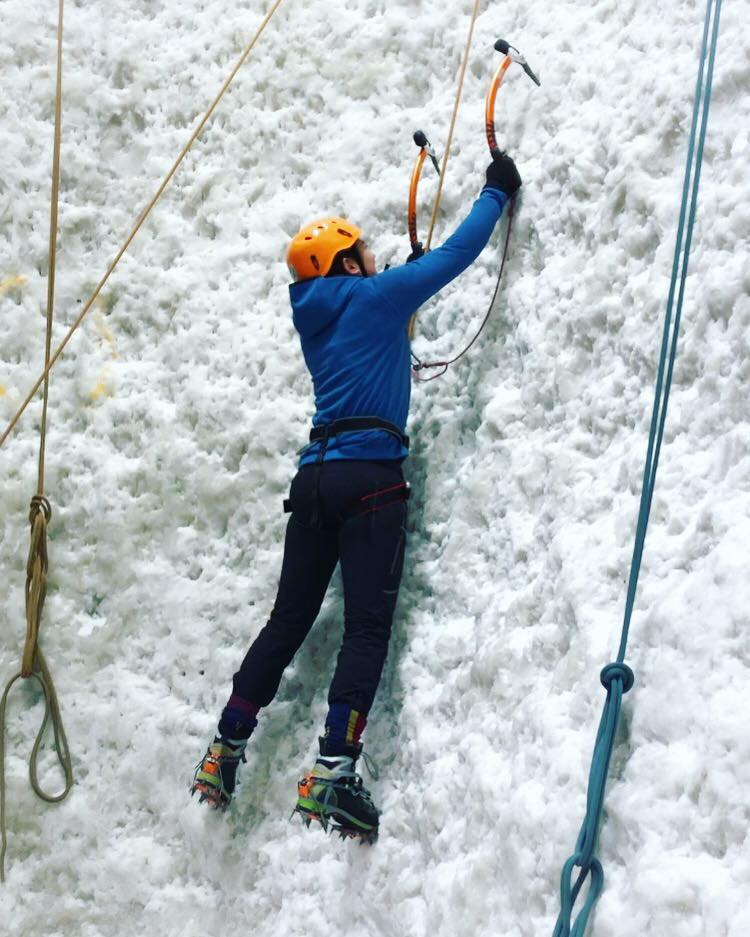




 you’re supposedly more stable this way. It’s quite an unnatural stance and it was hard to trust that the crampons would hold my weight, although I quite enjoyed ramming the front spike into the ice as you can kick it quite hard.
 curiousgnome