Cornwall, May 2021

May bank holiday meant a free three-day opportunity to get away in the van, our first proper trip post-lockdown easing (excepting a quick foray in the South Downs). We left on Friday evening and found an excellent, out the way overnight spot on Bodmin Moor, the car park at Crowdy Reservoir, and spent the night under a jet black sky full of stars.

Saturday 1st May

I was up at 6am to go down to the water and watch the sunrise over the reservoir, which was very tranquil in the morning mist. After a lovely little walk I went back and badgered Ryan to get up, then we ate breakfast (a Subway salad we didn’t eat the night before, not even sorry) and drove along tiny, twisty roads to the discrete parking spot for the Devil’s Jump crag just west of Bodmin Moor, near Helstone.

Climbing at Bodmin Moor

We followed the instructions in the Rockfax guide to get to the crag, which took us uphill along a path and through a farm, over a wall (in slightly the wrong place, but we worked it out) and over open moorland past a bunch of cows. We approached the crag from above and saw what looked like a nest of crows on the left hand side of the rocky outcrop. We got a bit closer, realised to my excitement that it was actually a raven’s nest, and scrambled down the steep, overgrown bank to reach the bottom of the rock face.

While gearing up at the bottom we felt a few drips and realised that we’d been pooed on by a raven, which – if anything – added to the experience. We climbed the two-pitch, 24m VDiff South East Climb, the only route in the Rockfax guide. Ryan led the first pitch up the solid granite and I led the second. It was straightforward trad climbing up an obvious crack, as far as I can remember (I’m writing this three months late), which was a good thing as we were a bit out of practice post-lockdown. I belayed Ryan up to the top of the slabby face while enjoying stunning views over a long, wooded valley. At the top we jumped across a disconcertingly wide gap, clambered down the back side of the outcrop and scrabbled back down the bank to retrieve our stuff.

Porthcurno beach

We stopped at Asda in Bodmin to do a supermarket shop, then headed south west to Porthcurno. We’d considered stopping for an explore in Penzance and Mousehole, but the former was too busy and the latter was too awkward to park in. The car park at Porthcurno is set just above the beach, which is narrow and quite deep, nestled in between two  rocky, grassy headlands. The water was Mediterranean blue, the sand glowed in the sun, and we’d found a new favourite place. We sat against the rocks on the right side of the beach and I pottered around the rockpools, considered a dip in the sea (but got no further), people watched – although it wasn’t too busy – and played Ryan at beach chess.

After a while we walked up the steep, grassy cliff on the other side of the beach and sat admiring the view on an old wartime pillbox. The bay in front of us was dream-like, with the deep blue water on the horizon fading gradually to clear azure as it stretched in to touch the yellow-grey rocks and nearly white sands of the small beaches. Having been in some form of lockdown for what felt like an age, we were so pleased to taste freedom again. With evening approaching, we walked back to the van and drove to Lands End.

Lands End

We parked on the grassy area towards the back of the large, mostly empty car park and after chatting to some other van people who’d decided to stay overnight, walked through the tourist complex to see the heathery cliffs of the UK’s most southwesterly point.. It was a very attractive place and I liked the whitewashed First & Last House sat alone against the wide sea and wild moorland, but in my opinion it was slightly spoilt by the visitor attractions, which include a Shaun the Sheep and Arthur’s Quest experience, eateries and gift shops. We took an obligatory signpost photo and went back to the van for stir fry. A bit later on we went back to watch the sunset over the sea, which was beautiful.

Sunday 2nd May

Climbing at Sennen Cove

In the morning we drove the short distance along the coast to the pretty village of Sennen, set overlooking the long stretch of white sand that is Sennen Beach. We parked in the harbour car park, grabbed our climbing gear and walked up the hill to an old coastguard lookout. The descent down to the climbing area was a steep, rocky scramble, and at the bottom we followed the large ledge around to the easy-looking climbs of Golva area on the right.

We spent the day ticking off some very easy grade climbs, including the Diff grades Junior’s Route, Senior’s Route and Staircase. We alternated leading, seconding and scrambling back down to go again. The rock was solid and the lines we took were up wide cracks – it was good to get back into the swing of trad climbing after so long, but we felt quite out of practice. Just being there was lovely after lockdown, and for a few hours the world was reduced to a high, grey-brown rock face, the deep blue sea stretched across the horizon and just us sandwiched in the middle under a clear blue sky.

Sennen Cove beach

The crag started to get busy by early afternoon, so we topped out and walked back down the hill to the van. We had lunch then walked along to Sennen Beach via a roundhouse gallery where I bought a map, and a tourist-type convenience shop where Ryan the child bought a couple of snorkels and a stunt kite.

The whitish sand sweeps across the curve of the bay in a long stretch between gentle green cliffs, and towards the back of the beach is a boulderfield made from large, sea-smoothed rocks. I spent a while collecting plastic from crevices between the rocks, mostly old rope and fishing line, and was amazed (and saddened) by how much there was.

We went back to the van, had a gin and decided to squeeze an evening climb in – I think it was the mod grade Sinner’s Route. We were pleased that the crag had emptied and glad for the late sun. Back at the van we spent the night talking, cooking (or watching Ryan cook, on my part) stir fry and playing chess. The harbour car park allowed overnight stays, so we tucked the van in a corner and slept peacefully by the sea.

Monday 3rd May

We’d hoped to go snorkelling but the sea was grey and choppy, so we thought better of it. After a good explore of the rock pools just below the harbour car park at Sennen, we started making our way slowly home.

Padstow

First we stopped at Padstow, a very pretty old fishing village on the north Cornish coast. Annoyingly but not surprisingly as it was bank holiday Monday, it was heaving with people. We parked by the lobster hatchery (sadly closed at the time) and walked the short distance to the small harbour, which is surrounded on three sides by quaint pubs, cafes and shops selling fish, chips, coffee, boaty-type clothes and a hundred million varieties of pasty. We walked round to the far side to look at the fishing boats, then headed up the narrow, bustling streets to look in some of the surf-type shops. This time Ryan the child bought a skateboard, which we’ve both since fallen off quite spectacularly.

Port Isaac

Feeling a bit peopled out, we left Padstow and drove north east along little roads to Port Isaac, where Doc Martin was filmed. We parked at the top of the hill and walked down the steep slope into the village, the majority of which sits in a tight little bowl connected to the sea by a narrow opening in the harbour wall. It was another very pretty, quaint and cosy place, with steep, narrow streets lined with a mix of quirky stone, whitewashed, painted and slated cottages.

We walked up the hill on the other side of the harbour to Doc Martin’s house (just to send a photo to Ryan’s mum) and poked around some back streets to find “squeezy belly alley”, which was once recorded as the world’s narrowest thoroughfare. Charmed by the timeless little streets, we grabbed a drink from an outdoor bar on the harbour, sat and watched the seagulls and reluctantly traipsed back up the hill to the van (via the Co-op for road snacks to dampen the back-to-work-tomorrow feeling) and headed home, refreshed in equal measures by the sea air and the taste of freedom.

North Pembrokeshire, June 2021 (1/2)

This blog post (1 of 2) tells the tale of the first half of a week campervanning in Pembrokeshire, a coastal national park in west Wales, spent with Ryan (boyfriend), Mum (mother and chef), Dad (father and taxi driver) and Angus (not-so-little brother).

Ryan and I drove up as soon as he finished work on Saturday evening and we found a quiet wild camping spot near the village of Newport, where we’d be staying. The van was fully loaded with climbing gear, surfboard, bodyboard, mountain board, power kite and other miscellaneous toys, so the week was looking good.

Sunday 27th June

Parrog & Newport

We joined mum, dad and Angus at Tycanol campsite, a basic site with lots of green space and stunning views over the wide, sweeping Newport beach. First on the agenda was a walk along the Pembrokeshire coast path, conveniently accessible from the site, down to the quaint old port of Parrog. It was a tiny, pretty place, where little boats sat moored in a calm quay cut off from the sea by a sand bar and green hills perched above the cliffs and dunes across the bay.

We walked a short way up the hill to the bigger village of Newport, where the busy streets were lined by attractive stone houses, shops and cafes. We grabbed some supplies and walked back along the main road to the campsite, where we took advantage of the wind and flew Ryan’s stunt kite.

Castell Henllys

After a ploughman’s lunch, we all got into dad’s van and went to Castell Henllys Iron Age village. It was worth the £7.50 entry fee – the walk up to the village took us along an ancient stream, through leafy woodland and past the resident pig. The roundhouses were very authentic and the three talks/demonstrations on food, village life and battle were excellent. To my delight, we had a go with the slingshots and I took great joy in lobbing a lump of dough at dad. Remarkably, he still treated us to a drink and a cake at the café.

Nevern & Preselis

On the way back we stopped at a timeless hamlet called Nevern to see the bleeding yew, a remarkable, 700 year old tree in an atmospheric little churchyard which oozes blood red sap. It was simultaneously eerie and serene, a strange combination, and the sap smelt nasty on my fingers. A brief excursion across a stream and up a wooded hill took us to the site of an old motte and bailey castle, now reclaimed by nature, where only earth mounds disclosed its human past.

Still keen to explore, dad then drove us back through Newport and a little way into the Preseli Hills, where the four of us (minus mum, who had a bad knee) walked the short distance up through heathery moorland to the rocky tor of Mynydd Caregog. The plateaued landscape reminded me of Dartmoor, with its distant rolling peaks and scattered granite outcrops, and there were spectacular views over the sweeping blue curve of Newport Bay, tucked between strikingly green Dinas Head to the left and pasture-topped cliffs to the right.

Realising that it was 7pm, we hurried down to Parrog and arrived just in time to order fish and chips. After a long wait and some impatience on my part, we ate them in the van – delicious – then went back to the campsite for some drinks.

Monday 28th June

St Davids

The weather looked wet in the morning, so we decided against strenuous activity. After another bimble around Newport we drove 40 minutes west to St Davids, the smallest city in Britain with a population of 1,600. Grey stone houses and shops lined its bustling streets, which were pretty despite the overcast sky, and the old cathedral was incredible, with flagstone floors, carved and painted high ceilings and perfectly symmetrical stone arches. Ryan and I walked back up the hill to the stone cross at the city(!) centre, queued for ages to get lunch (chicken baguette and a pasty), and met the others back at the modern information centre by the car park.

Whitesands Beach

We realised that we hadn’t planned beyond St Davids, so decided last minute to visit Whitesands Beach just up the (very narrow, twisty) road. An archaeological excavation was going on at the site of an old chapel just above the beach, which is being threatened by erosion. We peered down, fascinated, on people brushing dust from thousand-year-plus old human skeletons, including that of a baby. See https://www.bbc.co.uk/news/uk-wales-57685284 if you’re interested.

While mum and dad sat on the beach, Ryan built stone towers, Angus pottered around the rockpools and I went to explore a rocky promontory. The vertically layered slate was awkward to walk on but the excursion was worth it for the deep, coral reef-like rockpools, sea-filled tunnels and wild, remote scenery. I went over the other side of the big rocky lump, away from the beach, and looked out on a small, empty beach, wild headlands and a calm sea under a moody sky. There wasn’t a boat in sight and all that interrupted the horizon was a few small, hazy islands.

I clambered around the rocky lump and made my way back to the beach via a rockpool-bottomed tunnel, which required a short climb out the other side. We regrouped and went back to the campsite for the evening, where mum cooked vegetarian curry and we sat planning the next day’s hike.

Tuesday 29th June

Hiking in the Preseli Hills

In the morning Ryan, Angus and I were dropped off on a roadside near the village of Crymych. Our plan was to walk the bridleway that runs east to west across the spine of the Preseli Hills (sometimes – dubiously in my opinion – called Mountains) and get picked up from a pub on the other side. Meanwhile, mum and dad went to a woollen mill, much to mum’s delight and dad’s indifference.

The forecast was dry and overcast, but there was a distinctly wet-looking fog hanging over the hills as we approached. We went through a wooden gate which marked the eastern boundary of the Preselis and instantly deviated from the bridleway to climb Foeldrygarn, the first hill – a big, green, rocky lump looming in front of us – that sits slightly north of the path and is topped by a trig point, which we decided made it worth a visit. It was steep enough to break a sweat and once at the top we messed around on the rocks (at one point I got stuck a little too high and needed a spot from Angus) while Ryan experimented with his new gimbal video thing.

We rejoined the main path and headed west across the undulating moorland plateau, which was full of sheep, fog and rocky outcrops. We spotted an enormous red kite (questioning at one point whether it was a lost eagle) and a few skylarks, but it was otherwise quite barren. We stopped to pull on raincoats on account of the wet fog that engulfed the hills and thwarted what was probably a stunning view over north Pembrokeshire. The next four miles was oddly enjoyable and consisted of bleak fog, the occasional bog and passable banter.

We stopped for a strange lunch of pork pie, cheese, lamb pasty and mugshot pasta (I can’t recommend a Jetboil enough) by the edge of Pantmaenog Forest, then headed south away from the main bridleway towards Foel Cwmcerwyn, the highest peak in the Preselis and the last hill of the hike. The sun had started to burn through the fog and it was quite clear by the time we reached the top. The view was incredible, stretching out over miles of quiet valleys, green fields and dark forests, and we looked back to see the Preselis still shrouded in the isolated layer of thick white cloud we’d just emerged from.

The walk down was reminiscent of the hobbits leaving the Shire, with abundantly biodiverse meadows and verges on either side of us filled with all kinds of grasses, wild flowers and trees. In front and to the left was a heartwarmingly pastoral view over peaceful Welsh fields rolling way into the distance, and behind was the lush, fir-lined edge of Pantmaenog Forest.

The path dropped down through a sheep field into the village of Rosebush, where our 8.5 mile hike ended at the Tafarn Sinc pub. The community-owned pub is worth a mention in itself, with its purple corrugated iron cladding, sawdust-scattered floor and timeless décor, which includes various mysterious agricultural implements and several legs of ham hung up to cure. We had a drink while awaiting our taxi, then another when it arrived bearing mixed reviews of the woollen mill.

Newport Beach BBQ

The taxi (dad) drove us onto Newport beach, where we kicked a ball around and explored rockpools, shallow caves, a small waterfall and grassy sand dunes. Ryan and I watched England beat Germany (much to our surprise) on my phone, in terrible quality as signal was bad, while dad cooked the barbecue. We had sausages, burgers and salad (to which my contribution was foraged sea beet and dandelion), washed up in the back of the van and went for a walk along the long stretch of sand towards Parrog, which was cut off by a deep stream. The beach was practically empty and the sunset was lovely.

Wednesday 30th June

Tombstoning at Blue Lagoon

The forecast was good so we decided to get wet. We went west along the coast to Abereiddy, a tiny, pretty coastal hamlet with a small beach and a disused slate quarry which has become a hotspot for swimmers, paddlers and ledge jumpers. The quarry is called Blue Lagoon, which is a lovely if unimaginative name as it’s effectively a large bowl of clear blue water connected to the sea by a narrow channel. On the far side are two man-made platforms, once used as part of the quarry, which drop straight down into the water.

The three of us (mum and dad chose to stay at the beach) walked down into the bowl, changed and clambered over the rocks and into the cold water. We swam across to the other side, dodging swimmers, paddleboarders and a huge jellyfish, and climbed out and up to the platforms. There were a lot of people queuing for the lower one, which is about 4 or 5m high, so we went straight to the higher one, about 12m – nearly the same height as three double decker buses.

Peering straight down into the dark water below was adrenaline-inducing enough, so without hesitating we checked it was clear and one-by-one, jumped off the edge before reluctance could take hold. It’s the highest thing I’ve ever jumped off and the feeling of weightlessness was exhilarating, if a little terrifying – my instinctive fear response sent a “what the hell are you doing” type message through every fibre of my being and it felt like I was falling for an age. I hit the water the right way but it was still quite an impact due to the height of the drop, and – relieved to be alive – I swam to the surface grinning, retrieved the terrible wedgie, and hauled myself out onto the rocks like an ungainly seal. For some reason, I did it several times more.

We were probably in the water about an hour before deciding we should get back to make our pre-booked 2pm kayaking spot, so we swam back across the lagoon to our stuff on the beach. I shivered my way into my changing robe, which provided immense relief, and we walked the short distance around the coast back to the van, parked just behind Abereiddy beach.

Kayaking & Paddleboarding at Llys-y-frân

I’d booked a canoe for dad and Angus, a paddleboard for Ryan and a kayak for myself at Llys y Frân, a lake and country park at the foot of the Preseli Hills. After a brief altercation – I think the only one of the holiday – about washing up and being slightly late, we were out on the water in the warm sun. It was incredibly quiet, wild and peaceful. First we paddled up the smaller, left hand “arm” of the lake, past lush green banks with trees overhanging the water and over roots visible through the shallows – it could have been prehistoric. The only people we saw were a couple picnicking in a clearing at the end and the safety man in his powerboat.

Ryan and I swapped, then we paddled back to the bigger, wider arm of the lake, which gave a good view of the Preseli hills. It was less sheltered here and we were fighting the wind, which was fun as it was quite hard work. On one side the bank was crammed with thick, leafy trees and on the other a grassy slope was occupied by people fishing, walking and sitting on benches. We paddled as far as we could go given the 2 hour hire time, then turned around and came back. Angus treated us to a drink at the clean, modern café, then we headed on to the pub for a meal.

Tafarn Sinc & Bessie’s Pub

The food at the Tafarn Sinc was lovely and service was good, considering how early we arrived. It was a simple, proper pub menu with nothing fancy or unpronounceable (apart from the Welsh side). After a meal and a couple of drinks we headed back to the campsite via Bessie’s pub, properly called the Dyffryn Arms, nestled in the thickly wooded old valley of Cwm Gwaun.

I’ve never known a pub so cemented in time. The bar is a tiny hatch in a room with a tiled floor and granny-style floral wallpaper, filled with a hotchpotch of chairs and decorated with what would be, if hung up anywhere else, a naff old bunch of pictures (including a painting of Queen Elizabeth in her 20s, probably the most modern object in the pub). They do approximately one ale and one cider, mysteriously extracted from somewhere behind the hatch, and the unlit outside toilets are charmingly ancient, cold and dark. Our pints just about stayed upright on the wonky bench as we overlooked the field, stream and woods on the other side of the narrow valley. I think it’s one of those places that should never change.

It was our last night in North Pembrokeshire and the end of the first half of the holiday. When we got back to the campsite, Ryan and I packed up our stuff and went wild camping for a night on the Preseli Hills, where we found a small, pull-in car park hidden in thick fog. We watched Jeremy Clarkson’s Farm on my phone and planned the next day, where my next blog post begins…

Alps 2020, Day 7: Return via Switzerland

We packed up our stuff and left our cosy Italian apartment, sad to be homeward bound. The first part of the drive took us along a road flanked by magnificent, snowy peaks,  out of Italy via the Great St Bernard tunnel. We climbed up to it in our little VW Polo hire car, paid the toll and emerged in Switzerland 6km later.

We wound down the equally mountainous road on the other side, marvelling at the Swiss Alps. The roads were wide and smooth and large chalets made up towns and villages, boasting hotels, amenities and ski-related things. We stopped at the Relais-du-St-Bernard, a service station on the edge of a town called Martigny. It was nice to stretch my legs after an hour or so of having to concentrate on the road, rather than the stunning surroundings, but we were amazed (not in a good way) at the price of food at the service station.

The next bit of the drive took us north along flatter ground to Montreaux, a large town on the eastern side of Lake Geneva. We parked on a roadside close to the edge of the lake and got out for a wander. It felt like a well-kept place, with benches, trees, clean pavements and an attractive marina. We walked down to the lake and just stood there for a while, taking in the breathtaking view of the rippling water backed by high, jagged, snow-scattered mountains under a moody sky.

We got back in the car reluctantly and headed to Geneva along the long north side of the lake, bypassing Lausanne and hoping to get there with enough time to drop the hire car off and have a little explore. I’m writing with hindsight and I don’t remember anything notable about the drive, until we got to Geneva.

Our Air BnB and the car drop-off point was near the airport, north west of the city centre. We had quite a long, stressful time finding a petrol station and returning the car. We got to the busy part at what must have been rush hour and Google maps wasn’t being particularly helpful at finding us a petrol station. Angry Swiss drivers exacerbated the situation, so Ryan became a stressed and (sorry) fairly unhelpful passenger while I navigated the difficult-to-understand roads, conscious that there were probably Swiss driving etiquettes to which I was oblivious. Eventually we managed to fill up and return the car to the multi-storey car park drop-off point on time.

Loaded with all our stuff, we set off on foot to find our Air BnB, a very basic, student halls type apartment in a not-particularly-nice area that we’d chosen because it was within walking distance from the airport and relatively cheap (about €60, which was ridiculously expensive compared to our lovely French and Italian accommodation). We dumped our bags and, starving, didn’t bother to change before setting out to find some food.

We’d hoped to see the city centre but were exhausted and hungry from the stressful drive, so we found a bar along a main road within walking distance of the apartment. From memory this part of Geneva wasn’t anything special – I remember wide roads, slightly run-down takeaways, peeling posters and a lot of overhead wires. The bar was lovely though, a proper “local” where nobody spoke a word of English, and the wine went down a treat – as did the complementary cheese savouries and cured meats.

After a couple of drinks we found a restaurant called Da Vinci’s, just down the road. It was too posh for our salopettes and base layers but we didn’t care. For starters Ryan had porto soup, a thin broth made with port and beef stock, which was absolutely nothing to write home about – unless to warn against ever ordering porto soup. I had snails in garlic butter which were chewy but tasted nice. For mains Ryan had pasta carbonara, which was lovely, and I couldn’t resist my favourite treat – prawn cocktail. Afterwards we sat at the bar for some drinks and were pleasantly surprised when the bartender cut into a huge wheel of cheese and handed us complementary snacks, including lots of olives (another favourite).

Eventually we left the bar and went back to the apartment, exhausted and sad that the holiday was nearly over. Our flight was early the next morning and we were up at an unearthly hour, lugging bags to the airport. The bag weighed in a few kilos too heavy (always anxiety-inducing) but luckily we had a friendly baggage attendant, so Ryan put on his heavy mountain boots and we layered up even more, somehow reducing the weight to under the 20kg limit. Everything else was unremarkable; we hung around at the airport for a bit, mournfully watched Switzerland disappear through the plane window, and got picked up early from Bournemouth Airport by Ryan’s brother.

We were lucky to get abroad in 2020, given the pandemic that shocked the world just a month after we set foot in Switzerland. I’m writing 14 months late due to various diversions, so may have missed a few things out, but I’m relieved to finally have finished my Alps blog. Definitely a place to return to, as often as possible. In hindsight, even losing control of the hire car along a steep, icy back road makes a good story. 10/10 an excellent adventure.

Alps 2020, Day 6: Aosta Valley, Italy

I’m writing this a year and four months late, which is quite poor even by my timekeeping standards. A lot has happened since then (global pandemics etc) and other diversions have meant that I’ve neglected my blog terribly, so consider this my effort to catch up.

We woke in our cosy Italian Air BnB, breakfasted on cereal, made coffee on the hob with a saucepan and ladle (no kettles in Italy) and drove off to find somewhere to hike. I can’t remember why we went where we did – maybe we Googled local hiking spots – but after a short drive we ended up parking in a pull-in halfway up the side of a mountainous valley. The weather was kind of grey and snowy, but visibility wasn’t too bad and we loved the remoteness of the location.

We waded through deep snow towards a forest, following what vaguely resembled a path. When we reached the trees it was as if we were transported into a winter fairytale. Dark green firs, pines and spruces towered above us, branches laden with thick snow, and as we got further in the tracks faded and the white ground ahead became pristine. It felt like we were the first people to ever set foot in the forest.

We played around, shaking snow from branches, throwing snowballs, falling over, climbing bits of rock, drinking from a stream and shuffling along the trunk of a fallen tree. It was surreal, like noone else existed. We ate feta and salad sandwiches under the shelter of a rock and, childish impulses satisfied, headed back to the car the same way we came.

I drove cautiously along the winding roads, down the side of the valley and into the town of Aosta. After a brief altercation with an uncooperative, non-English speaking parking meter, we managed to get a ticket and wander round the town. Neither of us had been to Italy before so we found it really interesting.

Aosta is an ancient place which has largely retained its Roman foundations, including thick city walls, an amphitheatre, some old gates and a regular, blocky street plan. On approaching the centre we walked through a couple of stone arches and were bemused by the juxtaposition of thousands-of-years-old architecture with modern, raised walkways and handrails. Despite this contrast the town didn’t feel fragmented or piecemeal in any way – it felt simultaneously old and new, “then” and “now” inextricably woven together and brought to life by a vibrant buzz of people, flags and shop fronts. We weaved along cobbled streets lined by four and five story buildings painted yellow, orange and beige, populated by all kinds of shops and pizza, pasta and gelato places.

We left the buzzing high streets and found the cathedral, a towering neo-classical building fronted by tall white columns topped by intricate carvings of crucifixes, wreaths, figures, books and ornaments. Set back under the large front arch is a wood panelled door surrounded by a colourful display of painted biblical scenes, framed by golden columns and another arch containing delicate statues with painted robes and faces cast upwards. I cant do it justice with few words, so here’s a picture:

We explored the side streets, intrigued by intricate architectural details and the simple, timeless elegance of the place. Snow-scattered, mountainous valley sides rose above rooves and chimneys, giving the town a self-contained, cosy feel, and statues (notably of Neptune, huge trident in hand), arches and an abundance of churches hinted at Aosta’s long, rich history.

We wandered back to the car feeling satisfied with our cultural immersion, only to find some paperwork under the windscreen wipers and a couple of police officers lingering on the street. Hearts sinking, we realised that the road was being closed for the “Fiera di Sant’Orso”, some kind of festival that had been advertised on banners around the town but which we’d paid no attention to, nor had we seen road signs warning of closures (not that we’d have understood them anyway). One of the police officers said something semi-irately in Italian, to which we replied quite uncomprehendingly in English, and she took back the paperwork and let us drive away after a bit of gesturing and what was probably a bit of a telling off.*

A 20-minute drive through the valley took us back to the Air BnB, where we had a camembert snack and researched places to go for dinner. We wanted to try proper Italian pizza and we found a pizzeria called Le Vieux Bourg in a small town called Etroubles, 15 minutes from the apartment. We got there about 7pm, found a tiny shop and picked up a couple of cartons of €2.30 wine (always classy) for later, then waded through snow to get to the restaurant.

I’ve never had pizza like it. It was perfect – a thin, light base, just the right amount of tomato sauce, melty, gooey cheese, perfectly cooked toppings and not greasy at all. I had the “Twin Peaks” (sausage and onion, I think) solely because I liked the name, and Ryan had something meaty. Prices were very reasonable – more than passable wine at €2 a glass – and the waiter was friendly, as well as English-speaking. We had gelato for dessert, which we didn’t need as the pizzas were so big, but we wanted to try it and it was also very good. I can’t emphasise enough how good the pizza was, we still think about it to this day. 10/10 would recommend. I’ll stop now as I’m getting hungry.

I drove us back to the apartment and we spent our last night in Italy drinking cheap wine and trying to get over how good the pizza was. We like Italy.

* We’ve since received a parking fine in the post (14 months later) which we’re contesting. Fun & games.

A quick(ish) reflection on 2020

Well that was a year I didn’t see coming. I thought global pandemics were far-fetched works of fiction and cinema, not real, inescapable beasts that tether our ankles and incarcerate us in lonely little microcosms.

I’ve been luckier than many in that I’ve been living for the most part in a house of eight lovely people, I’ve been able to see my family and a few friends a handful of times (but not nearly as much as I’d like), and I’ve been working from home since it all kicked off in March. I’ve been unlucky in that I moved work from Reading to Bristol (same organisation, different office) in February, which meant renting a little cottage in Warminster for a grand total of three weeks before the pandemic started and I moved in with (ie. was adopted by) Ryan’s family in the New Forest.

I’ve done less “gadding around” than usual this year, although I’ve still managed a few escapes…

January: week-long trip to the Alps in January, which I’m extremely happy to have squeezed in before anyone had heard of covid. Skiing, snowboarding, winter hiking etc… amazing

February: overnight stay in the South Downs before a social trip to Butlins; a trip to London to see Touching the Void in theatre, followed by a few days in the Peak District

March: last pre-lockdown night in the van on the Dorset coast

April: nothing really, thanks lockdown (although I did spend a lot of time in and around the New Forest)

May: tried coarse fishing for the first time, went cycling and kayaking for my birthday, stayed local

June: took a week’s leave but couldn’t go far – couple of days’ bikepacking, walking and mountain boarding in the New Forest, slept in a cave on the Dorset coast

July: VAN TRIP! Great week hiking, climbing, mountain biking and canoeing in the Lake District

August: was supposed to camp in Snowdonia with the Hillbillies but weather said no so we camped in the New Forest and explored Avebury stone circle instead

September: Made it to my favourite place… Scotland! An amazing week in the van exploring the Highlands, Cairngorms and Edinburgh. Climbing, hiking, scrambling, mountain biking etc

October: Four days in Cornwall with the other Hillbilly children, exploring around the Lizard. Climbing in Dartmoor en route home

November: Lockdown #2 stifled my dreams, incarcerated once again. Managed a day’s climbing in Dorset with Angus and an overnight fishing trip

December: Lovely, much-needed van weekend away to Exmoor. Christmas was supposed to be on the Isle of Wight but last-minute-Boris said no

I’ve spent much of my “free” time running, walking, cycling, doing the odd bit of art and generally trying to a) be productive, and b) not go crazy. My blog has been neglected because the vast majority of my non-working laptop time has been spent working hard on an environmental project that I hope to launch fairly soon, but as always the intention to write about all of my adventures listed above remains. Hopefully soon.

I have some good news – I was worried that keeping my beloved campervan Bjorn would be financially unviable because of the rust underneath, but a lovely local garage has given me a reasonable welding quote and booked him in for the end of Jan. I have everything crossed for our future together. In other good news, unless I mess something up I’ll qualify as a lawyer in March, which is kind of scary. I still plan to use this to save the bees, trees and seas from meddling humans.

If anyone reads this (and I don’t mind if nobody does – I write to keep a personal record of what I’ve been up to, unless anyone decides to sponsor me, in which case I’m available for negotiations) then I hope you have a happy, healthy, more certain 2021. I can’t wait for more freedom and more adventures.

Endnote: I would find some photos of highlights from this year, but quite frankly there are too many and I can’t be bothered right now (classic lockdown). Here are a couple of pictures taken on Christmas/Boxing day, just so you can put a face to these ramblings:

Glencoe: Scotland Day 1, Sep ’20

We drove up to Scotland with ten days of freedom, no concrete plans and enough tinned soup to keep an army going for a week, and we came back (reluctantly) with twinkly eyes and tartan hearts.

The drive up from the New Forest was uneventful and went unusually quickly, for a seven-hour journey. We stayed in a layby on a quiet road about half an hour into Scotland and woke early the next day to drive to the West Highlands, stopping briefly on the bank of Loch Lomond to admire the mountains and the vast, choppy blackness of the water. Our planning had been as comprehensive as “let’s go to Glencoe and see where we end up”.

Glencoe

As we approached the Highlands, hills turned into mountains and foresty, swampy, heathy wilderness crept up all around us. The horizon grew higher until rugged slopes towered over the smooth road, which snaked around the valley floor as if frightened of treading on the toes of the giants. We had reached wild country, where hulking masses of great grey rock reign over dramatic glens carpeted by reddish-purplish-brown heather and the kind of yellow-green grass that thrives on harsh weather, poor soil and general hardship. My favourite place.

No words could do justice to the drama and excitement of the route that is flanked by the impossibly mountain-shaped Buachaille Etive Mor, the towering Three Sisters, and the strikingly insignificant whitewashed Lagangarbh hut, which looks imminently susceptible to being devoured by its barren backdrop. Despite having visited a couple of times before (the very reason I insisted on returning), I gawped all the way to the visitor centre at the far end of the glen.

Here we learnt about the history of Scottish mountaineering, mountain rescue, avalanches and the infamous 1692 massacre of Glencoe, in which the McDonald clan were murdered by the same soldiers that they’d housed and fed for two weeks. The centre is newly refurbished and really interesting, and the big relief map shows how Glencoe is just one part of an immense landscape.

We drove back the way we’d come and parked by a waterfall just up the road from the Three Sisters to take in the scenery. I was keen for a decent hike but Ryan wanted a bit of a rest as we wanted to climb the following day, so after a few photos we drove back towards the visitor centre. We parked off the road and did a short, waymarked trail through a fairytale-like forest of towering pines and lush broadleaf trees that took us to Signal Rock, a big mound purportedly used by the McDonald clan as a beacon. I squinted through the trees in an unsuccessful search for a pine marten, and after a bit more gawping at the wild glen we drove through its western “entrance” to Glencoe village.

The village is a funny, quirky little place with a small shop, a couple of cafes, a museum and a village hall. We parked on what I suppose is the high street and paid £3 each to visit the folk museum, a heather-thatched old croft cottage with some really interesting displays of Highland weaponry, clothing, toys, trinkets and tools. The bulk of the exhibits were in the two big rooms that made up the entire building, and a couple of outbuildings housed some other interesting bits.

On the way back to the van we stopped at a Himalayan market held in the unlikely location of Glencoe village hall, which was a deluge of colour and exotic ornaments, jewellery and clothing. Then, after a brief search – it’s not signposted – we found the impressive Glencoe massacre memorial monument.

Having decided that we’d climb Ben Nevis the next day due to a one-day window of clear weather, we drove half an hour north and camped in a quiet, pretty spot just outside Fort William. We had a humble dinner of pasta and spam in a tomato sauce and planned our route up the mountain’s North face, which would be a scramble/rock climb up the famous Tower Ridge. I look forward to writing about that…

Endnote: having researched mountaineering in Glencoe, Buachaille Etive Mor in particular has moved right to the top of my list of mountains to climb. We’d have liked to have done it this time but decided that Ben Nevis via Tower Ridge took precedence, so rather than travel back on ourselves (we wanted to head further north) we’ve firmly resolved to return at our earliest convenience…

2020

New Year, the Dorset coast

2020 is a satisfyingly round number so I like this year already. It started well – I spent New Year’s Eve making burgers, drinking cider and talking rubbish in the van on the Dorset coast. Our parking spot overlooked Weymouth Bay and the night was warm enough that we kept the side door open to watch the fireworks across the water and breathe in the sea air. I think going out for NYE is overrated – too busy, too expensive and always anticlimactic.

We had a chilled morning in the van on New Year’s Day, then walked around the deserted village of Tyneham. The village is situated on a military range and was cleared out for WW2 training purposes, so all that remains are empty cottages, a pretty church and a very cute school.

After a quick wander we took the donkey track down to Worbarrow Bay, a lovely self-contained curve of the Dorset coastline, which was picturesque but far too peopley. To make the walk circular we climbed the steep cliff and took the much less busy, much more scenic route back along the SW Coast path, and before we knew it we found ourselves in a Wareham pub.

Other news

I didn’t take any time off over Christmas as I’d rather save my leave for adventuring, so I don’t have anything particularly notable to share. So far this year I’ve ran around the rolling valleys of Wiltshire, got back in the bouldering centre, done some much-needed admin and caught up with some unforgivably neglected friends.

I would have done more but my usual style of living fast while trying not to die young were abated by a rugby-induced hospital visit in Guernsey on Saturday 4th Jan. Fortunately I hobbled away with just (annoyingly lingering) whiplash and fond but blurry memories of gas and air. Guernsey was cool, though – rocky, quirky and pretty similar to Jersey.

In other other news, I object to “new year’s resolutions” because I’m always unrealistic and inevitably disappoint myself, but the one thing I’ve thought about lately (the fact it just so happens to be the turn of the decade is coincidental) is how I’d like to write more on my blog. So I suppose writing about writing on my blog is a start – great success.

Upcoming excitement: The Alps

The real breaking news of January 2020 is that Ryan and I have booked flights to Geneva with the intention of exploring the Alps at the end of the month. We’ve even been organised enough to have booked four out of seven nights’ accommodation (near Chamonix) and a hire car. This might be more advance planning than I’ve ever done before, so smug is an understatement. (I only realised today that we’re off next Friday – I thought we still had about 3 weeks to wait – but that’s by-the-by).

Beyond that we don’t have a plan, which is cool. Activities on the cards are skiing, snowboarding, snowshoeing, hiking, rock climbing, ice climbing, summiting a summit or two and kayaking on Lake Geneva. We’ll think about it soon, but I’d love recommendations if anyone has been in or knows about the area, especially in winter. Would also accept charitable donations and/or winter kit, as it turns out the lifestyle I’d like is more expensive that the lifestyle I can afford.*


Thanks for reading this far, more to come soon as per my strictly non-new year’s resolution.

Love, a (very) Curious Gnome x


*Obviously tongue-in-cheek, the world is in turmoil so please redirect all charitable donations to the Australian bush fire effort or similar

Dartmoor, October ’19

We left for Devon on Friday evening, undeterred by the miserable forecast and keen to escape the week. After a drink in the Ring O’Bells at Chagford and a sketchy drive along some flooded back roads (sketchy because of the flooding, not the drink), we spent the night in an empty roadside car park on the moors near the Warren House Inn. The wind howled outside and sideways-rain thrashed relentlessly at the windows, making the van extra cosy and the thought of a Saturday hike extra unappealing.

Fortunately the 9am England vs New Zealand World Cup semi-final provided a watertight excuse to chill out in the van. That morning I discovered the best way to watch rugby: tucked in bed, coffee in hand, storm raging outside, on a phone held by two karabiners onto a bungee cord strung across the ceiling of the van. For those 80 minutes the world was perfect, and England’s 19-7 victory topped it off with icing and a cherry.

Reluctant to waste the day, we drove across the bleak, blustery moor. I’d hoped to wander over the old clapper bridge at Postbridge but it was flooded, so we went on to Princetown and went round Dartmoor Prison museum. The prison itself is a foreboding, horror film-esque building, but that morning it was swallowed and obscured by oppressive, thick grey fog. The museum was really interesting; highlights included escape stories, improvised weapons, cleverly concealed contraband and all sorts of prison-made matchstick models.

The weather was still grim so we wandered round the National Park visitor centre, turned down a (strangely?) friendly shopkeeper’s invite to a Halloween party, found a good overnight spot in Princetown, chilled out in the van for a while, planned Sunday’s hike and spent the evening eating and drinking in the cosy Plume of Feathers pub. I assume we had a good time as I don’t remember returning to the van.

We were up quite early on Sunday morning, thanks in part to the clocks going back. We watched South Africa beat Wales during breakfast at the Fox Tor café, a buzzing little outdoorsey hostel/café in Princetown, and plodded (mild hangovers prevented exuberant movement) out onto the moors to make the most of the dry weather.

I’d plotted a rough route by circling tors on the map and joining them up. We walked past the towering Princetown TV mast along a long stretch of bridleway, then scrambled down a rocky edge into disused Foggintor quarry. This is a big granite playground containing a lake, lots of bouldering/climbing/scrambling/camping potential and a few sheep bones. After messing around like children we carried on to King’s Tor as the crow flies, which involved scrambling down a huge pile of boulders and wading through knee-high tufts of boggy grass.

It was pleasantly dry at the top of the hill and we scrambled over the tor, admiring the view. Rugged moorland surrounded us on three sides, punctuated by granite tors which towered like huge stacks of elephant poo, and in front rolling countryside marked the edge of the National Park. We climbed down and carried on, following a curved track once used by quarry carts round to Ingra Tor. After a bit more scrambling we bore east and headed uphill past a group of hardy-looking Dartmoor ponies towards the scree-sided Sharpitor, but it was a little out the way and looked pretty similar to the other elephant poos so we turned left at the B3212 and headed back towards Princetown.

This section took us parallel to a slab-lined stream which we’ve decided to revisit in summer – it’s practically wasted as a water supply as it’d make a perfect lazy river. We walked along this low-lying bit of moor, past dark fir forest, reddish ferns and scrubby bushes, found a tucked-away spot by a waterfall for next time’s pre-lazy river camping, and climbed the gradual slope up to Hart Tor. Here the surrounding moorland is covered by rippling golden grass which touches the horizon on three sides, broken only by the blue haze silhouette of Sharpitor and Tryfan-shaped Leather Tor to the southwest. View admired and Hart Tor being our last circle on the map, we descended across the wild, yellowey moor and followed the road back into Princetown.

So far I’ve failed to mention my idiocy the previous afternoon, perhaps in the hope that anyone reading has got bored by now. I had been enjoying van’n’chill so much that time spent listening to music with the ignition on had flown by and drained the battery. We realised this on Saturday but prioritised the pub (which I do not regret), so we were left with the job of organising a jump start post-hike. I was devastated to find out that a) we couldn’t jump the main battery with the leisure one, and b) my breakdown cover doesn’t cover campervans, but found an alternative service (Kev from Plymouth) which arrived quickly and sorted the problem.*

And so we left Dartmoor, half ashamed, half amused, fully satisfied with a lovely weekend (despite the weather) and fully disappointed that it was over.

*NB – I’ve since written to the insurance provider and received a full refund plus the cost of Kev’s callout, so you can sleep tonight knowing that justice was served.

Cheddar Gorge, October ’19

After a sedentary couple of weeks due to the complicated removal of two awkward wisdom teeth, I was twitchy-restless. The weather looked grim so we decided to have a gentle weekend away and travelled the shortish distance to Cheddar Gorge, part of Somerset’s Mendip Hills AONB, on Friday evening.

We found a perfect roadside camping spot between the high walls of the gorge and graced a couple of lovely little pubs with our presence: the Gardeners Arms, a cosy old bar, and the White Hart, which did really good food at really, really good prices.

It rained heavily overnight but was okay by the time we were awake, caffeinated and stocked up with painkillers for my still-chubby cheeks. After a brief wander round Cheddar we set off on a 4-mile hike around the gorge. Starting from the town, we walked up a steep, muddy wooded section to gain the high north edge, then through rugged goat fields along the West Mendip Way.

73482766_429838307940953_1386903308483952640_n

I laughed at Ryan when he saw a “budgie” fly up from the forest across the gorge, which I suspected was some pale brown bird lit up by the sun but later turned out to be (maybe, I’m 50/50 convinced) a yellowhammer. We descended into a wood crammed with hazelnuts, crossed the road at Black Rock and climbed up the steep wood to the gorge’s long, scrubby, mushroom-scattered south edge.

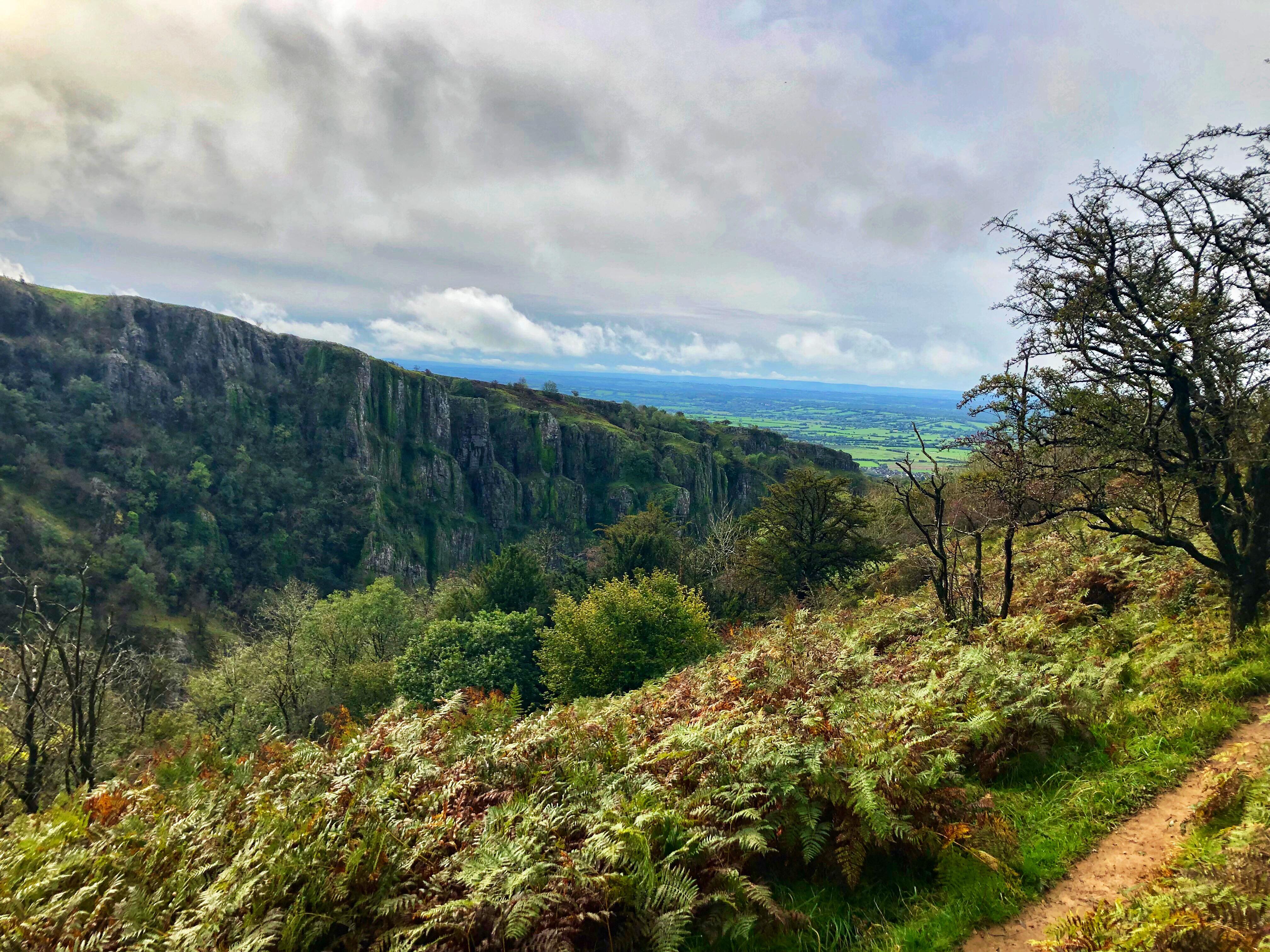
The vertical limestone faces on this side are without doubt the most impressive part of the gorge, towering over the tiny road that winds through the middle. We wandered onto the huge grass-covered fingers of rock jutting into the shadowy valley, regretting that it was too wet to climb – nice looking, partly bolted rock stretches down for several pitches. There’s something exhilarating and unsettling about how the suddenly the ground drops away here, and I was fixated by the ant-like cars snaking along the pass hundreds of feet below.

This south edge offers the best view of the gorge, which abounds in three things – lush vegetation, rocky outcrops and goats. Funny little coarse-haired faces pop up all over the place, from high up sheer rock faces to roads down in the town. Looking across the valley over the crevasse-like edge, the north bank slopes comparatively gently and is carpeted with scrubby, hardy grass, punctuated by smaller rock faces and wind-beaten bushes. A mixed forest thrives at the shallower top end of the gorge until its arrest on the south side by the huge grey rock faces, too sheer to be penetrated by roots.

The landscape around the gorge is strikingly flat in comparison. Miles of green fields stretch out in all directions, lined by straight hedges and interspersed with clusters of reddish rooves. The perfectly round Cheddar Reservoir and Brent Knoll stand out from the otherwise uninterrupted flatness, and the rough, rugged edges of Cheddar Gorge contrast starkly with its cultivated, inhabited, carefully constructed surroundings.

We climbed down the steps of Jacob’s ladder back to Cheddar town and spent the afternoon/evening buying cheese, drinking cider and playing pub games. Cheddar has a decent variety of shops and (more importantly) drinking establishments – we went from a sports bar to a wild west style saloon to a traditional, cosy pub. Choosing to bypass the hairdressers-by-day, nightclub-by-night, we stumbled back clutching kebabs and chasing goats.

Come Sunday the weather was less agreeable and my chubby, partly toothless face was hurting, so we loitered in the Costa tucked into the side of the gorge before heading to Wells, England’s smallest city. I was keen to see the cathedral and wasn’t disappointed – it’s a vast, beautifully detailed and satisfyingly symmetrical building situated in lovely grounds next to a moated bishop’s palace. There was a food festival thing on so the town was swarming with people, but otherwise it looked old and very pretty. We found a quirky old gaolhouse pub, rehydrated and headed reluctantly home.

NB: we didn’t do any caving due to very wet weather (so much so that some of the commercial caves were shut), one sore face and less disposable income than we’d like, but it’s definitely on the to do list for next time.

Lochnagar, May ’19

Last time I went up Lochnagar I couldn’t see a thing for blinding snow, cloud and ice. No crampons, broken compass, zero visibility, precipitous ridge, 10/10 could have died. During a visit to the Cairngorms in May I went up again to see what it looks like.

We started at the Spittal of Glenmuick and went up the same route as last time, following a straightforward gravel track which goes through a greener-than-green wood and up a long, gentle incline. It cuts through a few sweeping miles of high, heather-covered moorland, then becomes a less gentle incline and turns into a slabby path. It gets steeper still and the slabs disappear, leaving hikers to carve their own routes up the scrambley, bouldery rocks. As we climbed snow appeared, thickened, and soon covered everything.

We hiked/scrambled our way along the long, icy, rocky ridge which curves in a C-shape around a bleak, high tarn. The ridge drops precipitously down to the still, black water, exposing an intimidatingly sheer, dark granite face, and as we followed it round I was struck by the distance around the top to the summit. I realised that it was quite a feat to have climbed this munro in the middle of winter with zero visibility and minimal gear.

Eventually we reached the trig point, which stands proudly on a high outcrop, and stopped to gaze dramatically into the distance. We watched the mountains’ reddish-brown heather carpets fade to hazy blues and lilacs as they stretched out to touch the 360degree horizons, interrupted only by snowy peaks, and we could see for tens of miles all round.

I can’t think of a comparable landscape – at least not one that I’ve seen. Mountains often seem to envelop everything, standing high and imposing, shouldering each other as if competing for space. This place is different; equally dramatic, but in an open, rolling, panoramic way. If Glencoe in the Highlands or the Southern Fells of the Lake District are great white sharks, the Cairngorns are blue whales. Majestically vast, gentle and quiet. On a clear day.

We indulged in a picnic of olives, houmous, pitta and other posh bits (I didn’t even have porridge) and a cup of tea at the summit, then headed down the path which rolls over the hump-like southeast side of the ridge and lies parallel to our route up. We headed in the right general direction, then followed the path down along a crystal clear river. The snow retreated as we descended past lush, green vegetation and rushing waterfalls, and we found ourselves in a wood carpeted and roofed with unbelievably bright green foliage on the edge of Loch Muick.

The walk back was long and pleasant, along the flat, birch-lined north bank of Loch Muick. The rich trills of birdsong and the crunch of our gravelly footsteps emphasised the absence of background noise, and if I didn’t have a flight to catch I’d have been lured in for a swim by the still, dark water. We saw a herd of red deer in the open moorland beyond the loch and failed to identify several birds before returning to the pine wood by the car park, de-kitting and driving off [very, very] reluctantly.

With equal reluctance I caught my flight back to Manchester, lungs longing for more mountain air but chest otherwise empty as, once again, I’d left my heart in Scotland.