Scotland, Feb ’22: Inverness, Skye, Old Man of Storr

Wednesday 9 February

Inverness, Tilly

No lie-ins today, to my satisfaction and Ryan’s displeasure. Having fully exploited the Cairngorms, we planned to head west across to the Isle of Skye, a place that’s been right at the top of my “to do” list for years. We left Aviemore and drove north along the main A9 road to Inverness, parked in the small, fairly central Rainings Stairs car park we’d stopped in on a previous trip and walked down the long flight of narrow stone stairs to the town centre.

Having visited Inverness before we didn’t plan to stay for long, so Ryan got his obligatory McDonalds breakfast (which, as usual, we ended up sharing thanks to his generosity and my “I’m not that hungry” regret) and we shivered through the cold, damp, snowy street lined by attractive, tall yellow sandstone buildings, already a bit peopled out, straight back to the van.

We were in a pretty, quiet residential area on our way out of Inverness when we saw a little jack russell wandering around a road. We’re both very much animal people (generally more so than people people), so we pulled over and I approached the elderly-looking, placid little dog. Her collar told me her name was Tilly and she lived at the house she was hanging around outside, so I rung the bell and called the mobile number on her collar, both to no avail. Luckily her friendly neighbour pulled onto his drive and told me that she sometimes escapes, so he put her back in her garden and explained that he’d take her in but she doesn’t get on with his dog, a lovely little west highland terrier called Gordon. He reassured me that her florist owner was probably on a local delivery and wouldn’t be long, so feeling all warm and cosy about helping little Tilly (and instantly over whatever we’d found to argue about that morning – I can’t remember) we went on our merry way.

East to west coast

The drive across to Skye took a couple of hours and was a stunning route, mainly through open, yellow-brown moors surrounded by dramatic, rolling white peaks, several of which we eyed up as mountaineering destinations. The weather was classically Scottish – wet and claggy one minute, bright and sunny the next – and the road snaked along wild glens and through rugged little villages. Shortly before we approached Skye Ryan pulled into a small road so I could have an indecorous wee in the usual van style, only slightly hidden from any unfortunate passers by (happily there were none), and as we approached the island on the road that runs along the Loch Alsh sea inlet he stopped for his own indecorous wee, which gave me a good opportunity to photograph the striking Skye Bridge.

Skye

We crossed the bridge and headed to the Co-op at Broadford, all the while admiring the vast, watery expanse and wild little islands of the Inner Sound strait. We grabbed snacks and supplies, then drove up for nearly an hour up the northeast coast towards the Old Man of Storr.

Even under an overcast sky it was an other-worldly place. Skye is part of the Inner Hebrides archipelago, a chain of 79 islands sprawled up Scotland’s dramatic west coast. I was stunned by the fullness of the landscape, which seemed almost contradictory: there was so much land, rising out of the water and high against the horizon in its random, rugged, heather-brown and snow-white forms, yet so much water, dead flat and simultaneously light and dark. As a whole the sea reflected the bright grey sky, but the blue-black detail of the waves and ripples hinted at the mysterious depths below. It was captivating.

We snaked around the base of the red Cuillin mountains and glanced left at Sligachan to catch a glimpse of the black Cuillins, whose name alone is enough to command a sense of awe and deference. They towered over the rolling moors in jagged peaks, the indomitable kings and queens of the island. If it weren’t for the high winds and poor visibility forecast we’d certainly have set upon the infamous Cuillin Ridge traverse, but I’m not sad about having such a firm incentive to return.

The rolling moors continued on the road to Portree, a pretty, lively-looking town with lots of quirky independent shops, and beyond, where we climbed higher into thick clag and heavy snow. Ten minutes later the sky was bright blue and as the strip of water between the isles of Skye and Rasaay crept back into view, the iconic Old Man of Storr appeared ahead in his striking, bizarre elegance. We pulled up in the large visitor car park, ate some noodles and began the easy 20-minute walk up to the surreal formation of towering bare rock.

Old Man of Storr

We were surprised that a quick google yielded no climbing routes up the pinnacle (not to be confused with the Old Man of Stoer, a sea stack further north on the west cost of the Scottish mainland and something of a climbing mecca), but on closer inspection the rock has a strange, damp, crumbly texture. He stands about 50m tall and 10m wide, a brownish grey pinnacle of basalt in an ancient volcanic island of tantalising, intimidating, alien rock – The Storr. The snow that thinly covered the grassy, rocky landscape all around didn’t dare touch the dark obtrusion, which rose suddenly in jagged, triangular forms separated by sinister black gulleys. The Old Man’s upright position looked unnatural, like he should topple over any second, and as we walked right up to him we understood the story of the giant laid to rest whose thumb remained above ground, pointing to the sky. It was a strange, enigmatic, serenely beautiful yet slightly uncanny place.

The walk back the same way was breathtaking, overlooking the undulating isles of Raasay and Rona and in the distance the distinctive Black Cuillin mountains, which were framed perfectly below a curtain of thick grey cloud – even that hung respectfully above the towering peaks. Already stunned by Skye, we got back in the van and continued our drive north up the east coast of the island in the hope of seeing the Quiraing before nightfall.

Lealt Falls, the Quiraing

After about 10 minutes Ryan swung the van into a layby. He’d spotted a waterfall sign, so we went over to the viewing platform set just off the road and watched the tumbling white water of Lealt Falls rush into the Abhainn An Lethuillt river (catchy name). There were two waterfalls, a high, thin one and a wide, tiered one, both carving channels through the sweeping land and enabling trees to thrive thickly along the banks, even in this harsh landscape. The water rushed into a deep valley, at the end of which the sea sat high and blue cradled in the “V”. We watched it for a little bit, then scurried on to catch a glimpse of the Quiraing.

After a 15 minute drive past some quirky, sprawling hamlets, we were in the bizarre landscape of the Quiraing, an ancient craggy landslip near the northernmost point of the island with sweeping slopes, high cliffs and huge, random masses of bare rock. The road wound below the fascinating land formations and snaked twistily up one side. I got out the van and wandered up a small hill to take some photos, wishing that we had a bit more time for a proper explore. From there we drove across a wild, high moor and headed southwest through awful conditions in the dark – heavy snow with next to no visibility along the main A87 road – to Dunvegan, where we found an out-the-way pull-in on the bank of Loch Dunvegan, near the castle.

I cooked an improvised meal of vegan chilli con carne with bulgur wheat and we spent the night under a starry sky, which reflected off the glassy water of the loch and turned the low hills on its far bank into pitch black silhouettes. We fell in love with Skye that day.

How to Impulse trip: Lake District, June ’18

The weather has been incredibly un-British for the past few weeks and the week before last I (practically) finished my LPC, Masters and a legal work placement. Naturally I was desperate to run away somewhere wild, so on Monday my adventure partner booked the rest of the week off work and that evening we decided to hit the Lake District. After previous stunningly beautiful but grey trips, I couldn’t resist the chance to see the mountains in the sun.


Tuesday 26 June

Late-night packing complete, we set off about 5.30am and arrived about midday after a Morrisons breakfast at Newcastle-under-Lyme. We found a basic National Trust campsite, Hoathwaite, by Coniston Water, and were pitched and raring to explore shortly afterwards.

I’d recommend the campsite any day: with direct access via a footpath down to a lakeside beach, it’s perfect to take your own kayak or SUP. It has toilets, showers, washing up basins and water taps – basic but clean and an absolute luxury for us, having got used to wild camping. The Old Man of Coniston cradles one side of the campsite, and there are lovely views over other mountains, trees and the glistening lake. It’s on a hill, but there are plenty of flat spots to camp, no marked pitches and plenty of space.

We walked the half-hour footpath to Coniston, along the lake and across big fields, to explore and recce the pubs. It’s a really pretty town with dark stone buildings and a lively centre, with about four pubs, three small supermarkets and a couple of outdoorsey and gift shops, cafes, a bakery and a butcher. We walked around, got some shopping and went back to the campsite.

We cooked early, semi-planned the next few days and went for a gentle 5k run (I’m still recovering from injury) back towards Coniston, stopping on the way back to skim stones on the water. Tired from late packing and early rising, we went to bed early and slept like sloths.


Wednesday 27 June

On Wednesday we drove to Ambleside to get a map of Helvellyn. I’ve always used Ordnance Survey but a helpful man in Blacks told me that Harveys maps are sometimes more practical, so I welcome any input on this. There are four OS maps of the Lake District and we only had the Southern two, so we invested in the others and briefly walked around the town. I remember liking Ambleside before; it has a really lively atmosphere, plenty to see and an abundance of outdoorsey shops which make it seem like a hub for adventurous, active people – more so than tourist-saturated Windermere.

We’d never been Stand Up Paddleboarding before and I’ve been desperate to try for ages, so we hired a couple of SUPs for three hours from Derwent Water Marina near Keswick. We chose to explore Derwentwater over Windermere as it’s quieter and wilder, and had an amazing time surrounded by clear water and blue mountains, stopping at a beach for lunch and a swim. I’ll write about this separately as I definitely have more to say.

After SUPing we drove to Glenridding to climb Helvellyn via Striding Edge, setting off about 4.30pm in 30 degree heat. There’s a tourist path straight up the Western side but I wasn’t interested – I’d read about approaching from the East in The Great Outdoors magazine and insisted on the more picturesque, lengthy and difficult route.

Although sketchy at times, I loved scrambling up Striding Edge (much more so than Bertie) and reaching the clear, sunny summit of the tabletop mountain (third highest in England) at about 7pm – I couldn’t find words to do the clear blue and lilac, layered mountain panorama justice. I’ll write separately on the route we took. We got back to the car about 10pm and made it to Wetherspoons in Keswick with 10mins to spare, thanking heaven that they serve food until 11.


Thursday 28 June

We got up with the sun and walked down to Coniston Water to have breakfast by the lake and read books. We’d planned to hire bikes for the day and explore as far as we could get, but drove an hour through tiny country roads to Eskdale to find the place closed. Although a lovely drive, we’d seen that area before and I was cross at the wasted morning. I’d wanted to call to book but Bertie just wanted to get there, and he took about ten years searching the car for his lost wallet (because he left it in a stupid place) so he secured a place in my bad books.

We had a drink at the Woolpack pub and used the Wifi to find an alternative bike place. It was between hiring from Keswick and cycling the roads/bridleways, or from Whinlatter forest and doing proper mountain bike trails. I wasn’t aware of Whinlatter until then but had loved Grizedale previously, so it was a no-brainer for me.

After another hour-long drive, we picked up a couple of nice Cube hardtails for three hours and did the North loop of the Altura Trail (graded red / “difficult”, 9.5km) in 1-1.5 hours followed by the Quercus trail (blue / “moderate”, 7.5km) in less than an hour. I would have loved to have done the Altura South loop too but we didn’t have time, and I think Bertie – being less keen and confident than me (but probably equally skilled) – had had enough of expecting to die at any second. He was back in my good books as I loved it so much – long, fast, swooping sections of singletrack, tricky technical sections and berms to die for. That’ll be another post too, and I’ve sworn to return to the South loop.

That evening we walked to the Yewdale Inn at Coniston, ate pizza (which I highly recommend, generous amount of cheese) and drank cider while England lost to Belgium.


Friday 29 June

On Friday morning we packed up, got some barbecue food for lunch and took the kayak out on Coniston Water. Once again, the sun was blaring down and it was so peaceful; there was barely anyone else on the water. We stopped at Peel Island, which could have been straight out of a holiday brochure; leafy, rocky and surrounded by clear water. I swam around, not thinking of the Coniston pike I’d google imaged that morning.

We left and paddled back under a clear blue sky, surrounded by forests and mountains. It was surprisingly hard work against the breeze and we were starving. Eventually we got back to the beach, barbecued sausages and burgers, read for a while and went for a swim around the clear water. It was warm in the still shallows, but it was such a hot day that the cooler, deeper water was a relief. It shelved steeply and I came across a few small perch. The algae-covered stones were really slippery, and being naturally un-graceful I fell over and cut my leg. Dignity shattered, I dragged myself away from the water and packed up sadly.

The drive home was uneventful; we left about 5.30pm, had a meal deal at Preston and otherwise only stopped at Warwick Services, arriving home in Winchester just before 1am (thanks to loads of 50mph limits and a partially closed A34). We were up quite early on Saturday and spent the day enjoying our annual charity golf competition but already missing the North. We’d been blessed with mid-twenties to early-thirty degree heat the whole time, did loads of activities (the only disappointment was that I ran out of time for bouldering) and saw a lot of the Lake District under clear blue skies. I can’t wait to return.


Brecon Beacons: 3 Days, 4 Waterfalls, 5 Mountains — Day 1

This trip concluded in an unusual way: we accidentally climbed Lord Hereford’s Knob twice. I’ve had worse Monday evenings.

There were some strange bits in the middle too: once we ended up in a field with a bull, twice we got lost (not so unusual), thrice we found ourselves in Wetherspoons (even less unusual) and we got swarmed by “f***flies” four times. If nothing else, I learned to count.

We left about 6am on Saturday and got to Go Outdoors Gloucester for when it opened at 9. I could spend so much money in that shop, if I had so much money. We got to the campsite about midday after cursing our way through the Hay-on-Wye festival traffic and were pitched and heading to Brecon within half an hour, hoping to get some afternoon inspiration from the visitor centre. Turned out the visitor centre had moved, but eventually we ended up parking near Garwnant (a lovely eco-tourist-information-car park-café-woodland-centre thing) and planning a rough route over the car bonnet.

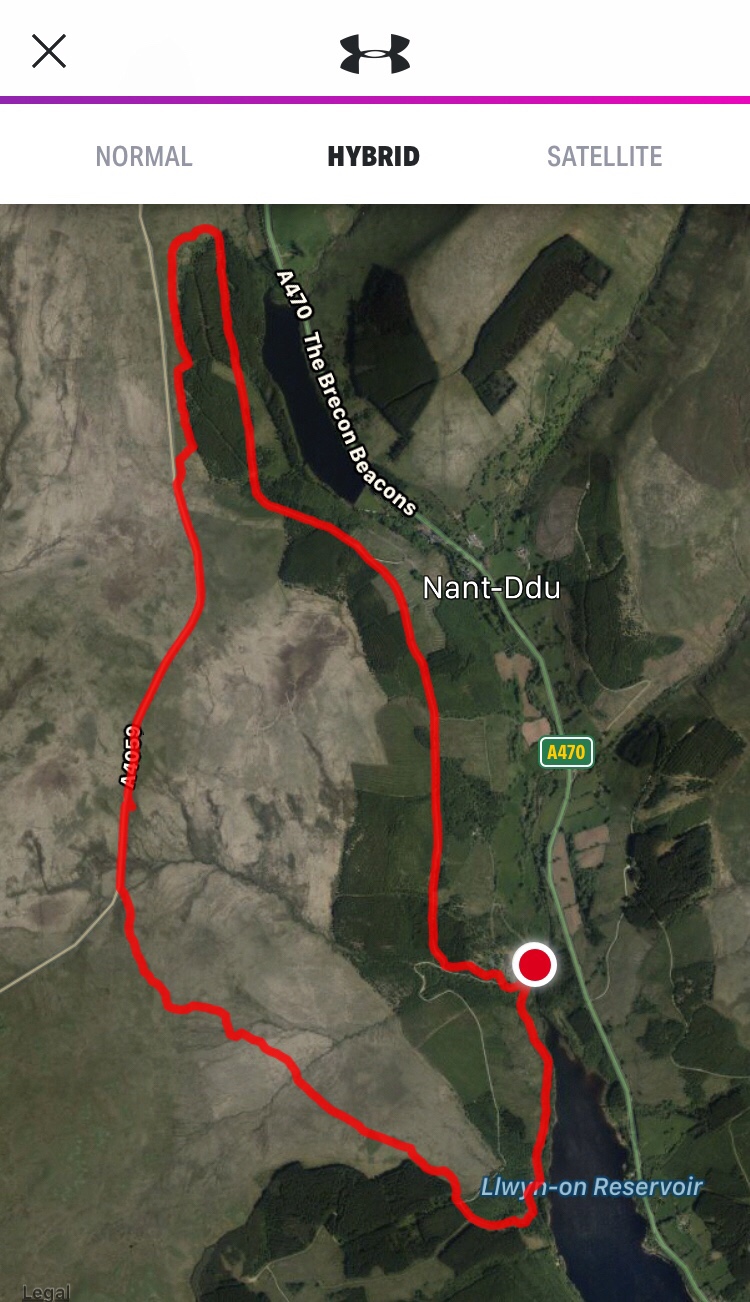
We set out at 3ish in the sun, heading South and admiring the serene black water and idyllic fishing spots of Llwyn-on Reservoir. Before long we veered off the road, across a stream and onto a windswept, golden plain. A little way in we realised the path went slap bang through the middle of a group of cows. Having grown up in the countryside, this didn’t faze me until I spotted an enormous “cow” with rippling muscles, a tree-trunk neck and an unmistakeably un-udder-like undercarriage. We thought it unlikely there would be a bull in a field of cows, but there definitely was. To spice things up there were a handful of calves in the melée, and anyone who knows anything about animals will know that mums don’t like blundering, invasive humans getting near their babies.

Regardless, we gave them a wide-ish berth, survived and came across our next, often-frequented challenge: the elusive, disappearing footpath. As usual we took a blasé approach and headed in “roughly the right direction”, North West across the knee-deep tufty, grassy, boggy, extremely untrodden plain (I had flashbacks to my last Dartmoor trip). I nearly lost them to the suctionney, hidden, black mud a few times, but apart from that my trusty flip flops served me well.

The sun was warm and despite some haze, the visibility was pretty good. Although frustrating to cross, we’d found an extremely picturesque bit of Wales. Pen y Fan and its horseshoe-shaped brothers lay to the North East, ahead and on our right, and an anonymous green ridge sloped and curved protectively behind us and to the West. Black forests broke up the rugged, green mountainsides and we were surrounded by the rippling, golden (deceptively deep and tufty) grass of the open plain, interrupted only by a few anomalous trees and whispering streams. I spent a while fiddling with my Nikon, trying to capture an arty close-up of pretty little pastel pink flowers which cropped up occasionally, alone and peaceful.

I think we crossed the Nant Ffynnonelin, the Garwnant Fach and the Garwnant Fawr streams, as well as about 2km of this wild, beautiful, slow and hugely irritating terrain, before we reached the A4059 and plodded a few kilometres North along the roadside and past a lot of (surprisingly photogenic) sheep.

We’d hoped to be able to cut down into the forest to the East via one of the footpaths marked on the map, or even over the fence and down a firebreak, but the map was a few years old, the fence looked a few years new, it looked like new trees had been planted and naturally we couldn’t see even a trace of a path. It was coming up late afternoon and the pub had been beckoning for a while; it wasn’t the first time I’d half-formed a plan ready for if/when we were lost, hungry, miles from anywhere and facing a cold, dark night.

We ended up pulling away from the road, cutting across more nasty ground and down a steep hill to the East, right along the North-Western edge of the forest that had been taunting us for over an hour. Halfway down the valley, it was a huge relief to find a gate and a disused-looking track heading back into the forest, criss-crossed by fallen pines and lined by half-uprooted trees whose earthy, rooty bases yawned and groaned as the wind pulled the branches back and forth.

Having kept half an eye on the mist that had been creeping up the valley from Pen y Fan way, we pulled waterproof coats on when we felt the sudden, pre-rain temperature drop and stillness of the air. Fortunately it didn’t materialise and we followed the track a long way through the forest, straight back to the car. 13km and just under 3 hours later (it felt like longer, bearing in mind we’d expected to do half that) we headed to the pub, dizzy at the thought of a pie and a pint.

Unfortunately it wasn’t that simple – several pubs had stopped serving food by the time we arrived (to our horror), so we had to backtrack to Brecon and resort to Spoons. It’s not often I feel underdressed in a Wetherspoons, but half the population of the town seemed to be dressed up and congregating in there while I sat and people-watched in my second hand hoodie, outdoorsy trousers and flip flops. Nevertheless, it hit the spot and saved us enough pennies to warrant returning for breakfast the next morning… Adventures of Day 2 to follow!

Tip of the day: as any other ex-army cadet will tell you, a map is only accurate to the day (the minute, in fact) that it’s drawn!

On Kayaking

There’s something so liberating and solitary about kayaking on the open water, suspended between the earth and the sky and just existing. Keep still and you’ll feel simultaneously numb and hypersensitive; weightless and isolated, but acutely aware of sound, light and the feel of the air.


Perhaps my favourite thing about it is having the freedom to move without diversion.  On land our direction of movement is constantly influenced by paths, roads, walls, barriers and landforms, but on the water there are no waymarkers or boundaries beyond boats, buoys and the occasional rock. Without these predetermined “invisible arrows”, you have 360 degrees of glassy expanse to carve your way through before the water swallows up your trail. You could be the first and last person to ever take that exact route; echoing the eternal Fleetwood Mac, you go your own way. You’ll know what I mean if you try it.


Being in such a small vessel enables you to explore places you’d otherwise never see and discover creeks, beaches, woodland and countryside you didn’t know existed. At risk of sounding like the Youtube “Gap Yah” guy (I wonder what happened to him?), you’ll feel at one with nature as you immerse yourself in a new, bustling world of plant, bird and marine life.


Nature, enlightenment and self-discovery aside, paddling is great for core and upper body strength because it uses muscles that are often neglected, particularly in the shoulders and back. There’s something so satisfying about stretching out your arms and pulling yourself through the water, feeling your strength translate into each powerful stroke, and the burn in your muscles is one of those oddly “nice” aches. You also use your legs a surprising amount to stabilise, brace and manoeuvre the kayak.


Once you settle into a rhythm the repetitive motion is really therapeutic. This, combined with the healthy dose of fresh air and gentle lapping of the water, makes it both relaxing and invigorating. I particularly like messing around on tidal rivers as there’s something refreshing and restorative about the tang of salty air – it works wonders at blowing out cobwebs caused by one too many drinks the night before.


All that said, it’s a surprisingly versatile activity which doesn’t have to be all about flat water and balmy air. Getting out on a choppy sea or a fast-flowing river affords plenty of opportunities to try some whitewater action, which is understandably less relaxing but (depending on your outlook) more exhilarating.


I got out on the water last week for the first time in a while and it reminded me how much I love everything about it, so I thought I’d pay tribute to kayaking on my blog. If I convince one person to hire, buy or borrow a kayak I’ll be delighted and I’m sure they won’t regret it. And if anyone wants someone to go with, count me in.

Dartmoor, March ’18

This was the first time I put a tent up in the middle of a bog, at night, in the snow. Conditions weren’t ideal but without the bitter wind it might have been almost comfortable.


I love Dartmoor for its sand-coloured plains, rocky tors and open ruggedness. Although you’re never more than a mile or so from some kind of settlement in Southern England, this place feels really wild – like you could be anywhere. As you enter the National Park there’s a stark, knife-edge contrast between the cultivated green fields of Devon behind you and the vast, untouched moors in front, and then you’re plunged into a bleak, beautiful expanse of wilderness.


The main roads through the middle can get busy, particularly during summer, but it’s easy to park in one of the many roadside spots and slip away into the moors. Most visitors don’t venture far from picnic spots, viewpoints and tors within bimbling distance of the car.


This time I arrived as the daylight was fading and parked in a Princetown residential road. Dartmoor has a climate of its own, so I shouldn’t have been surprised that it was snowing heavily despite being grey and muggy when I left Hampshire a couple of hours before. I set off NE towards the mast (a hugely useful landmark) which towers over the town, following a roughly pre-planned route.


The wind was bitter and the blizzard was relentless, but I was glad for it. Night navigation was much easier with the snow reflecting any kind of light; I could distinguish treelines, tors and hill brows, which I wouldn’t have been able to do without the white-black contrast. A couple of hours into tramping through mean, rocky, slippery terrain, I found myself on track but in a nasty patch of boggy, wet, undulating ground. The snow wasn’t so helpful here, as it hid what was under my feet rather than illuminating it. I found a semi-flat bit of ground that was slightly sheltered by a low grassy mound; although keen to press on, I conceded that I’d rather camp in a dry-ish spot, so settled down onto my cheap Quechua sleeping mat after a bitter fight with the wind, snow and my cheap Eurohike tent.


Top tip: if you’ll be sleeping on snow, spend more than £4.99 on a mat. I should have learnt that in Scotland last year, but investing in a self-inflating mat is still on my to-do list. Fully clothed and curled into two cheap sleeping bags (spot the pattern?) I was still cold, but I survived.


Top tip #2: if you think you might be getting a blister, no matter how cold you are, right now is the time to sort it out. This was me half an hour after fight no.2 with cheap Eurohike tent (the weather didn’t ease overnight, by the way). Fortunately Great Mis Tor offered some shelter as I reluctantly stopped to shove a blister plaster on each heel, and I didn’t have any further issues despite wearing my shiny new Salomon Quest 2 4Ds for the first time.


It took a while to warm up, but once I did I could finally appreciate Dartmoor in all its rugged glory. After stumbling happily down a windswept slope, I realised that I couldn’t follow my route as a “stream” was less crossable than I anticipated, probably due to a combination of heavy snow and poor planning. I didn’t fancy a) getting myself and my 70l backpack wet, or b) drowning, so I followed it upstream hoping to find a place to cross. I was unsuccessful, so re-routed and ended up slogging through the most awkward, humpy, dippy, tufty, boggy ground I’ve ever walked across. This went on for a while, and despite it being a Saturday in the middle of the Easter Holidays, I didn’t see a soul.


After another uncrossable river, a few sketchy traverses across rock edges perilously close to said river and a glute-achingly steep, rough valley climb, I found myself at Lydford Tor and in the MOD danger area (having checked firing times beforehand – please do this). With the original route out the window and the smell of mum’s promised roast lamb filling my head, I adjusted my course  to arc back towards Princetown, using the map as a rough guide and aiming vaguely for the big mast. The weather had finally relented and the hike back was pleasant but uneventful; the landscape opened up and I could see the Beardown Tors, dark woods towards Two Bridges and the ominous granite walls of Dartmoor Prison.


I made it back to the car unscathed and, true to form, went straight to the pub (I should probably sort out my spending priorities). I recommend the Plume of Feathers in Princetown – it’s welcoming, cosy and does great steak pie. Fed, thawed and thirst for adventure temporarily quenched, I trundled back to Hampshire just in time for Sunday roast lamb.