Black Forest, Germany: Waldkirch and Triberg

Wednesday 11th September 2024

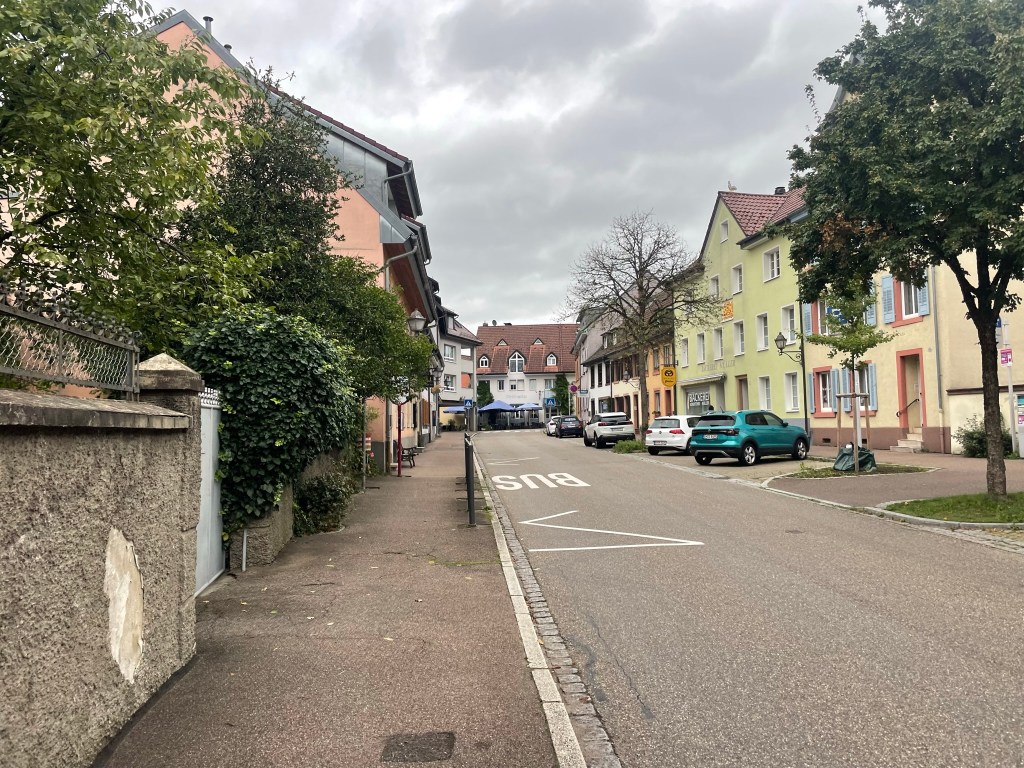
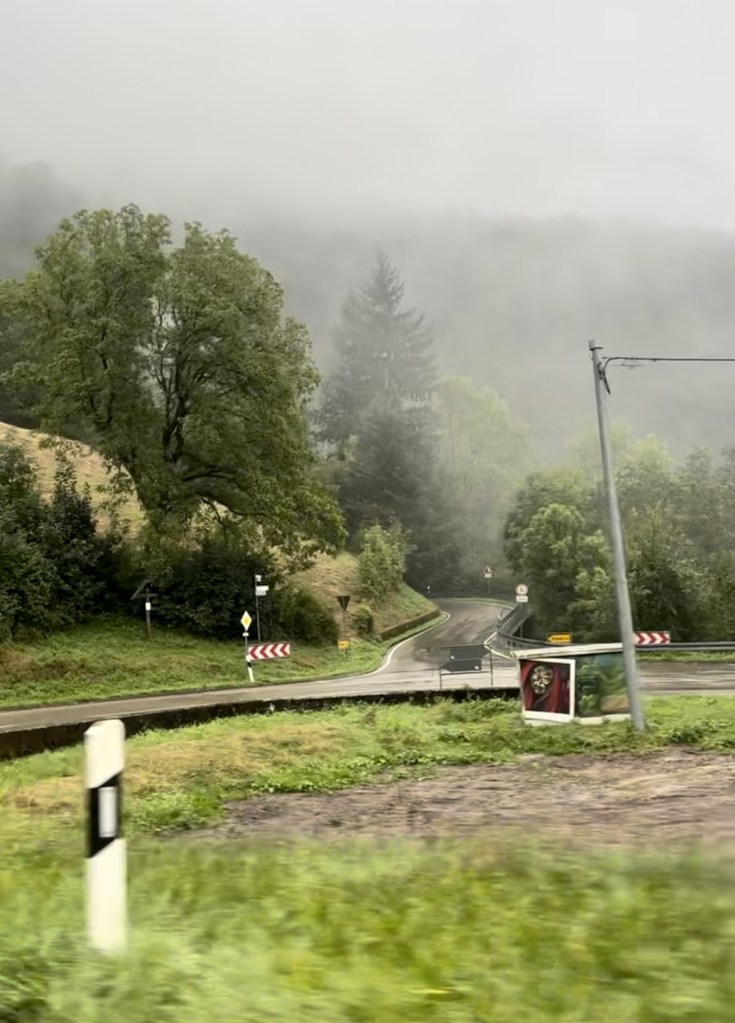
Eager to immerse ourselves in German culture, our plan for the morning was to visit the twice-weekly market in the small, nearby town of Waldkirch. The damp weather didn’t inspire us to rush out of our cosy apartment, so we took our time over a tasty breakfast of sausage, egg and toast, watched closely by Kraut the cat. When the rain subsided we set off in our little hire car through the scenic Simonswälder valley and arrived in the town at 11am. Parking was a stressful experience as the numerous little roadside car parks were full and we didn’t understand the road signs, but thankfully we found an underground place with plenty of space.

Waldkirch Market

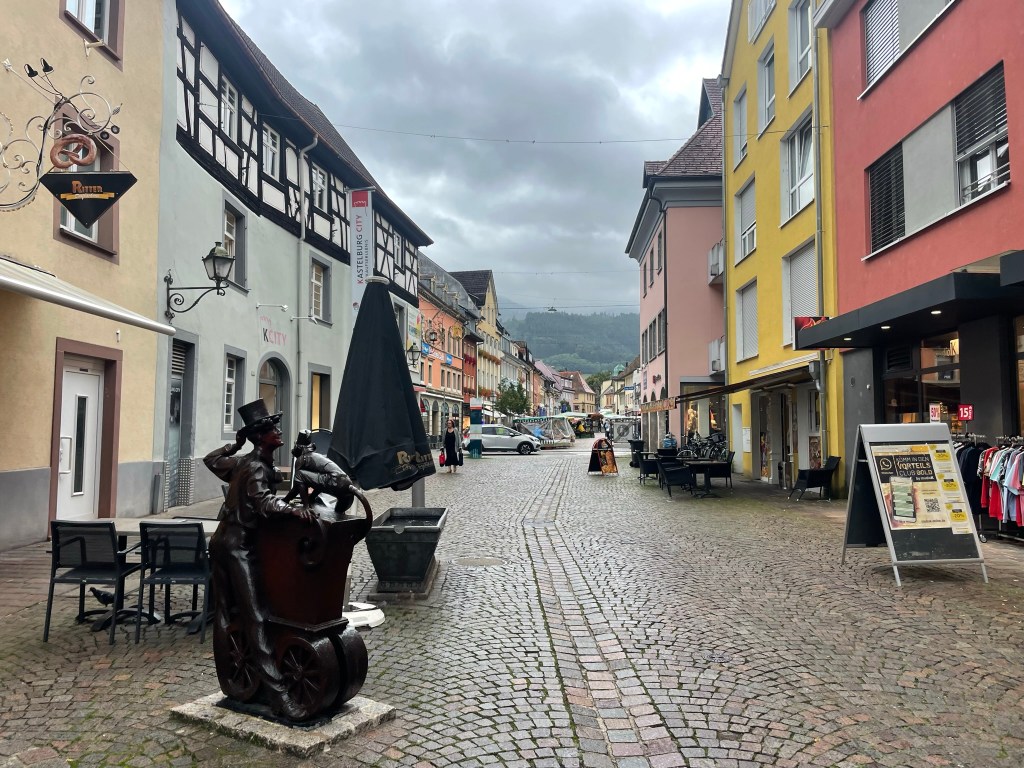
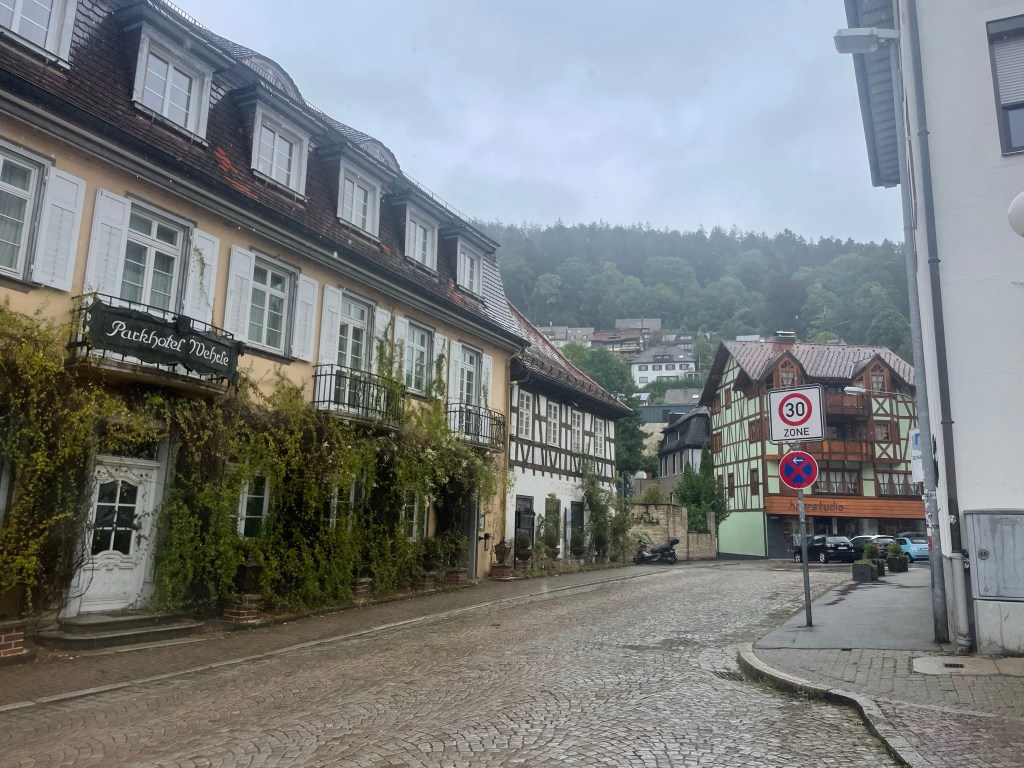
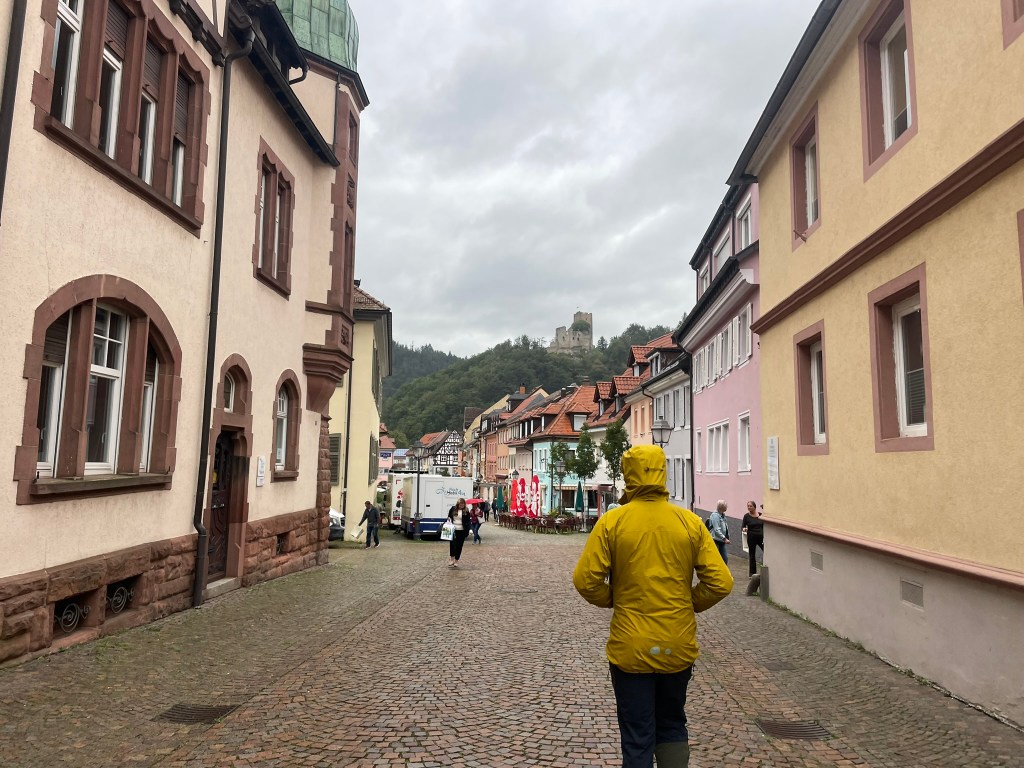
The market spanned both sides of a cobbled street lined with pastel-painted houses and backed by misty, forested hills that rose high on either side of the town, their dark tops cloaked by an obstinate curtain of cloud. An atmospheric castle ruin loomed above red-tiled rooves at one end of the street, looking as if it had fallen out of a fairytale. The market was quite small but there was a wonderful array of crates, baskets and counters filled to the brim with local produce: colourful fruit and veg, fresh and cured meats, bread, cheese, eggs stacked in big trays, herbs and spices and a stall full of homewares and utensils all made of wood. It was utterly charming, and there was no disposable plastic to be seen.
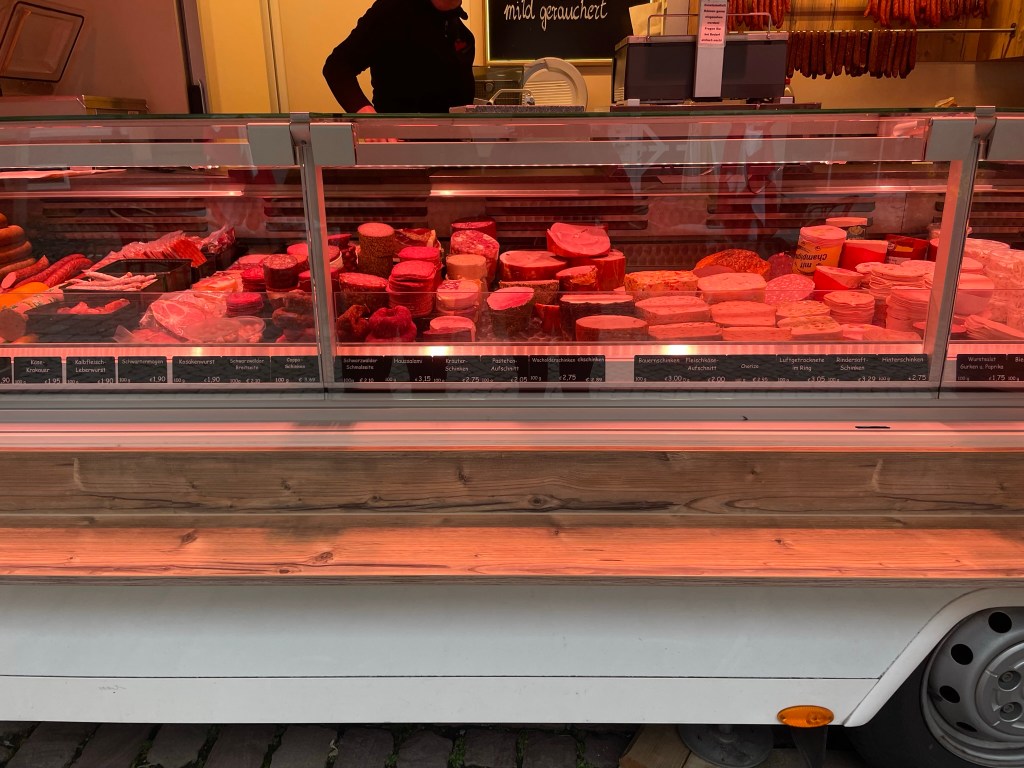
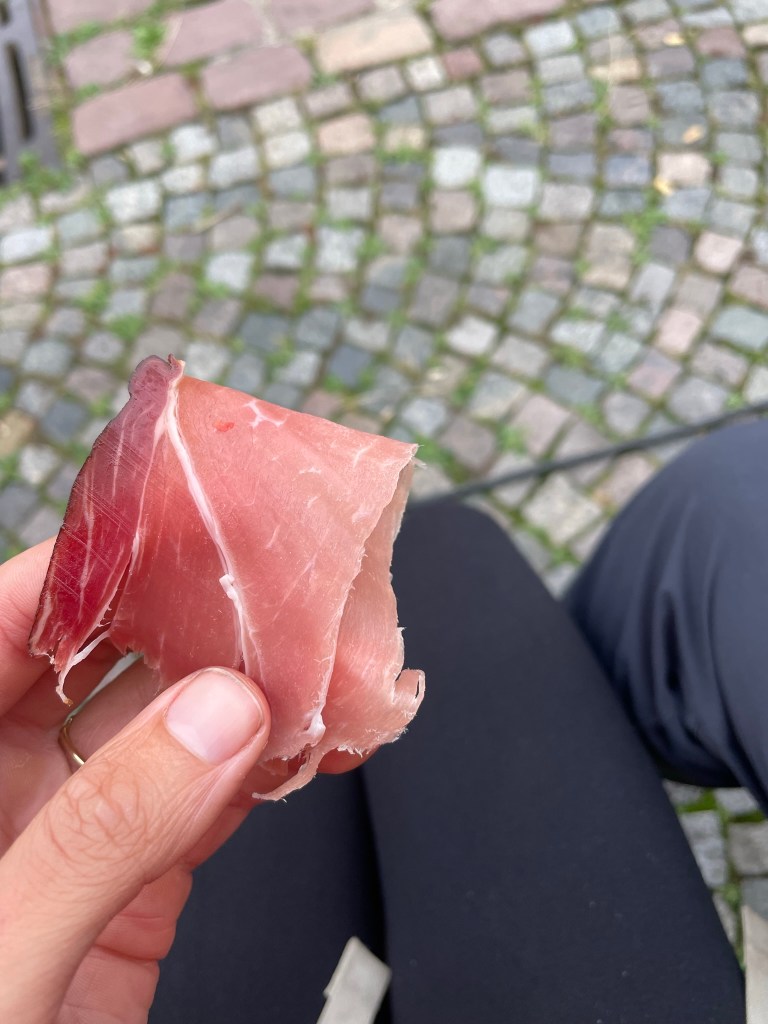
I had a pleasant conversation in broken French with a cheesemaker and we came away with large chunks of – I think – morbier and comté, which had travelled across the nearby border with eastern France. I was almost as pleased with the conversation as I was with the cheese. We had a slightly less successful time communicating to an accommodating German butcher that we wanted to try the famous Black Forest ham and a couple of skewers (meat unknown), but got the message across with some emphatic pointing. We sat on a bench and tried the ham, which was divine – wafer thin with a very strong woodsmoke taste. Our last purchase (which also necessitated pointing) included a jar of homemade tomato sauce, fresh spinach and some bright orange chanterelle mushrooms from a greengrocer.

Satisfied with our miscellaneous ingredients for an unplanned meal, we wandered around the town, resisting the pull of cosy little cafés and bakeries crammed with pastries and pretzels. The regional theme of clean, cobbled streets and neat, colourful houses was as present in Waldkirch as everywhere else we’d been the day before. The town was small and it didn’t take us long to feel as if we’d completed it, so we returned to the car and formed a plan to drive east to Triberg, which we’d read about in various “Black Forest must-do” articles.
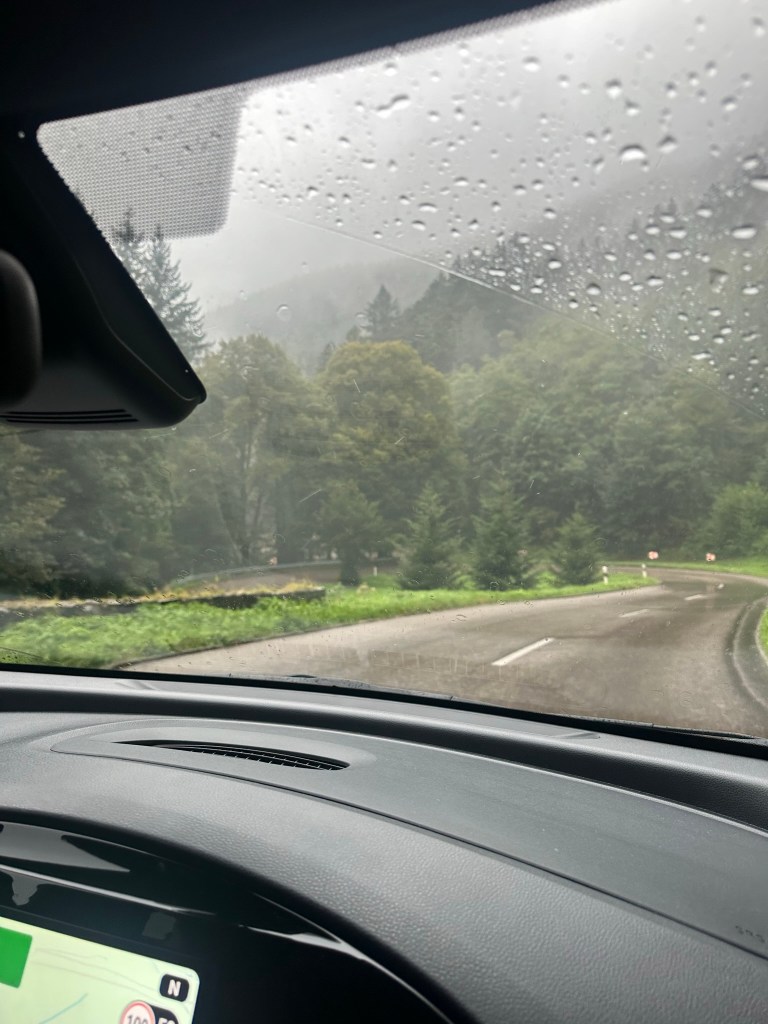
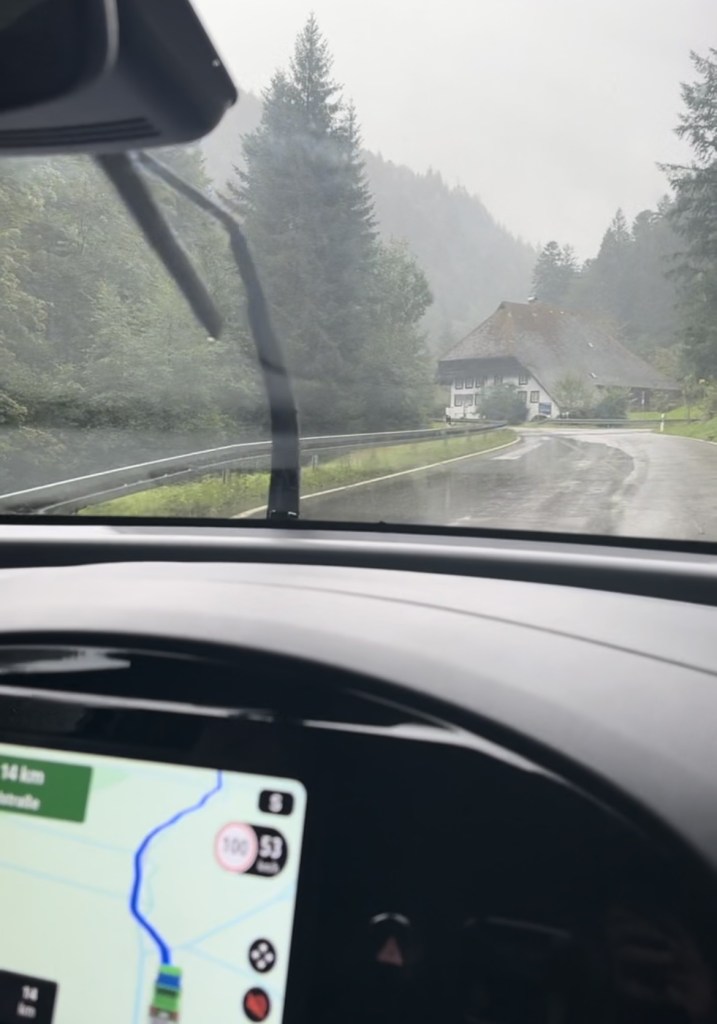
The drive took us northeast up the long Elz Valley to Oberprechtal, where we’d walked the previous day, then south along a high, scenic, serpentine road which carved a narrow line through endless dark forest. It rained heavily the entire way, but thankfully I’d become quite accustomed to the Black Forest’s hairpin bends and lofty glimpses of great, green valleys. Nevertheless, I was relieved when we dropped into the town and arrived safely in a multistorey car park – the 50-minute journey had seemed a lot longer.

Triberg

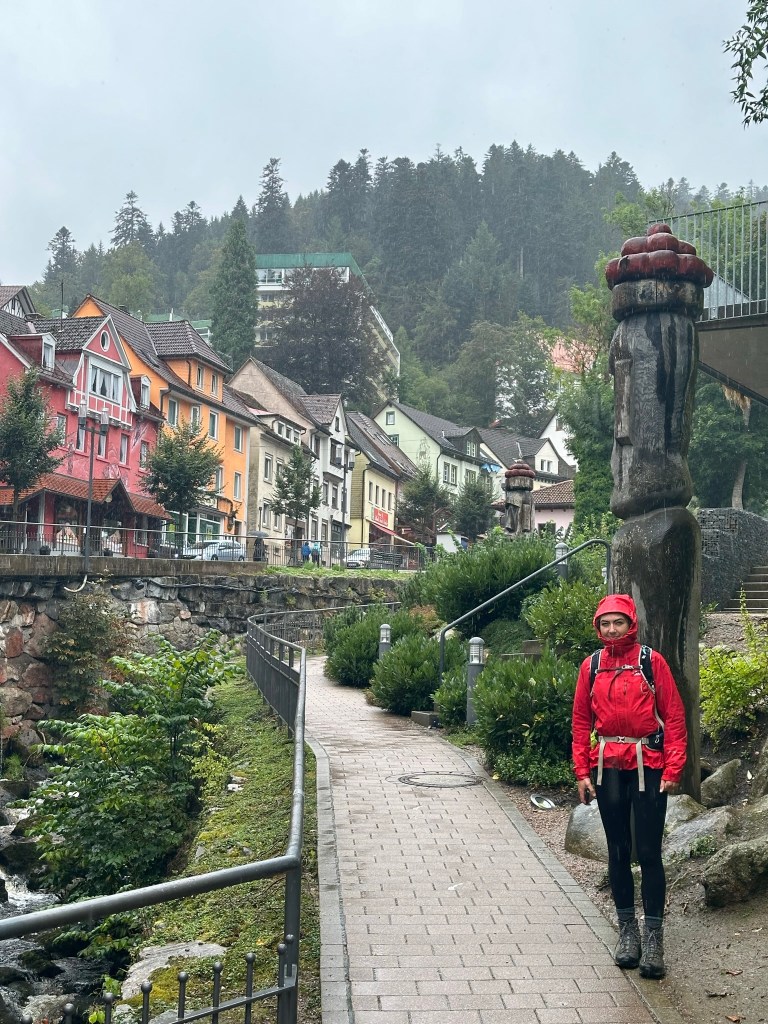
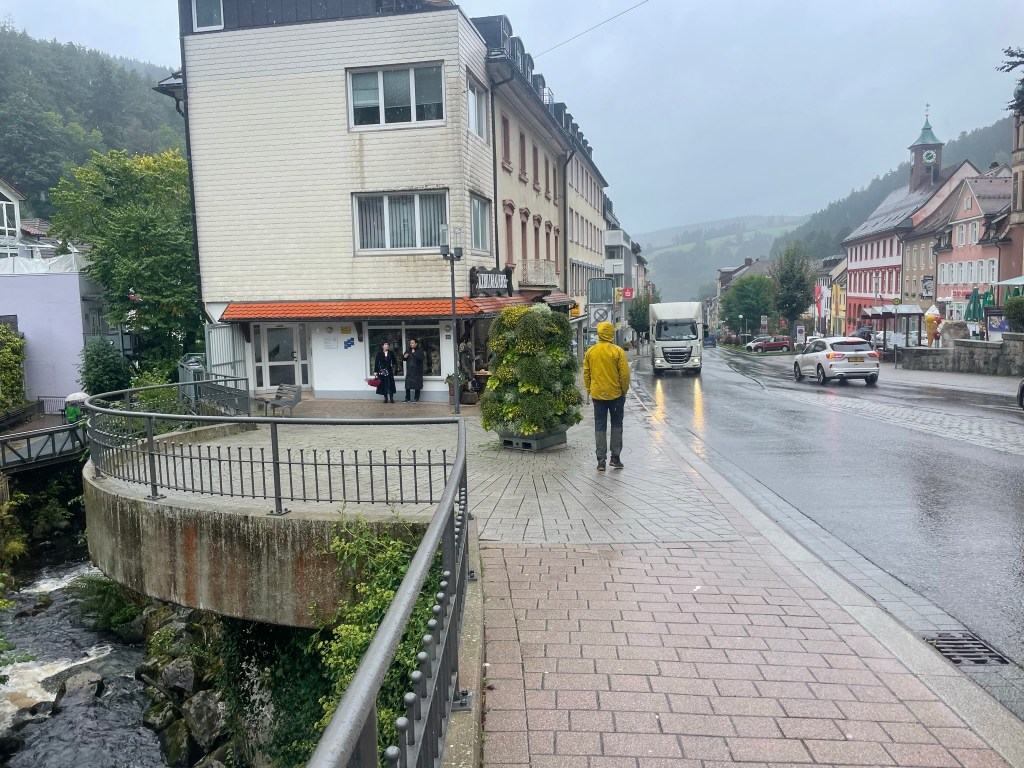
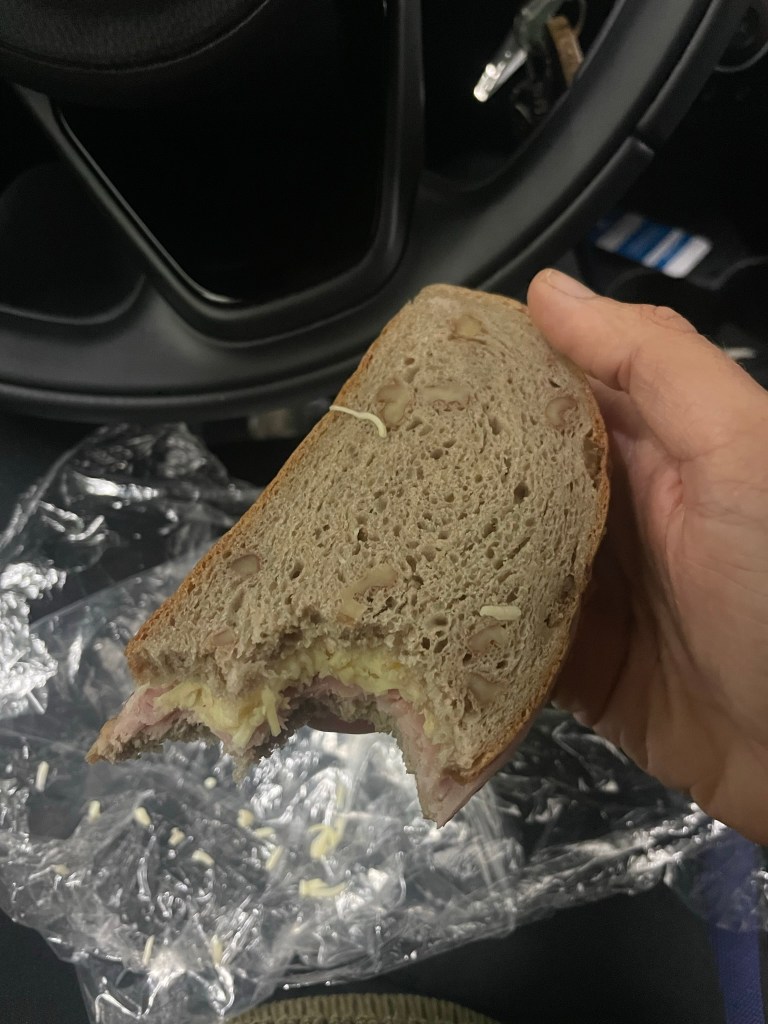
We munched ham and cheese sandwiches in the car, then headed out into the pouring rain. A walkway that followed the rushing Gutach river upstream led us to the centre of the small town, which sat in a kind of bowl surrounded by rising, impenetrable-looking forest. Unlike Waldkirch, which was set in the flattish belly of a valley, the colourful buildings of Triberg followed the contours of the slanting streets and rose into the trees in steep layers, giving a sense of self-contained, nestled cosiness.
House of 1000 Clocks

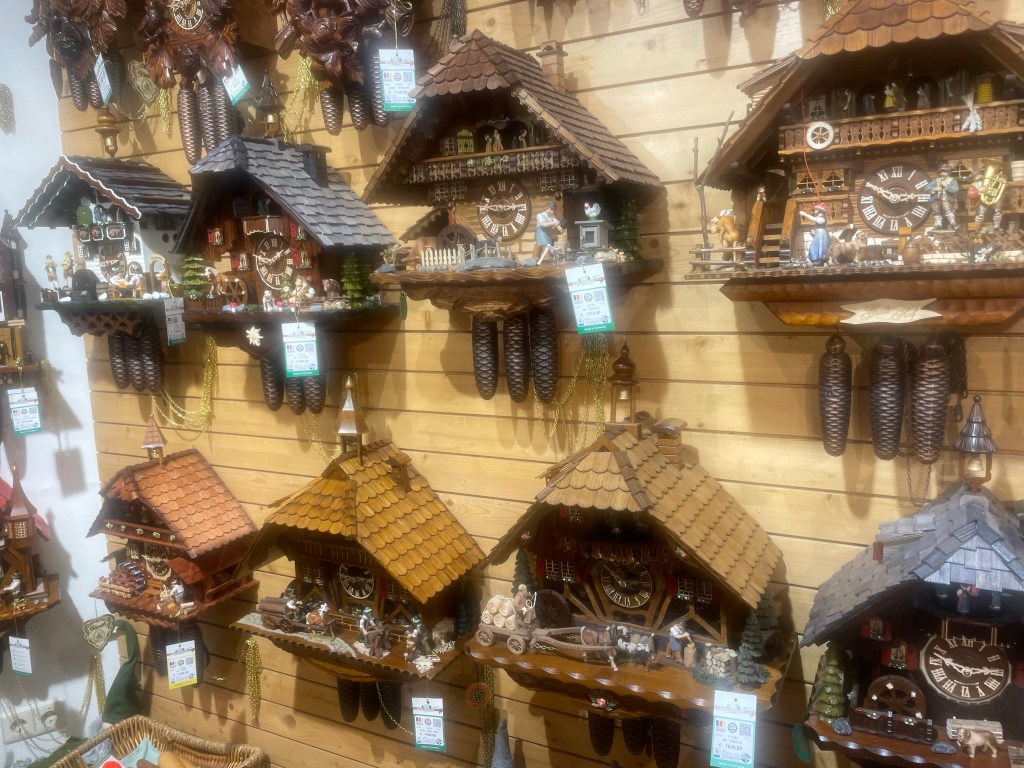
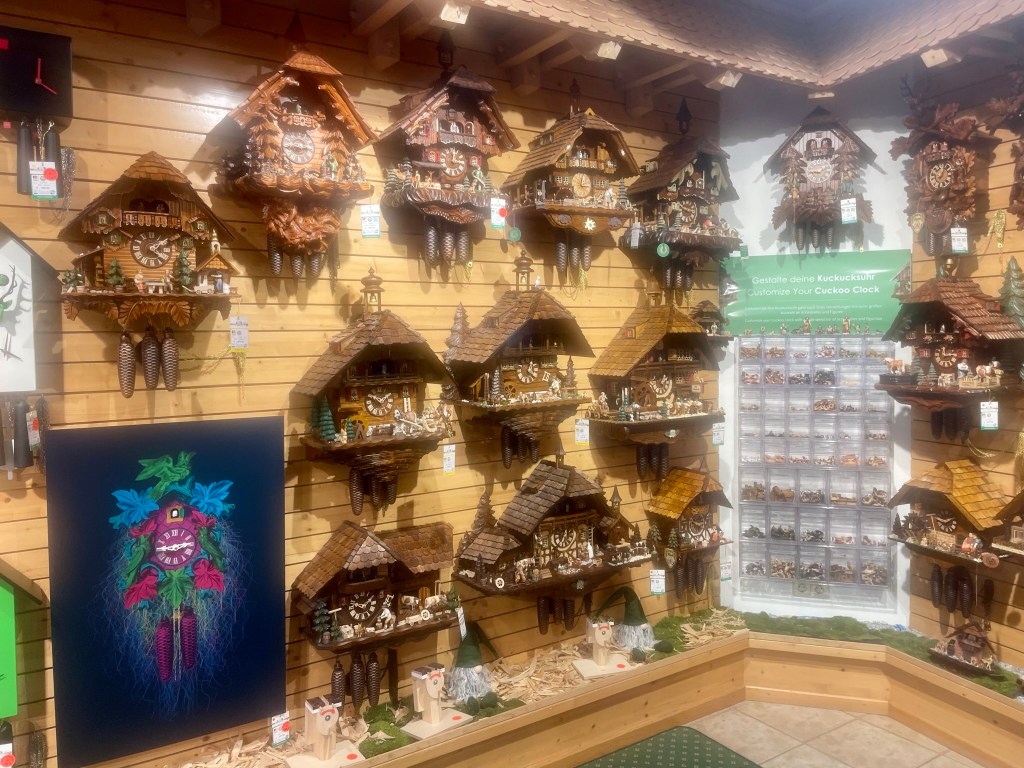
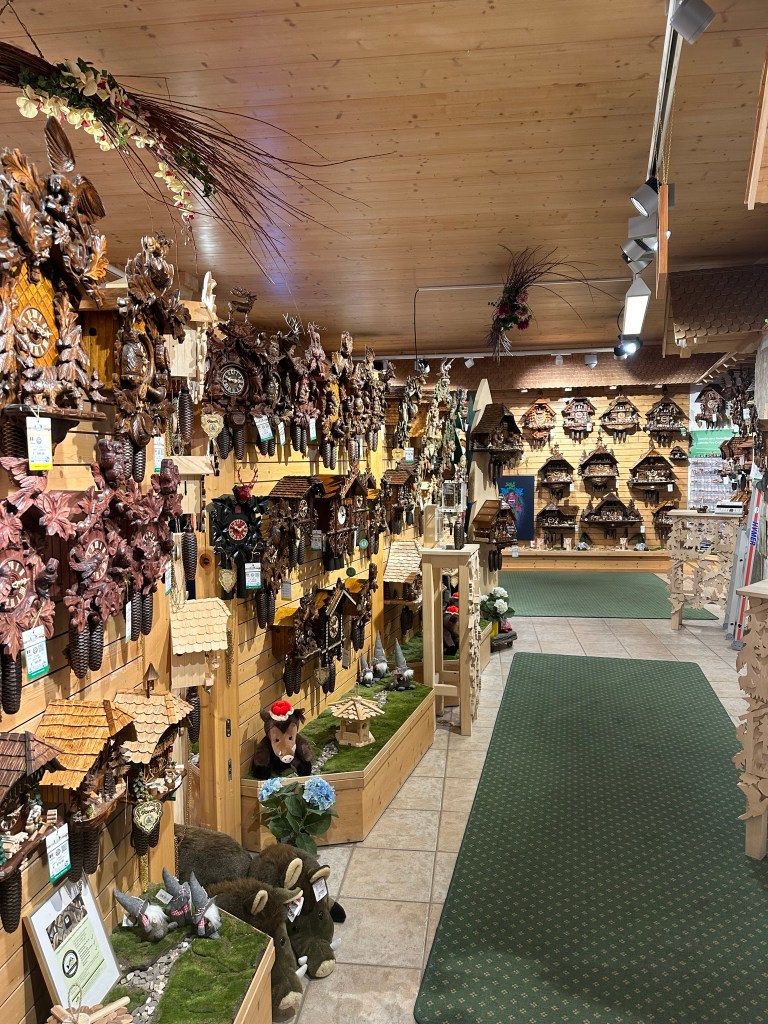
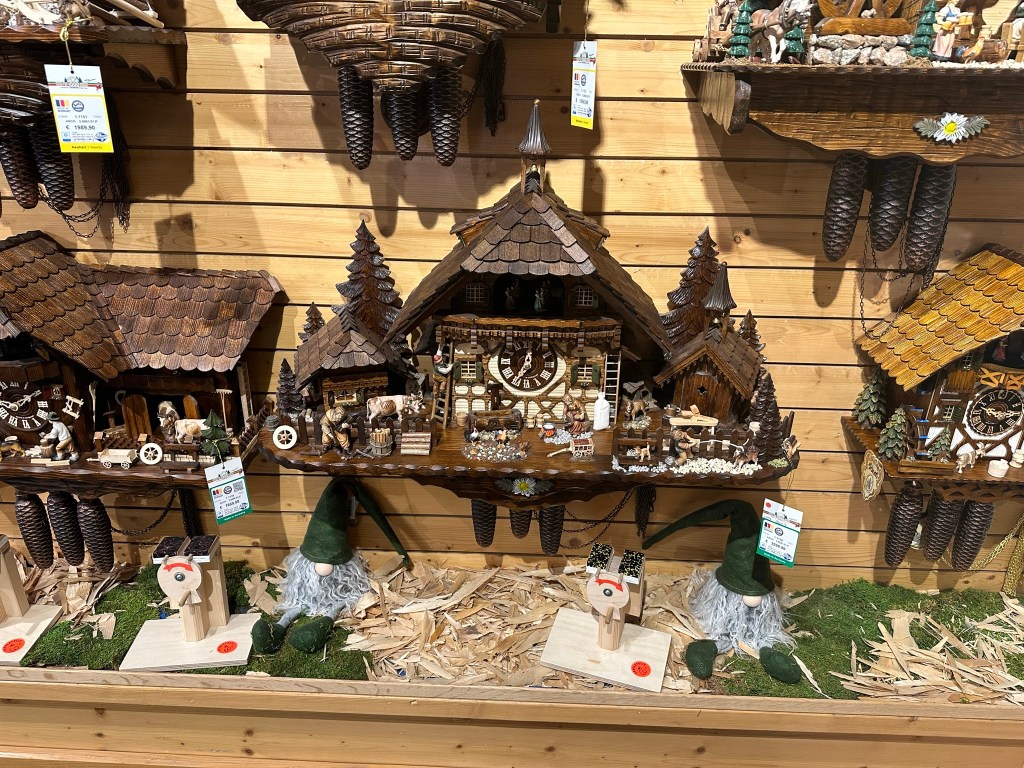
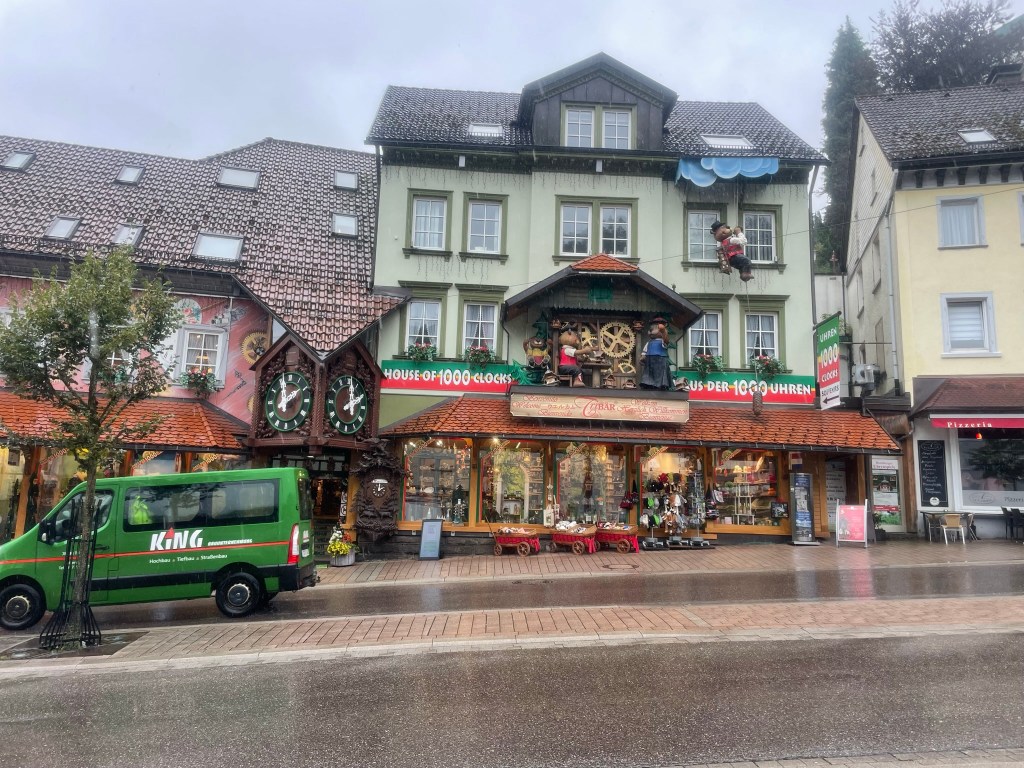
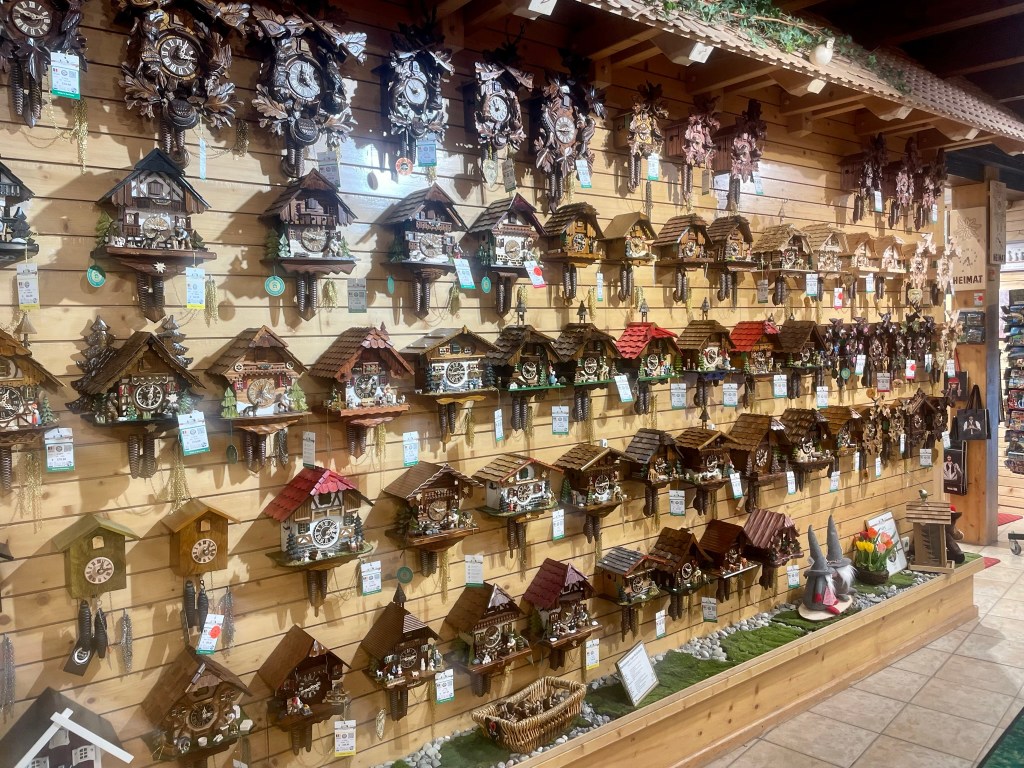
After a brief look down the high street, we crossed a main road and took respite from the rain in the House of 1000 Clocks, a charming shop with a huge wooden cuckoo clock built into the front. Its name is self-explanatory and it was unlike any shop I’ve ever seen: its cladded walls were covered in hundreds of intricate wooden cuckoo clocks, all unique and all incredibly detailed. They featured tiled rooves with chimneys and bell towers, balconies, shuttered windows, carved trees, animals and scenes of farmers, lumberjacks, craftspeople and beer-drinkers, all in traditional German dresses and lederhosen, complete with carts, mill wheels, log stacks and endless other little intricacies.

The shop also sold beautifully carved clocks featuring leaves, stags, hares and birds, and glass and metal clocks showing their mechanical workings, but I was most taken with the little cabins. They ranged from about 150€ to 3,000€ and I sorely wanted one of the cheaper, simpler ones, but we couldn’t have transported it home. We bought a cuckoo clock fridge magnet from the souvenir section in lieu of the real thing, and a little bottle of kirschwasser – a colourless local brandy – to try, then headed back out into the rain in time to see the cuckoo emerge from the huge shopfront clock at 2pm.
Waterfalls and Nature Trail

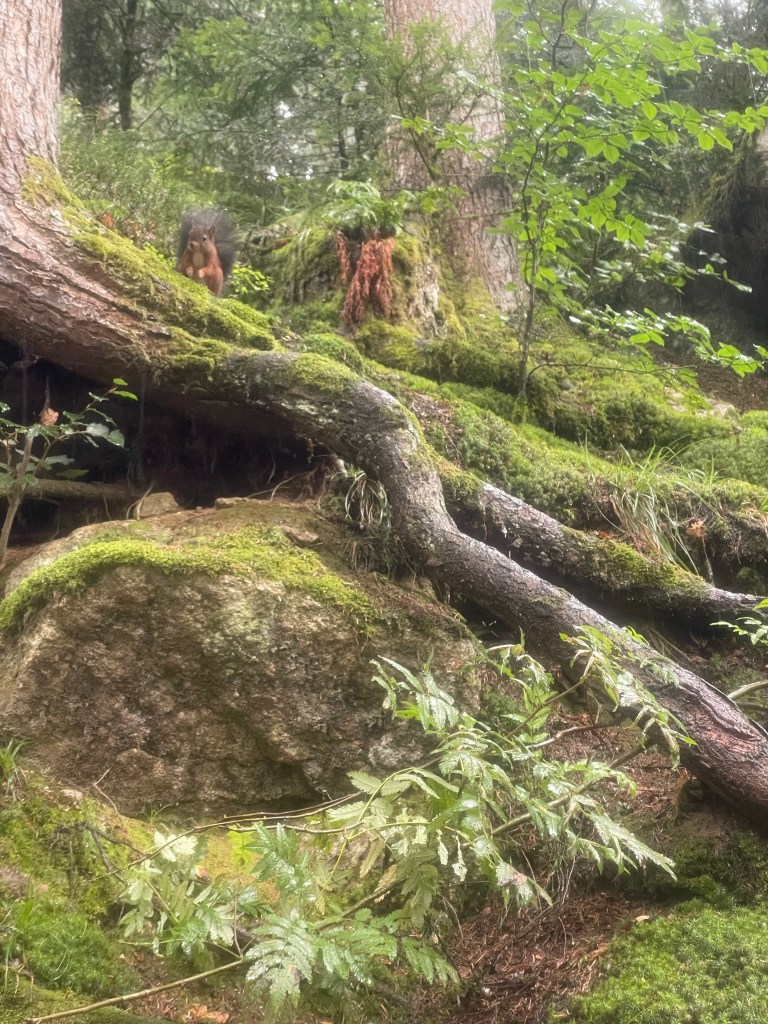
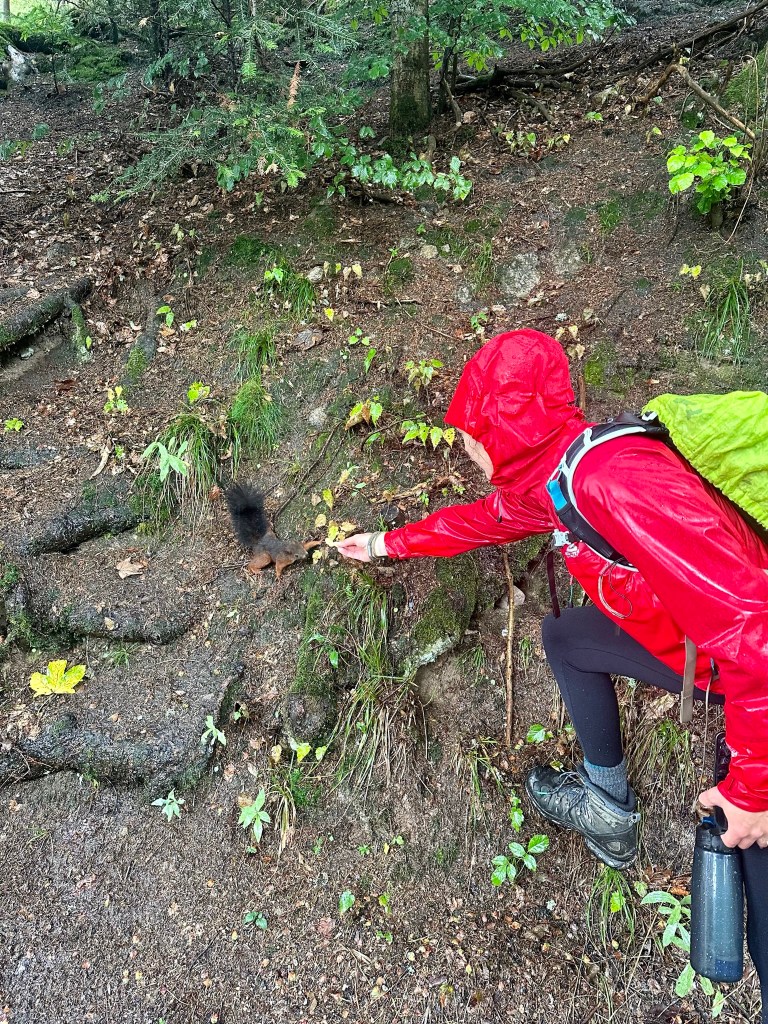
Triberg Falls comes up in a Google search as one of the Black Forest’s top attractions. We walked a short distance uphill from the clock shop, paid 15€ at the kiosk and picked the “nature trail” walking route. A red squirrel appeared just off the path and I ran back to the kiosk for peanuts, which Ryan had failed to mention when I was busy butchering the German language in my attempt to buy tickets. I was thrilled when the dainty little squirrel tentatively took a nut from just a couple of feet away: I’m very fond of red squirrels and always keep a close eye out for just a glimpse of one in Scotland, usually to no avail.

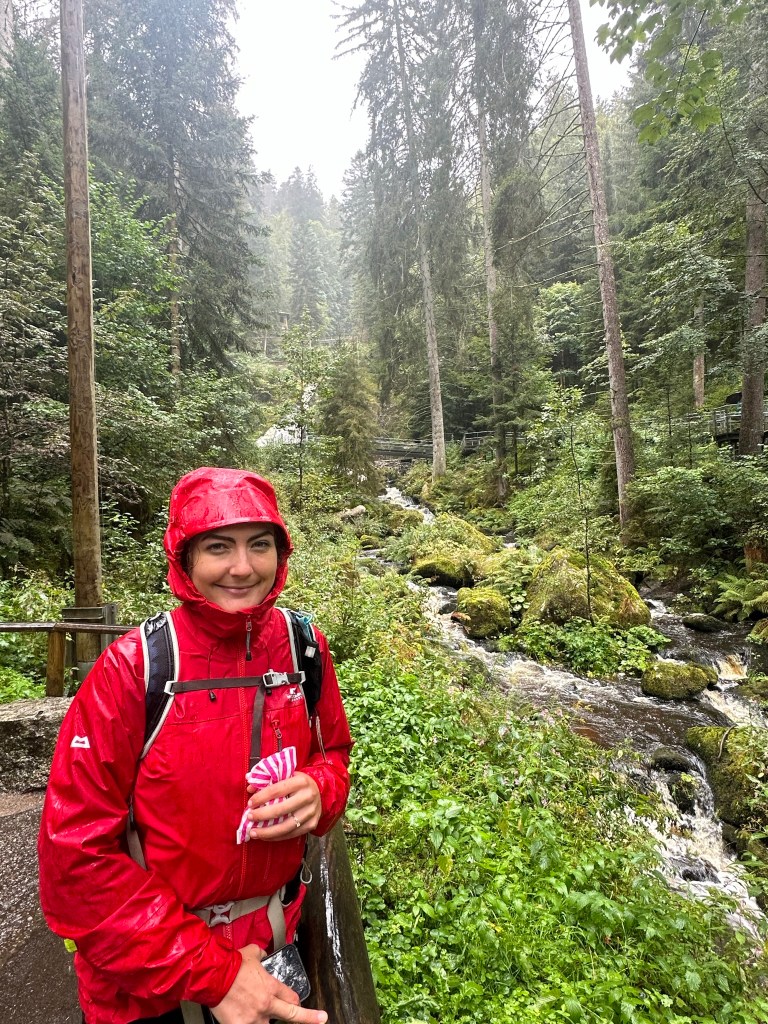
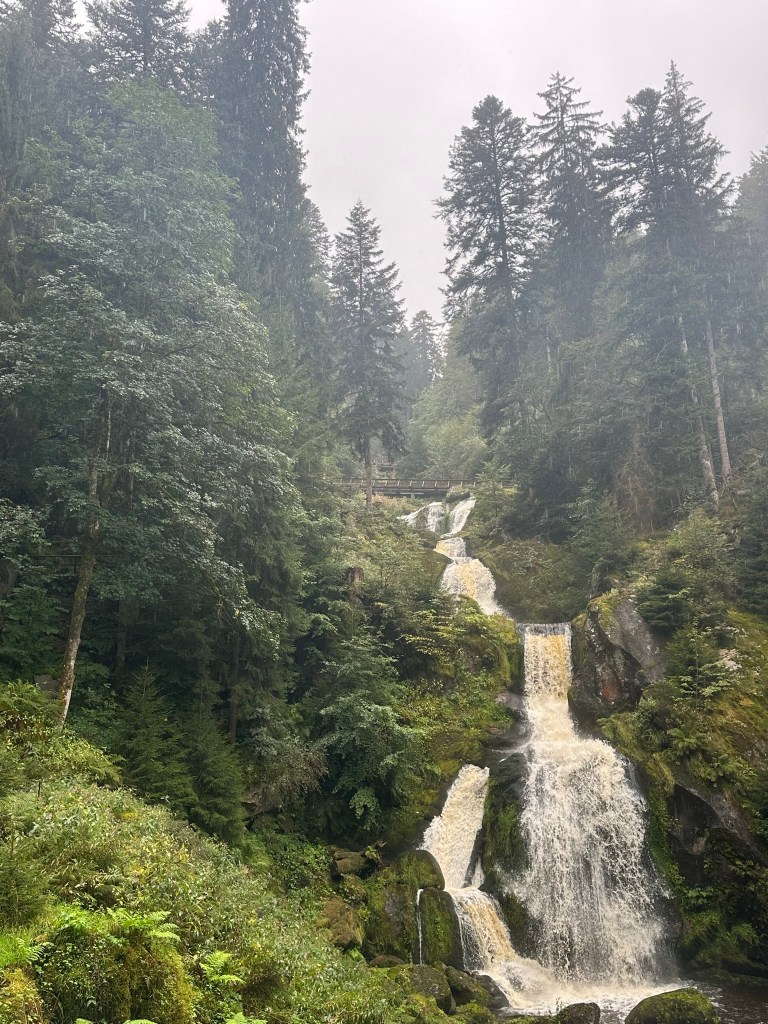
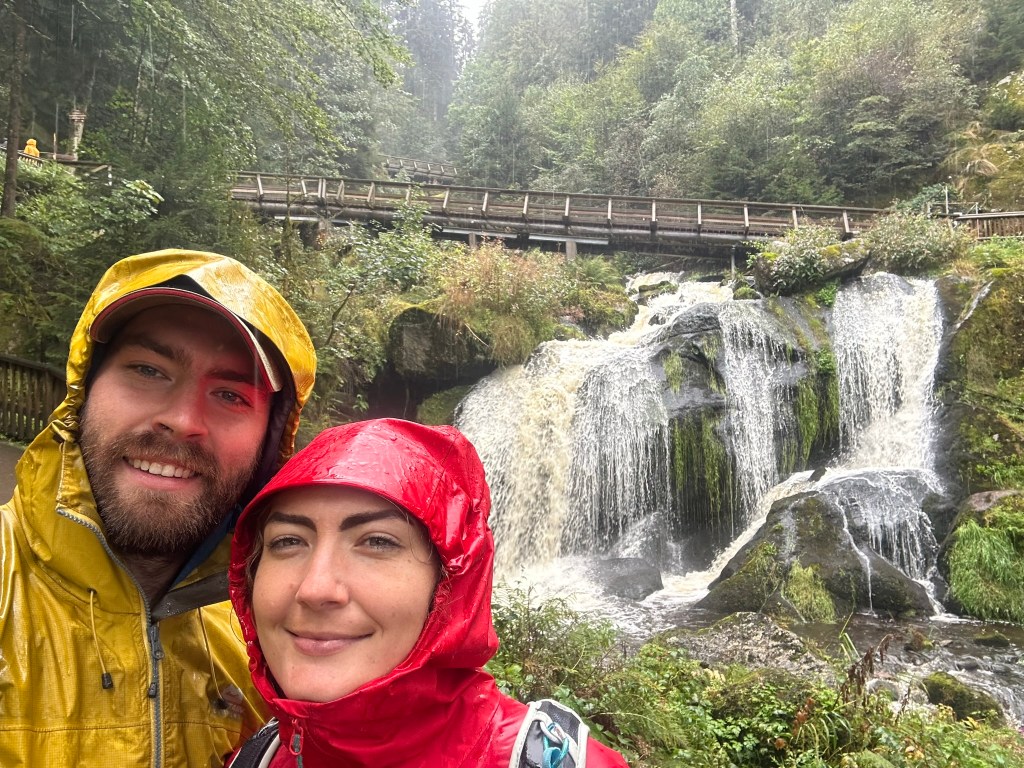
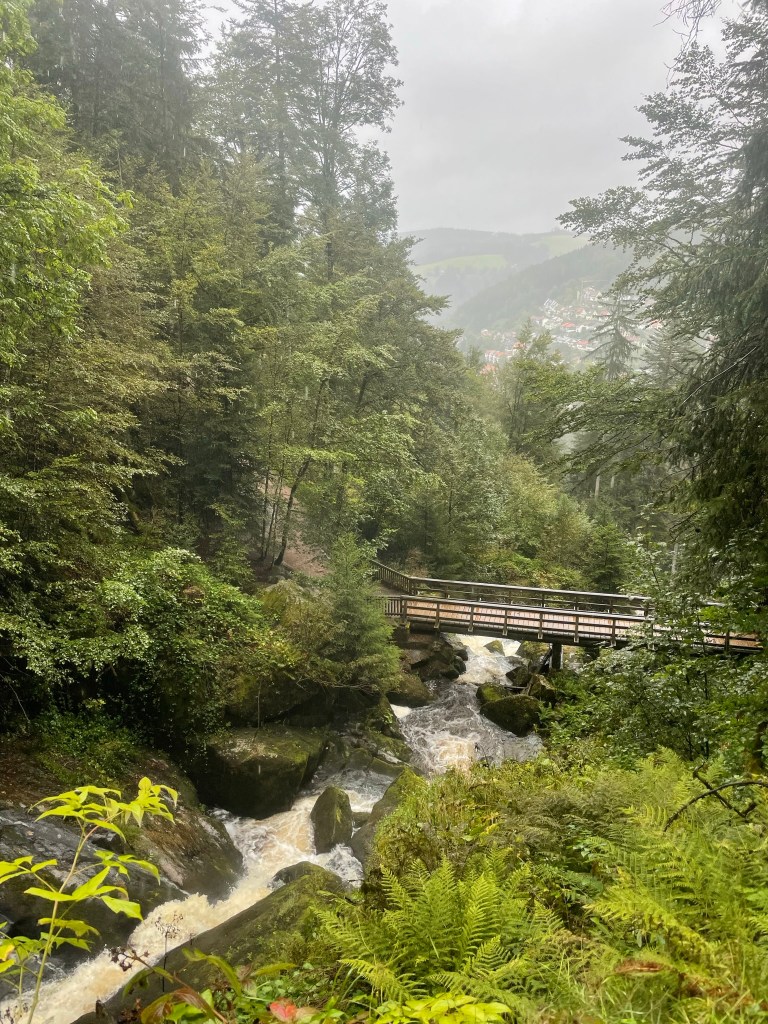
The tarmac path followed the rushing Gutach River upstream through lush forest. Tall pines formed a high canopy above layers of dark firs and leafy birches, and an array of bright green plants carpeted the ground leading steeply down to the water. Moss-covered boulders protruded from the river’s surface, allowing more greenery to take hold in their multitudinous crevices, and as we climbed higher the river took an increasingly tumultuous path down great rocky steps. After five wet minutes we reached the largest waterfall, a dramatic cascade that plunged down a huge, kinked “staircase”, and we took a moment at the viewing platform to gaze up and down the deep cleft carved by the furious water. In the downpour, it felt as though we were in a rainforest.

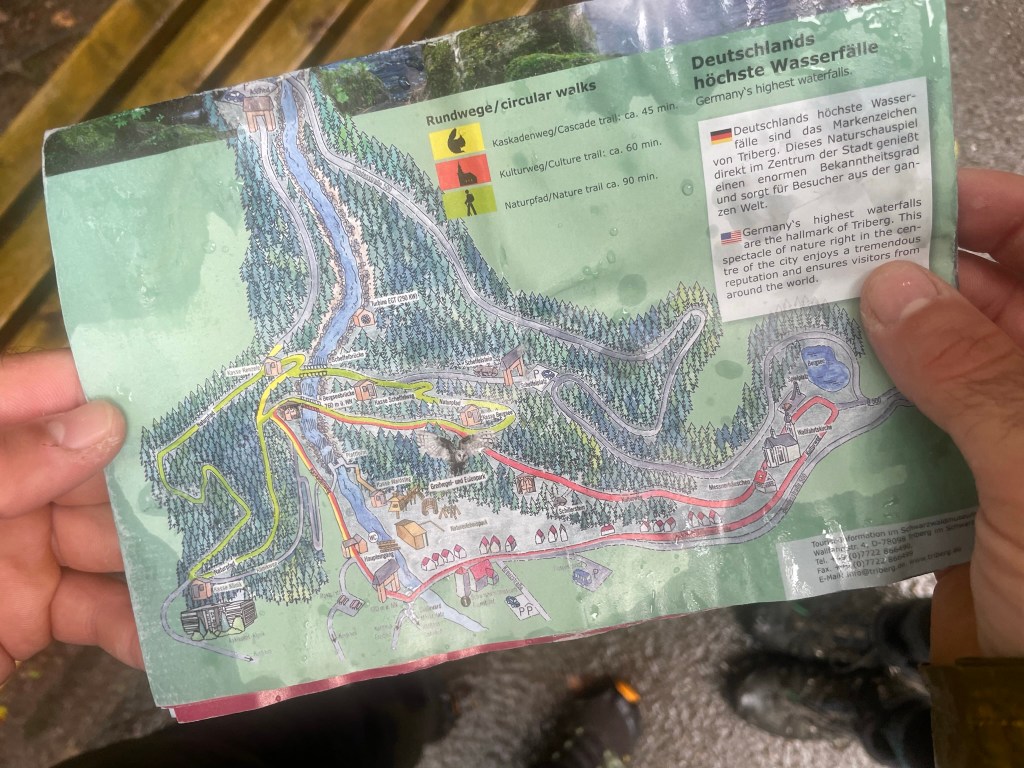
We crossed the river further up and followed the nature trail deep into the trees, away from the noisy banks. The way was clearly marked by a rough, rocky path, and – although the falls were beautiful – I was glad to be away from the manicured neatness of smooth tarmac and endless handrails, where the small handful of other tourists congregated in wet little groups. We snaked through the forest in a big loop, crossing back over the river further up and passing a couple of tiny huts where our tickets were checked – presumably to stop people sneaking in via the numerous hiking trails around the forest.

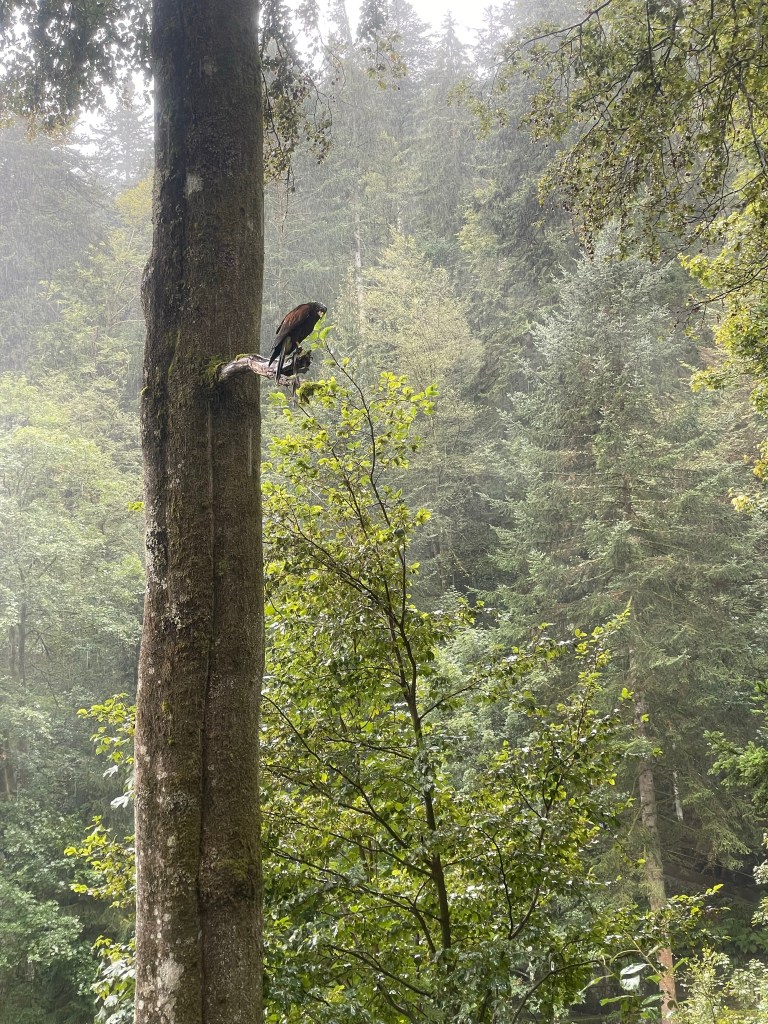
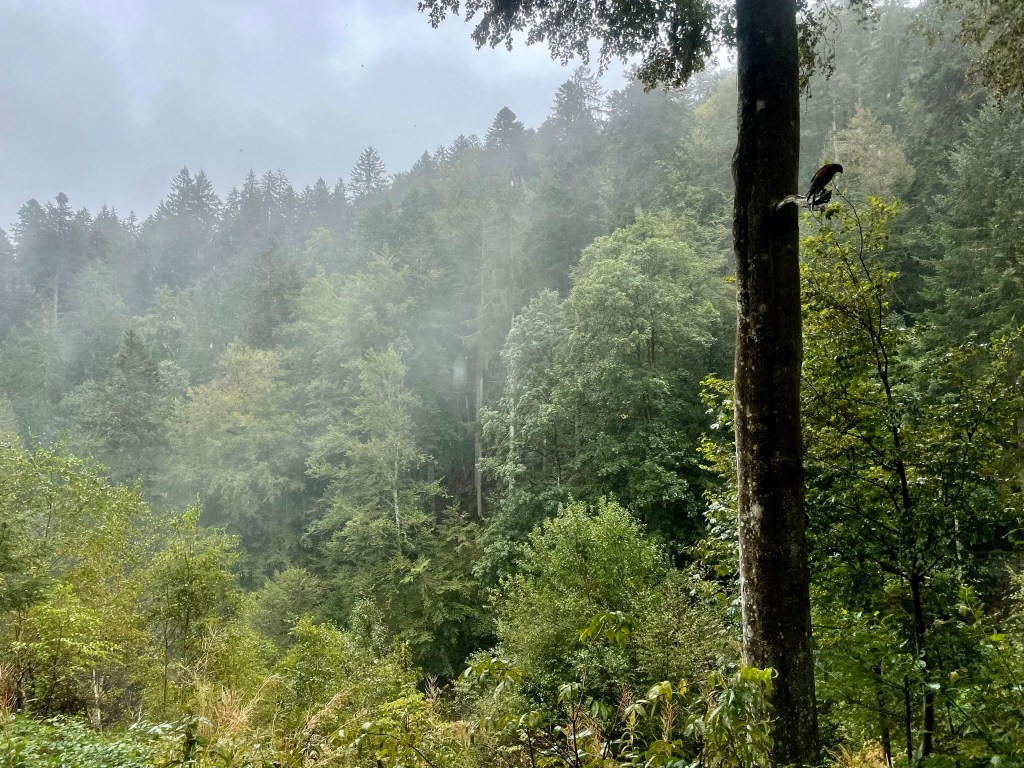
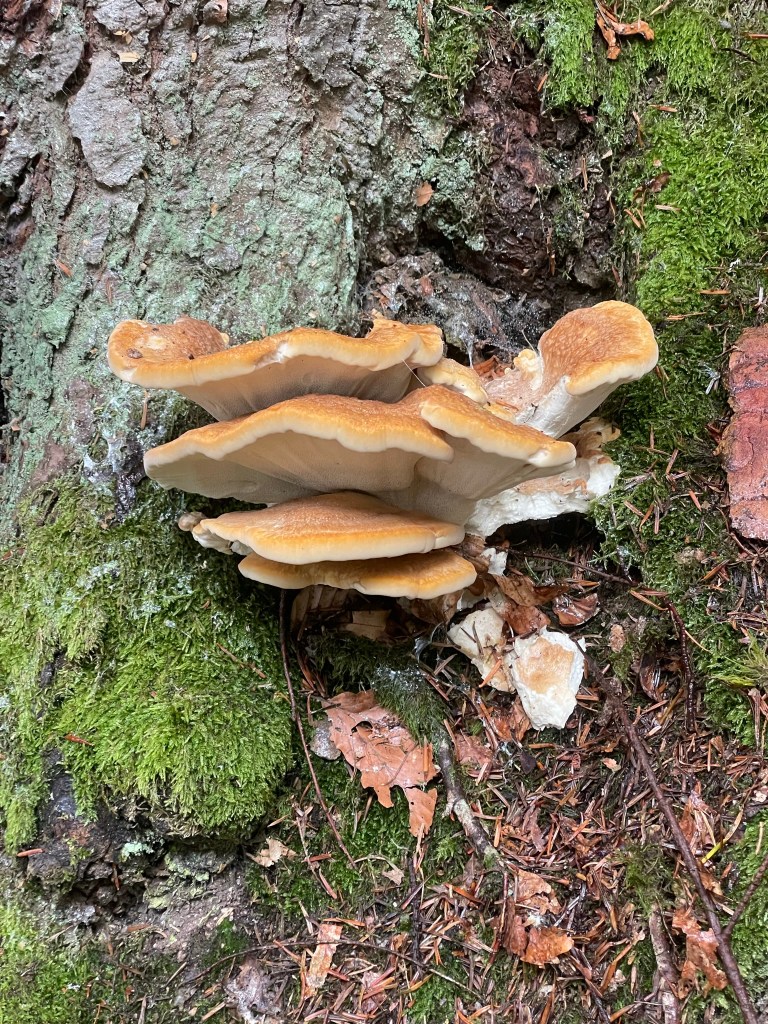
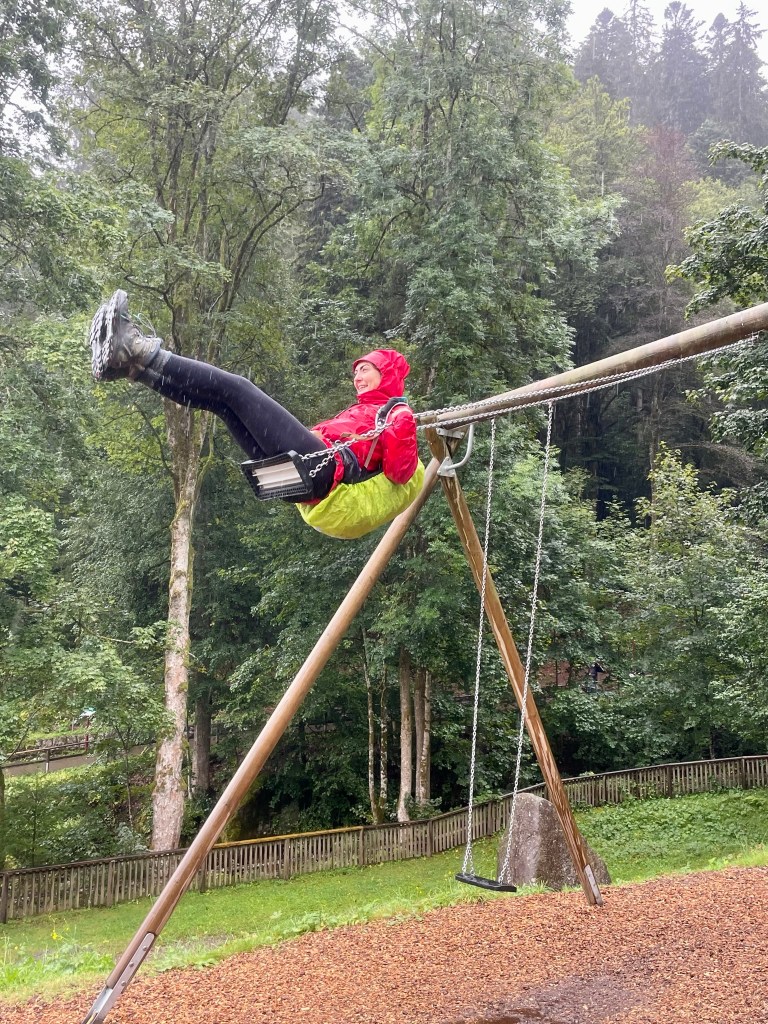
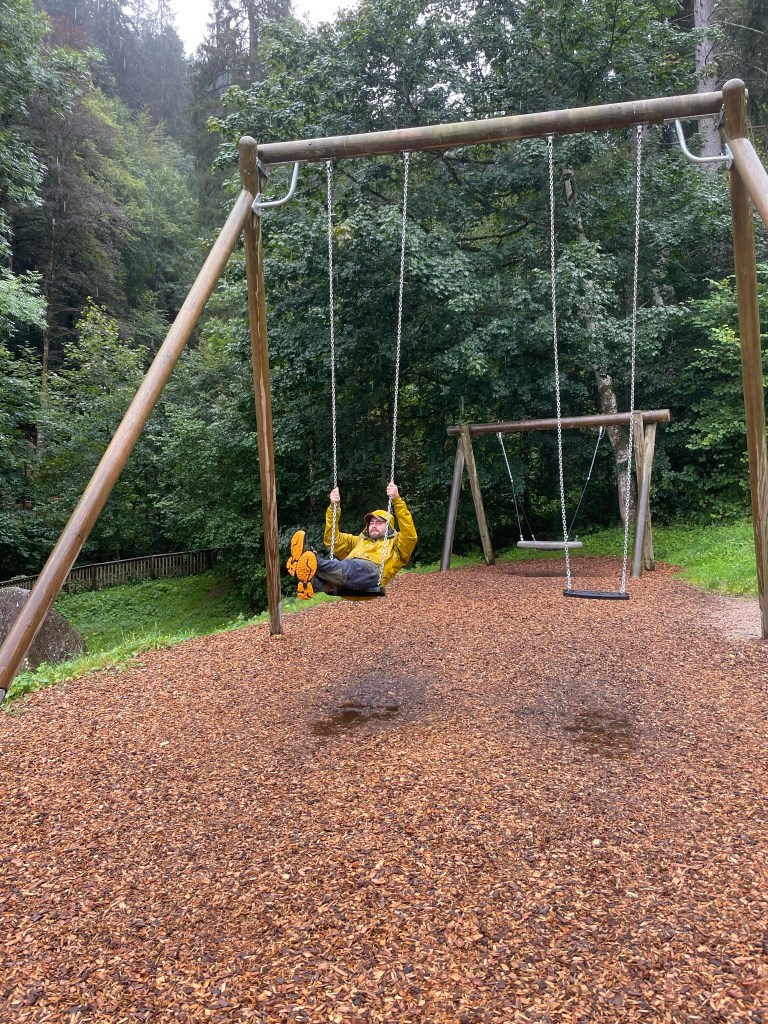
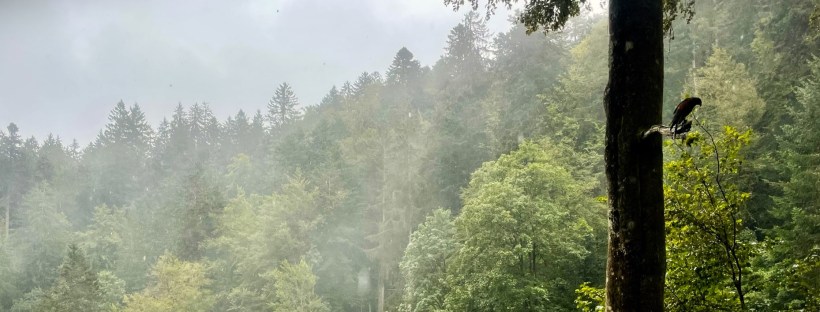
It was a lovely, circular route and we were thankful for the rain as we had the tranquil forest all to ourselves. We saw an escaped hawk with its jess still attached sat on a branch, fixated menacingly on something in the undergrowth, lots of red squirrels, jays, chaffinches, blackbirds, robins, mushrooms and – needless to say – an awful lot of trees. It took about an hour to get round, including dawdling and squirrel-feeding, and we topped it off with a few minutes playing on the giant swings overlooking the town, which we found just outside the exit. We were dripping wet and completely carefree.

Black Forest Museum

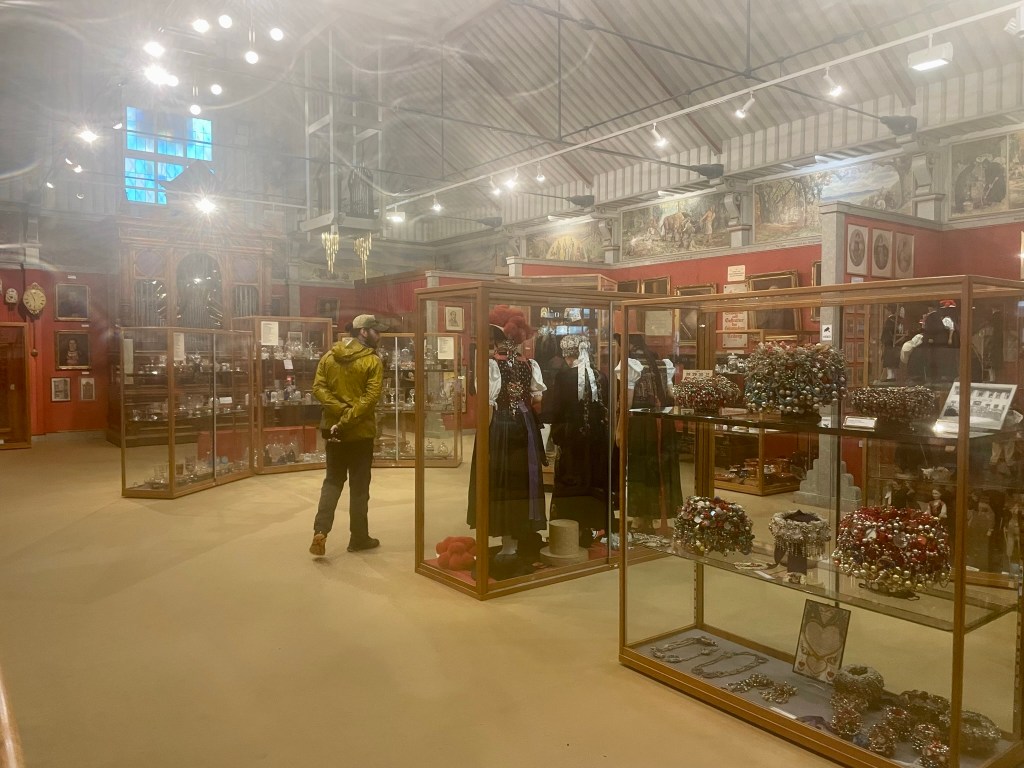
Once we’d exploited the swings, we crossed the road and dripped our way into the Black Forest Museum. We entered for free with our waterfall tickets and wandered through to a large, tin-rooved hall scattered with glass cabinets displaying traditional clothing from the region, an assortment of bizarre, heavily bejewelled headpieces, miscellaneous trinkets and generic old paintings. All the information signs were in German, which in a way was a relief (especially for Ryan) as I didn’t feel obliged to read anything.

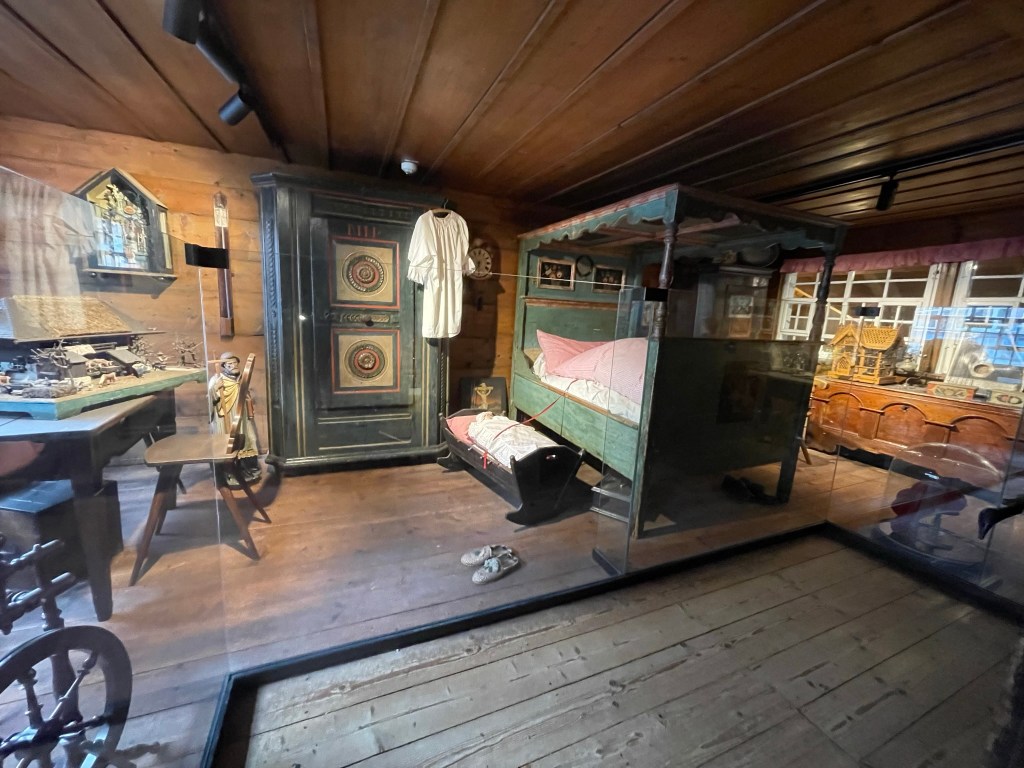
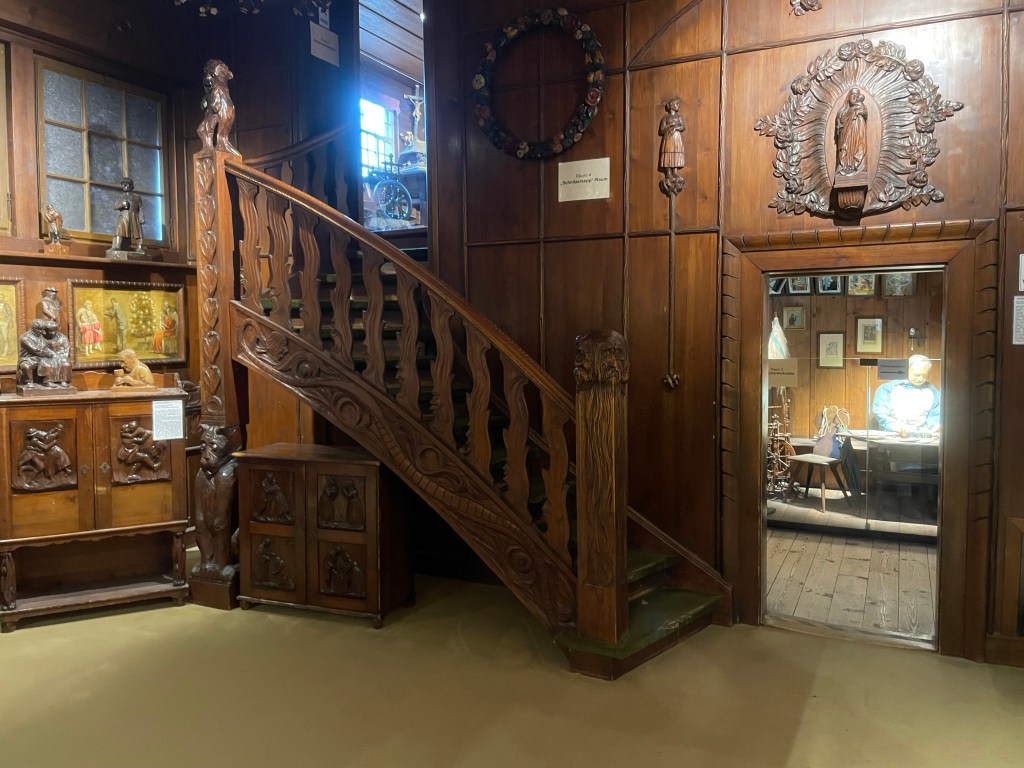
Although innocuous-looking from the outside, the museum turned out to be a small labyrinth. We went through a doorway into a wide, wood-panelled hallway, which led to a couple of little rooms decorated in a traditional style. There was a charming, low-ceilinged child’s bedroom, tucked away up some beautifully carved stairs, and a workshop containing a vast array of hand tools and woodwork projects.
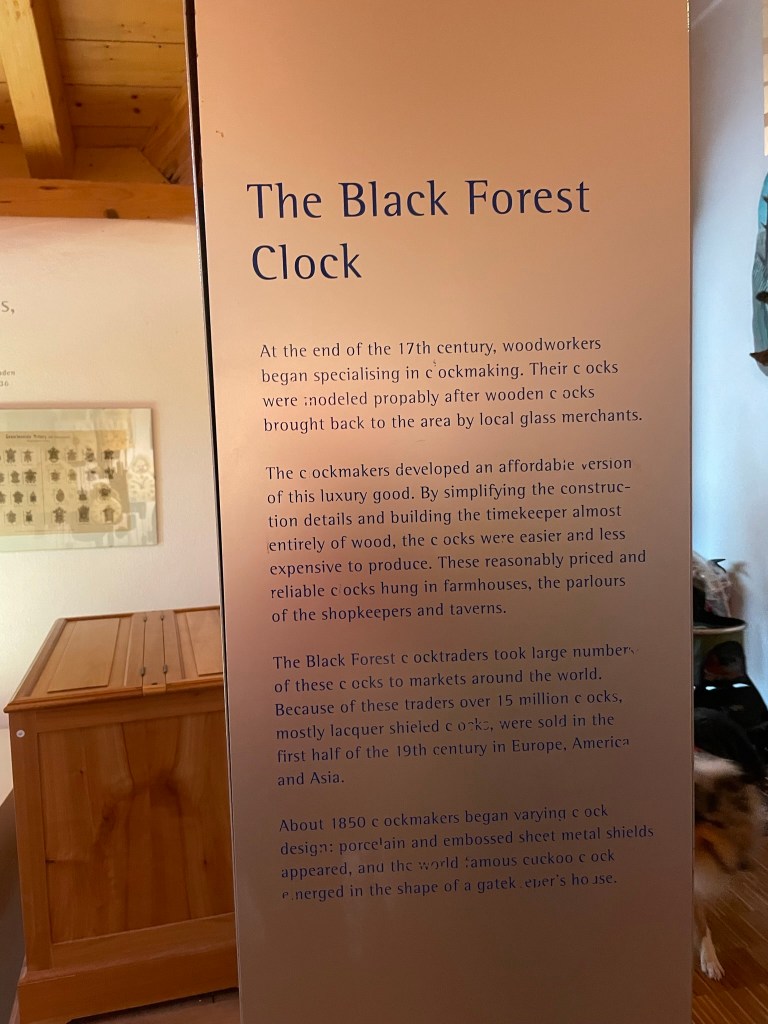
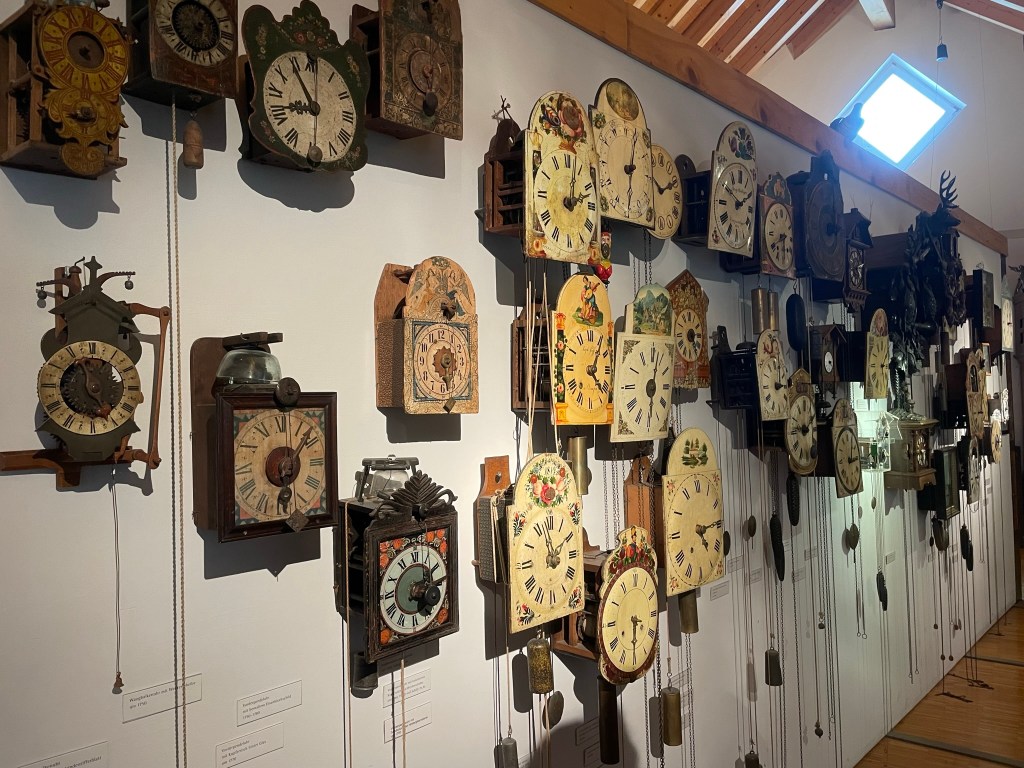
An arrow pointed us to the next section, which contained an awful lot of clocks and an information board in English – the only one we found in the whole museum, and for good reason:
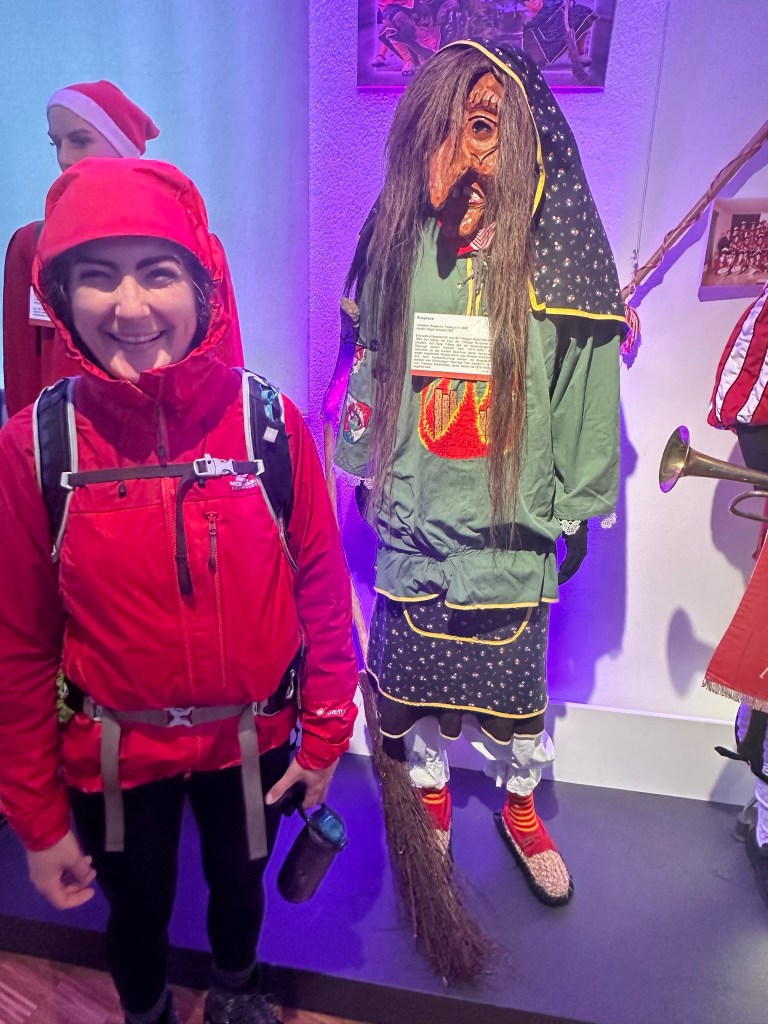
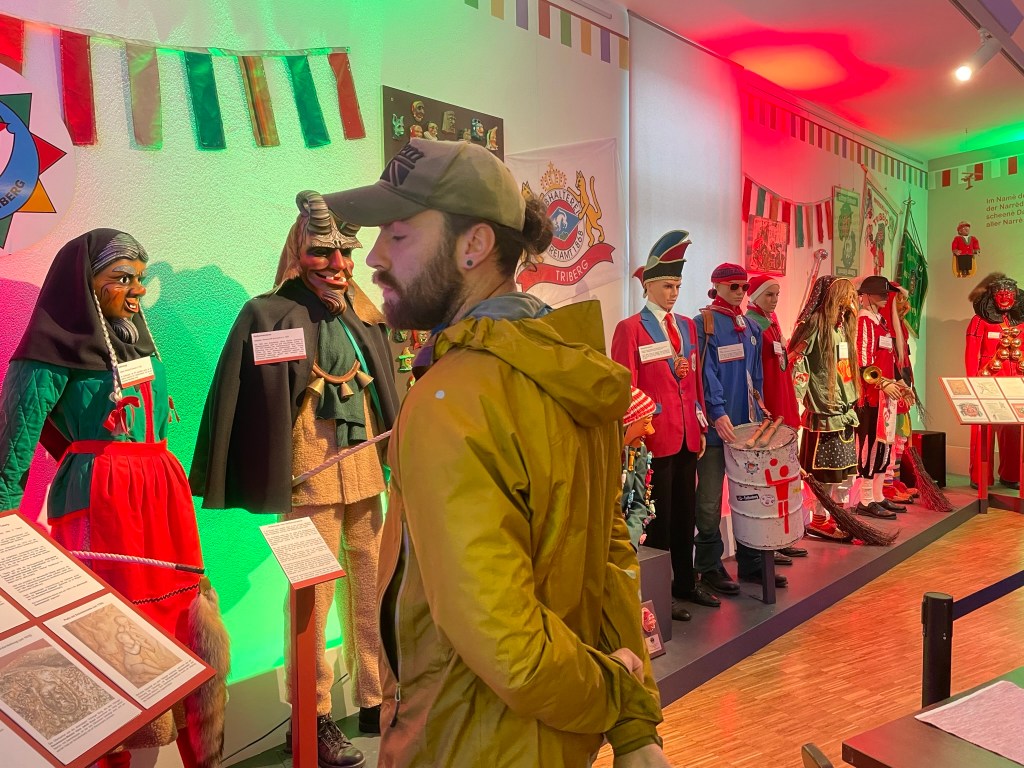
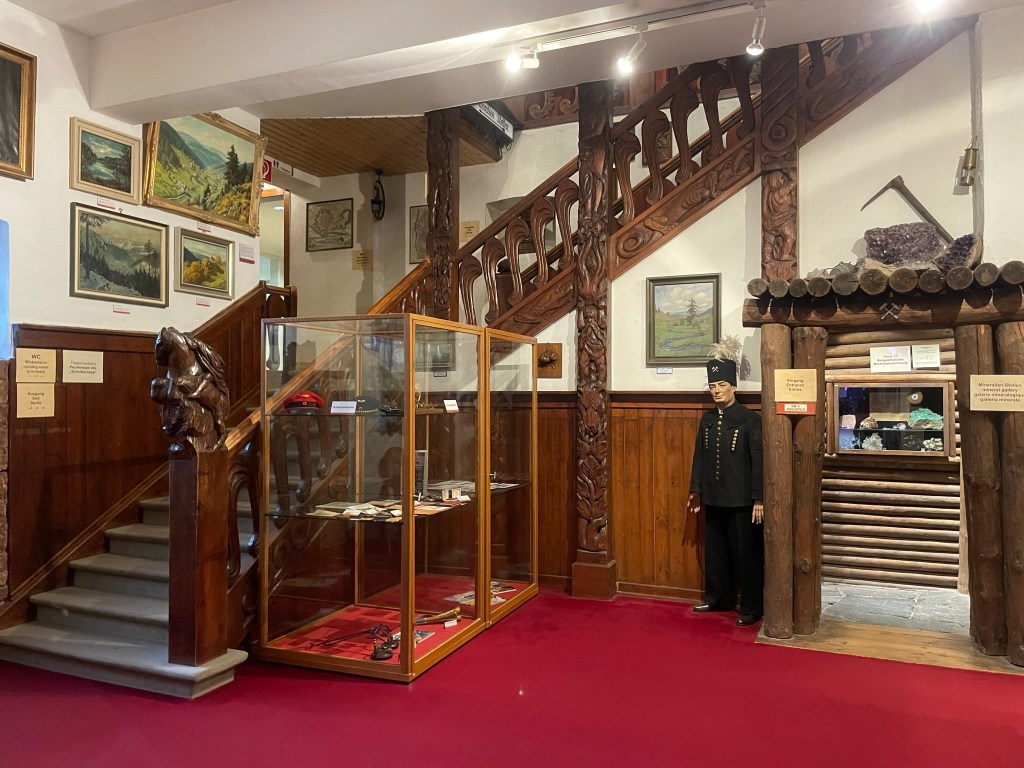
We emerged in the museum café, which was lined with several mannequins dressed up in traditional costumes ranging from  fancy suits with obscure hats to witch and devil-masked festival outfits, made even more fascinating by the absence of an English explanation. This led to another hall containing a huge model of the area and a tight corridor dressed as a mine shaft, featuring an incredible variety of glittering rocks displayed in the walls. We emerged from the passage and climbed an elaborately carved staircase back into the tin-rooved hall, impressed by the diverse content and curious layout of the museum; although we couldn’t read anything, the rich visual exhibits gave us good feel for the cultural, woodcraft, agricultural and mining history of the area.
Black Forest cake

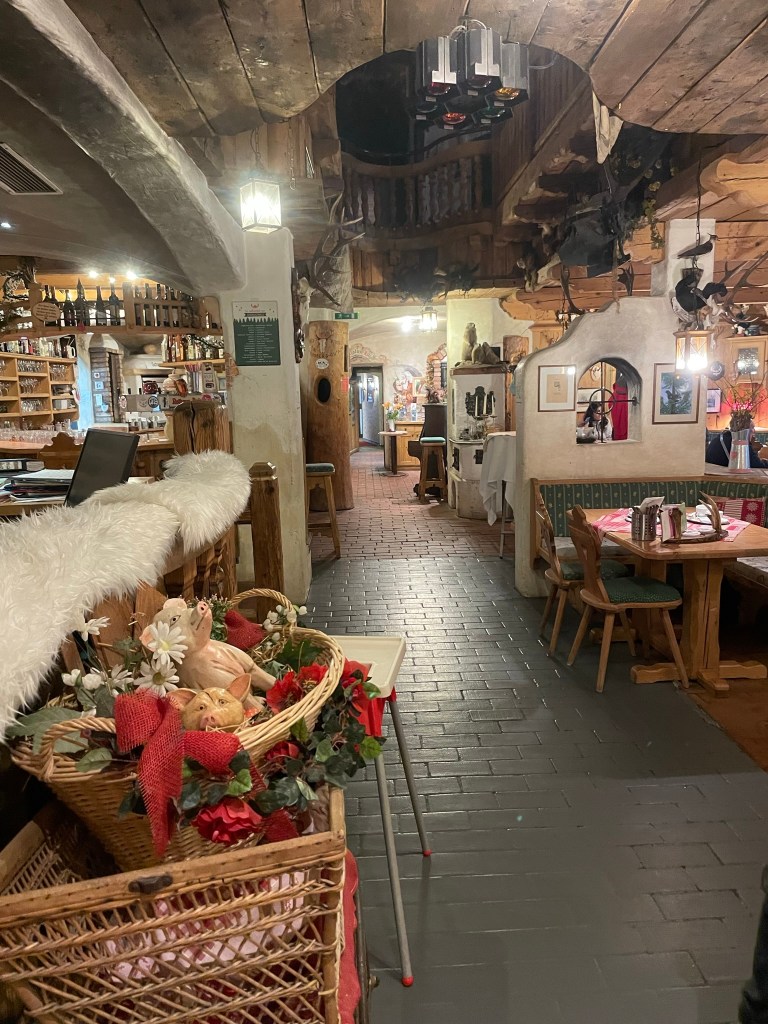
I was desperate to try some authentic Black Forest cake, so we left the museum and walked a short, wet distance to the guesthouse-café we’d spotted on our way out from the waterfalls. We climbed some stone steps, entered through a small doorway, communicated to a waiter that we’d like some coffee and were pointed through to the rear of the building. We were instantly charmed: a stone-flagged floor led us past a long, wooden bar and an open-plan dining area separated roughly into sections by rustic, whitewashed walls, adorned with forest paintings, assorted taxidermy and mounted antlers. An upper mezzanine gave a feeling of spaciousness, which was balanced by the timeless cosiness that emanated from the wooden furniture, cladded, lantern-hung ceiling and eclectic mix of rustic décor.

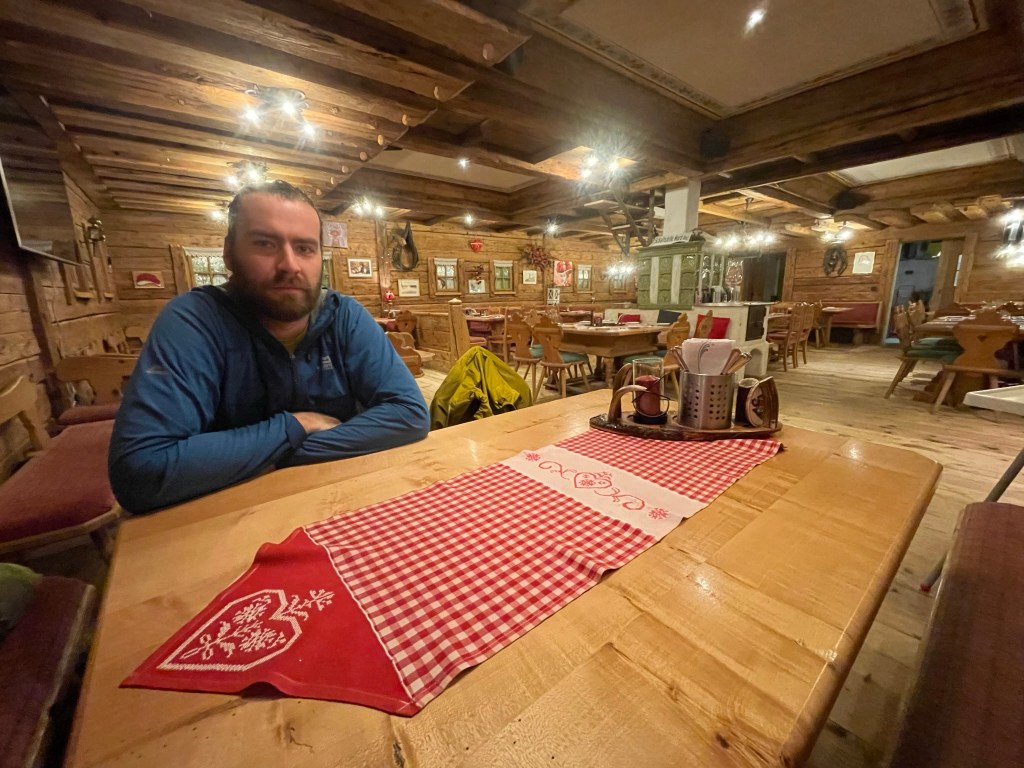
We sat in a corner of a large room at the back of the building, which was wood-cladded from floor to ceiling like a forest lodge from a fairytale. It was lined by small, square faux windows and miscellaneous art, and our table was decorated with a red-check runner and white doilies. Ryan had German beer while I had coffee and – at last – Black Forest cake. It was unlike any I’d had in England: incredibly light and fluffy, mildly chocolatey, and layered with light, sweet cream and sweet, sour, kirsch-infused cherry filling. I’m not a huge cakey person, and Black Forest cake has never been a favourite, but this experience has converted me.
Evening

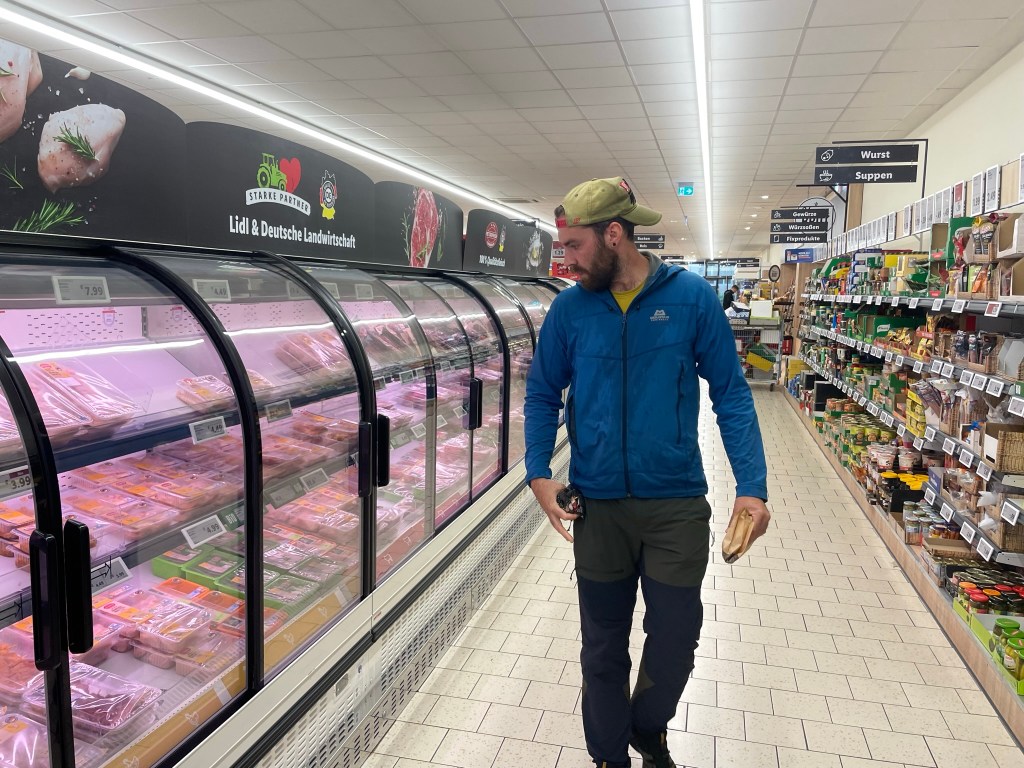
At 5pm we left the café with no little reluctance and returned to the car. On our way out of Triberg I realised anxiously that I’d forgotten to pick up my much-loved, much-used filter water bottle, so I pulled over so Ryan could run in and grab it – thankfully it was still there. We stopped at Furtwangen Lidl on the way back to Simonswald, marvelled once again at the vast selection of meat and cheese and the cheap alcohol (I picked up a local bottle of wine for 3€ and Ryan grabbed a few 44c beers), and rather enjoyed the atmospheric drive through relentless rain and dark, misty valleys.
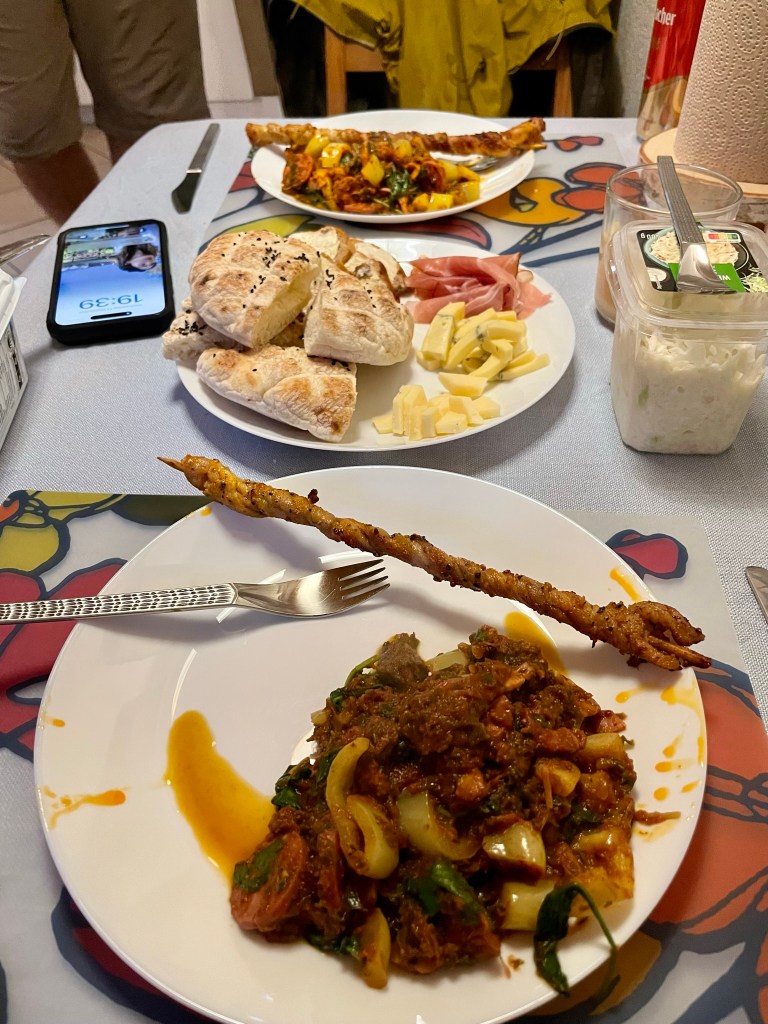
Back in our cosy apartment, I cobbled together a dinner with the ingredients we’d picked up from Waldkirch market and some random bits from Lidl. We had chanterelle mushroom and tomato stew with chunks of frozen sausage, paprika peppers and spinach, accompanied by the meat skewer (which turned out to be pork), bread, Black Forest ham, cheese and sauerkraut. It was delicious, if a little haphazard, and we washed it down with shots of kirshwasser – which turned out to be unequivocally vile.
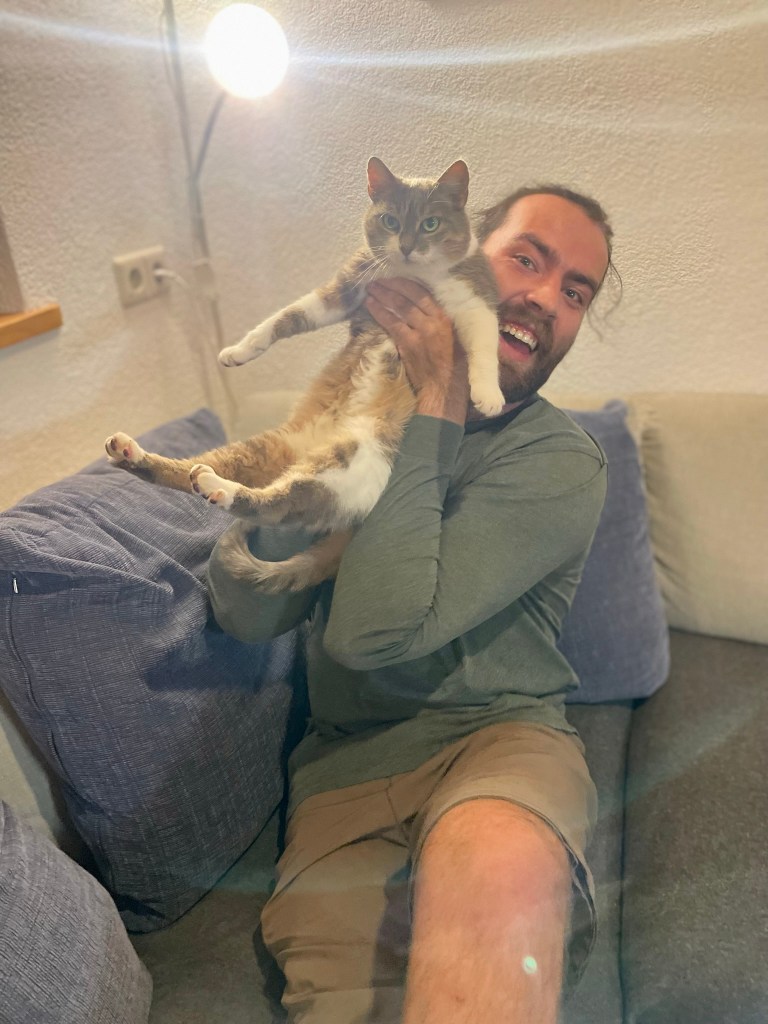
We spent the rest of the evening planning a hike up Feldberg, the Black Forest’s highest mountain, with the “help” of Kraut, and reflecting on our time in Germany so far. It had been another lovely day full of local culture, nature and history despite, or perhaps because of, the rain, as – in the absence of crowds, which I’d read often swarmed on Triberg – we barely felt like tourists.
Croatia 2023: Plitvice Lakes National Park

Disclaimer: Strap in – this was a difficult, lengthy post to write as I wanted to do justice to the intricacy and other-worldly beauty of Plitvice. Please excuse my rambling descriptions, inclusion of utterly unpronounceable names and repetitive variations of “blue”, “green” and “clear”…

Wednesday 5 July

After researching Plitvice Lakes, we’d initially decided that 40€ each was too much to pay to visit a National Park. However, I’d seen some photos and the seed had been planted, which meant (as it always does) that I’d inevitably reverse that decision. I decided to treat us to the trip on the conditions that Ryan a) get up early, and b) drive us there without damaging the rental car.

The journey

We were on our way by 6am. The 1h40 journey was traffic-free, which was just what Ryan needed to get used to driving on the “wrong” side of the road. We joined the tunnel-ridden E71 motorway shortly after leaving still, peaceful Starigrad, nestled between the Paklenica mountains and an inlet of the Adriatic sea, and entered Lika-Senj County to the north, which was – to our mild surprise – shrouded in early morning fog.

We arrived at Plitvice at 7:30am, parked very carefully at Entrance 1 and made our way to the chalet-style ticket office. There was already a long-ish queue and I was concerned that having made the journey without booking, we’d come across some issue that would prevent our visit. My foreboding was not unwarranted as the card machine didn’t like my bank card, but luckily a different card worked and we received tickets after an anxious few minutes.

We passed through the entrance and went straight to the information boards showing seven waymarked hiking routes, which I’d already researched online. We naturally picked the longest, an 18km trail that circumnavigates nearly all the lakes and cuts out the land trains and electric boats (bar one) that shortcut around the park. Having photographed the board, we wandered over to the start of the trail and were instantly blown away by the landscape.

Lower Lakes:  Veliki Slap waterfall to Milanovac

If we’d have been in a cartoon, our jaws would have hit the floor. A vast limestone valley opened up below us, pale rock walls rising from large pools that were bluer than blue and so clear that we could see the bottom from our high vantage point. These pools were set at different levels, and fell into each other via multitudinous cascades that tumbled as vertical columns of pure white water so bright that they seemed to emit light. A forest of the lushest, most brilliant green covered every inch of land that wasn’t rock or water, almost glowing, and across the valley the highest waterfall, Veliki Slap, dropped out of the trees at eye-level and disappeared behind a vegetation-covered, natural limestone dam, which held the torrent back from a series of small, tiered, turquoise pools set low in the basin. A distant mountain ridge stretched hazily across the horizon, just visible above the forested valley side, beneath clouds of white and lilac-grey interspersed by occasional blue patches. It was as if the sky, in deference, reflected the land.

We followed the handrailed, switchback walkway down the side of the valley, feeling as though we were dropping into a real life Avatar set. It was already getting busy so we were keen to see Veliki Slap, “Big Waterfall”, before the crowds descended. The lakes grew in size and clarity as we approached from above and looked impossibly, almost unnaturally blue. We reached a rustic (but solid) boardwalk across the water between Novakovića brod lake, which was level with us, and the Korana river, which was set low in the valley and fed by an abundance of falls bursting improbably from invisible sources concealed by leafy vegetation. We wandered along this boardwalk marvelling at everything: the lakes, the falls and the incredible variety of water grasses and leafy plants on either side of us. It was impossibly beautiful.

The boardwalk snaked around a sheer limestone face to Veliki Slap, a 78-metre high column of water surrounded by tens of narrower, only slightly shorter falls. It was utterly magnificent: I wondered how there was enough water on Earth to feed this powerful, constant giant, which erupted from the clifftop treeline high above. Once we’d gazed in sufficient awe we snapped a couple of photos and returned to the boardwalk, aiming to break away from the growing number of tourists collecting at the base of the unimaginatively but accurately named Big Waterfall.

We followed the boardwalk along the western side of Kaluđerovac lake, still awestruck by the water, and crossed a low limestone barrier between tiered pools to a path along the eastern side. The shallows were gin clear, melting to translucent turquoise and almost opaque blue-green in the middle as the lakes deepened. Fish basked nonchalantly in the open water, and the perfectly flat surface reflected pale rock walls and green forest across the valley.

The path bordered Gavanovac and Milanovac lakes under a leafy canopy and we walked past several tantalising, dark caves set into pale limestone walls on either side of the valley. The number of visitors had dwindled, as we’d predicted, and after a kilometre we crossed another low dam via a boardwalk over shallows brimming with vegetation. Wide, multi-columned Slapovi Milke Trnine and Milanovači Slap waterfalls rushed out of these shallows below us, connecting great Kozjack lake to its smaller sister Milanovac about six metres below, and I was in awe at how the rock held these vast waters back from each other.

Upper Lakes: Kozjak to forest trail

We followed the edge of enormous, irregularly shaped Kozjak to a large visitor area containing dozens of picnic tables, wooden food kiosks, a gift shop, toilet block and the first boat station, where tens of people queued to cross the lake. Happy not to join this rush, we continued along the western edge for a couple of kilometres, snaking round the lake’s undulating border through the fringe of a rich beech forest. We drank in the quiet serenity of the flat water and almost overwhelming brightness of the blues and greens, feeling utterly content now that there was nobody else around, save for the occasional pair of other visitors looking to experience the place in solitude.

The path climbed a short way into the trees, affording stunning views over Kozjak, which – now that the sun had emerged – was a perfect mirror of the verdant forest on the opposite bank. I was amazed by the biodiversity of the woodland, where all kinds of low plants, shrubs and fungi covered the floor beneath a glowing canopy. We had a good view of thickly forested Štefanijin otok, the park’s sole small island, before finding another waterfall about eight metres in height and width tucked away – somehow subtly – in a leafy corner.

We climbed a set of stone steps up into the forest, then walked down a bank and found the ferry dock, where most visitors disembarked having caught the boat across Kozjak. We had a minor disagreement over which way to go – I was keen to continue on Route K but Ryan was concerned that we’d miss out on the waterfalls, so wanted to go with the throng along the low path by Burgeti lake. I conceded at first but after about a hundred metres became stressed by the influx of slow-walking people constantly stopping for photos, so – to Ryan’s initial chagrin, but eventual approval – we turned back, climbed the wooded bank above the busy path and continued on a quiet, sun-dappled trail beneath towering, impossibly green trees.

Upper Lakes: Forest trail to Okrugljak

After a short way we came to a clearing and looked down across the glassy blue water of lagoon-like Gradinsko lake to Veliki Prštavac, the second highest fall in the park, which formed a wide series of white pillars erupting from the forest above. To call it a fairytale scene wouldn’t do it justice. The path then continued for a few kilometres under a high beech canopy that covered a steep bank overlooking a multitude of smaller lakes, which formed a watery patchwork that filled the valley floor, separated by snaking, leafy rock barriers. I was looking out enthusiastically for grizzly bears, featured in the National Park’s logo, but (to my disappointment) was only successful in spotting some large bracket fungi and some pretty nine-spotted moths:

Any remaining sourness from our disagreement dissipated the minute we emerged at another clearing, where the path turned sharply left before descending to the popular trails. We gazed over the blue glass of lake Ciginovac, surrounded by rising green forests, and above it, the vast, hanging lake of Prošćansko – almost as big as Kozjak, and just as irregularly shaped – whose mirrored surface shone into the sky, the unimaginable weight of water impossibly suspended by a steadfast limestone dam. It was as if the rock stoically kept the lakes in check, permitting water to move between levels via numerous regulated falls, but had no control over the vegetation, which spread on all but its most vertical surfaces and encroached in the shallows as if showing off its leafy mastery of the landscape.* I pointed out to Ryan, blissfully aware of my capacity to irritate, that we’d never have seen Prošćansko on the popular trails. I think he forgave me.

*This later made sense, on learning about the formation of tufa barriers – no spoilers here, you’ll have to read on

We wandered down the hill through more forest, paused at a viewpoint over three of the little patchwork lakes to admire more falls bursting from various treelines, took a couple of switchback turns and emerged back onto the tourist route by the edge of Okrugljak lake, where we rejoined the steady flow of visitors.

Upper Lakes: Okrugljak to Galovac

Another curving, handrailed boardwalk granted passage across the green strip of vegetation between small, bright blue Veliko jezero and Batinovac lakes, and I was delighted to see a two-foot long brown snake zipping effortlessly through the clear shallows in a graceful S-shape between roots and reeds.

Having crossed the water, a path took us slightly away from the azure lakes into a rainforest-like area of woodland, then north along the eastern side of Galovac, where an information board taught us how the limestone dams between water levels are actually called “tufas”. They are formed by a gradual build-up of calcium carbonate deposits from moss, invertebrates, bacteria and the blue-green algae that give the water its bright blue colour. These barriers are estimated to be 6,000-7,000 years old and grow at an average rate of 13.5mm per year. It was as if the science behind the landscape was necessarily explained to convince visitors of its reality.

Water tumbled in tens of narrow pillars down the tufa at the head of Galovac, its vertical course replicated by green columns of grass and moss that hung over the side of the dam. Yellow, pink and purple wildflowers climbed the tall, grassy bank below the forest edge, and fallen trees below the water’s surface accentuated its blue clarity, the long forms of their majestic trunks fully visible as they stretched far from the bank. We skirted along the edge of the lake, passing a photogenic trio of goosanders (it was strange to see a UK-dwelling bird in this exotic place), and stopped for our customary holiday lunch of highly processed ham and cheese sandwiches on a fallen tree trunk just off the path, overlooking an irresistible little lagoon.

Veliki Prštavac waterfall and Upper Lakes: Galovac to Kozjak

We didn’t hang around for too long, noting the presence of several large ants, before continuing past the gin clear shallows at the northern end of Galovac. The path took us through a wooded area between lakes, past another high, grassy waterfall and down a steep bank onto a busy, snaking boardwalk between Galovac and Gradinsko, where completely colourless water flowed steadily beneath our feet. We ambled along at the slow pace of the single-file line, approaching the base of 28-metre high Veliki Prštavac, which we’d seen earlier from high in the forest. It had looked quite tranquil from a distance, but proximity betrayed its intensity as white water rushed urgently in a wide, multi-columned wall into the pool below, its fine spray relieving us of the hot sun. Again, vegetation was everywhere: trees grew above the falls, grasses hung low over the edge of the barrier, mosses concealed every inch of rock and rhubarb-leaved water plants (I’m a poor botanist) crammed the edges of clear pools.

We passed a small crowd taking photos of the waterfall and continued on the boardwalk, which twisted tightly between several small, clear pools lined by reeds and slim, pale-trunked trees. Numerous falls poured from forest-topped tufas thick with hanging, trickling grasses and opportunistic shrubs, bursting from every nook and cranny that would take a root, and every inch of ground was covered by what seemed like a hundred different plant species. It was fascinating, and I wished desperately (despite the in-fittingly rustic boardwalk) that I could have seen the park before the age of tourism and slipped into its cool, clear, blue-green waters.

We wandered through this surreal, intensely detailed, prehistoric oasis until the boardwalk straightened along the edge of Gradinsko. A path took us through verdant pine and beech forest to the boat station at the southern end of Kozjak, and after a short wait we boarded and sat at the front of the electric boat as it carved smoothly across a narrow section of the lake past Štefanijin otok island to the eastern bank.

Return from Kozjak

After a quick loo break at a chalet-style café, we set off north on the quiet, shady path back to the park entrance. This trail hugged the eastern edge of the lake, and on clambering onto an overhanging tree for a terribly touristy photo, I – to Ryan’s great amusement – very nearly overbalanced and fell in. I dismounted quickly, muttering something about how a rucksack affects balance, and we continued on the final 4km stretch. Highlights of this last section include a dice snake slithering through the water a couple of feet away from us, more fallen trees emphasising the clarity of the lake, which shelved steeply on this side, and stunning views of waterfall-backed, dazzling blue depths as we climbed into the leafy forest above Milanovac, Gavanovac and Kaluđerovac on a high path parallel to the lakeside route we’d taken that morning.

We reached a viewpoint overlooking the curving boardwalk that crosses the pale turquoise water to Veliki Slap, which was now suffused with a long, moving string of ant-like people. This vantage point gave us a new perspective over the tiered series of green-and-white-dammed lakes stretching up the valley, and it seemed impossible that the high, pale limestone walls on the opposite bank could hold the weight of the immense leafy forest that climbed towards the sky like a long, green afro. Returning to the entrance above that first-described view of Veliki Slap was like being struck by déjà vu, or suddenly remembering a striking dream. I thought that if, even I’d looked over that verdant, rocky, watery basin a thousand times, I’d never not be awestruck.

We tore ourselves away from the view and after a quick peruse of the gift shop, we returned to the car. I expressed my disproportionate fury at paying for seven hours’ parking despite being just a couple of minutes over six, and we started the drive back to Starigrad at 1:30pm.

Journey back to Starigrad

On the return journey, we were astonished by the beautiful countryside that had been concealed by the morning’s fog. For some reason I’d thought the landscape would have been quite arid, but the lush fields, swathes of forest and abundance of shrubs and wildflowers revealed my naivety. Rolling hills and yellow-green meadows all around us were backed by the undulating, forest-covered Velebit mountains, which stretched in a wide panorama across the horizon ahead. Remote farm buildings were scattered thinly across the countryside and we drove past lots of quaint little roadside stalls selling homemade cheese and honey.

We passed through a couple of peaceful-looking villages containing stone churches, several hotels and large buildings painted pastel orange and yellow, guessing nervously at the uncertain speed limit. At the risk of sounding like a naïve British tourist (again), I thought it looked very “European”, not dissimilar to parts of France or Switzerland. We joined the motorway and cruised back to Starigrad, enjoying mountain views the whole way, Ryan’s driving confidence having soared to the point he was willing to overtake the occasional car and sing merrily (if poorly) as the road snaked into the now-familiar little town.

We picked up a couple of supplies from the supermarket and returned to the apartment, where we relaxed for a couple of hours, making the most of the air con. We had our customary dinner of cheap, tasty slop, this time a rudimentary paella with rice, fake sausage and tomato sauce, then headed into town for a swim.

Evening: sea swim and surprise street party

We walked all the way along the pretty seafront, past the market by the main quay, and stopped on a concrete block jutting into the water between small, stony beaches backed by a leafy walkway and a little seafront campsite. I swam around while Ryan watched a snorkeler collect clams and stash them on the beach under (presumably) his mother’s straw hat. The sun dropped into the sea at the foot of the dark, jagged Velebit ridge that stretched behind the town, casting a soft orange glow between the deep, textured blue of the water and the smooth pastel sky. It was indescribably tranquil.

When the sun disappeared, we walked up a quiet street past rustic stone and whitewashed houses, then headed back to the town centre via the main road. It was a very homely place: washing hung in colourful lines from the verandas of terracotta-rooved houses, small, cosy restaurants served pizza and seafood, children of all ages played football in a small, fenced sports court and people congregated in little groups on the pavement, laughing and smoking.

Back at the main quay, which we’d only seen quiet and still under a hot sun, we stumbled into what felt like a random, Wednesday night street festival. It was 9pm but the seafront was alive with lit-up stalls selling all kinds of peculiar little gifts and edible treats. Open-fronted restaurants served food and drink to tables that had popped up across the walkway and people milled around everywhere. We bought a curly fried potato on a stick, which was spicy, salty and greasy but in a delicious way, and listened to an excellent live band that had popped up on a small seafront stage. Children and adults danced to the music and people wandered around left, right and centre with ice creams, pushchairs and dogs on leads. We finally felt like we understood the culture, and it was so charming.

We’d have liked to stay all night, but had ambitious designs on the towering vertical face of Anića Kuk in Paklenica National Park the following day. It would be our first “big wall” climb and we knew that it’d require a good night’s sleep, so we left the party after half an hour. We returned to the apartment, packed our rucksacks and went to bed feeling a strange mix of extreme contentment after our wonderful day, and intense anticipation for what we knew was to follow – “an epic”.

Croatia 2023: Starigrad Paklenica, Mirila hike

Monday 3 July

Following the stress of preparing for our last minute holiday, it was blissful to wake up in our peaceful Croatian apartment with no urgent responsibilities. I did battle with the window blind and the coffee machine, two of my arch-nemeses (objects that I always struggle to operate, no matter the make/model), and ate cereal while Ryan worked on getting up.

Starigrad town

Our plan was to walk into central Starigrad on a reconnaissance mission – a term I used to help justify a relaxing day in this wild, exciting country – to gather information on the area and obtain a local map. We left the apartment at 9am and headed down the road towards the sea, drinking in everything about the place: the constant croaky hum of cicadas, the generously spaced out buildings, the variety of shrubs and trees, the clean streets and the hot sun. Most houses were painted white or cream, with red tiled rooves, verandas and shuttered windows. The gardens contained large, stone-chimneyed outdoor ovens, seating areas and abundant vegetable patches filled with all kinds of produce, and several residents had set up little stalls selling homemade jams, liqueurs, oils and home-grown fruit and veg. I was instantly sold on the place.

We walked past houses, campsites, cafes, supermarkets, restaurants and a petrol station, all lined up along the main E65 road through the long, narrow town, which is sandwiched between the Velebit mountains and a large inlet of the Adriatic Sea. On reaching the town centre we were drawn straight to the water, which was calm and impossibly clear. Little boats were moored in little quays and a small tourist market spread along the wide waterfront walkway, but – unlike other places we’ve visited – nobody tried to draw us in, despite our apparently obvious Englishness (throughout the week lots of people greeted us with “hello” rather than the Croatian “dobar dan”).

Remembering our mission, we peeled away from the inviting water and headed for the tourist information centre across the road. We picked up some leaflets and free maps, which we perused on a little wall outside. One of them described a 3-mile circular hike from Starigrad to the Mirila, a series of stone monuments in the Velebit foothills dedicated to the departed relatives of local people. I pitched the idea to Ryan, who must have inwardly rolled his eyes before agreeing.

Starigrad-Mirila hiking trail

We returned to the little market to buy a much-needed pair of sunglasses each, then headed up a peaceful, residential street to the start of the hike, examining the sun-drenched, productive, leafy gardens along the way. We followed a quiet road which climbed above the town, tried some not-quite-ripe fruit from a wild fig tree, and stopped at a viewpoint to gaze contentedly at the view. Orange rooves sprawled among lush trees, and we looked across the flat, blue water to the stretch of semi-arid mainland on the other side of the inlet. In, that moment, we knew that the hassle of travelling was well worthwhile.

We left the road and took a narrow gravel trail into the Velebit foothills and Paklenica National Park. It didn’t take long for me to regret – for once – wearing flip flops, as they became quite greasy under my hot feet and much of the route involved balancing across large, uneven boulders, but the karst limestone was too sharp to go barefoot. This, however, wasn’t my main concern: I was busy concentrating on not being bitten, having glimpsed a sandy brown snake (which I retrospectively identified as probably a balkan whip or aesculapian – both non-venomous) slither into a crevice a few metres away.

I struggled along, holding Ryan up for once, but I was far too happy to turn back. The way was marked by intermittent red paint on the rocks and required some careful route-finding – at one point we lost it in a boulderfield, so Ryan acted as scout while I examined a snakeskin and fended off a large hornet. We were keen not to stray as I’d read of unexploded land mines off the trails within Paklenica, but thankfully we regained the path and continued up the hill. I developed a snake-scaring tactic, which involved picking up handfuls of stones and tossing them onto the path a short way ahead to frighten off any lurking creatures prior to the arrival of my feet – this seemed to work, as apart from a few scratches I remained unscathed and unbitten.

After about a mile of this precarious fun we reached the mirila stones, which are set in a kind of basin between the hills of Mali Vitrenik and Veliki Vitrenik. This was our first taste of Paklenica’s beautiful wilderness: high, rounded hills of pale grey rock and dark green shrub dominated the landscape and the valley ahead of us brimmed with lush vegetation, filled with the ever-present buzz of cicadas. The bare, 350m vertical face of Anica Kuk instantly drew our attention, rising prominently above the valley and looking – from a climber’s point of view – both ominous and irresistible. We perceived (correctly, as we’d find out that coming Thursday) that Paklenica would become a very special place.

The stones themselves are small and so in-fitting that they could almost be missed among the textured, busy scenery. They were placed by the people of the mountain hamlets in the 17th to 20th centuries in memory of their loved ones, and the tradition was that the bodies must be carried there without stopping – a strenuous task – to greet the sun for the last time. Stone tablets were laid at the head and feet (the people must have been quite short), carved with various symbols, then the bodies were returned to local graveyards. It was believed that the souls of the deceased would remain at the site of the mirila, which the families visited more often than the actual graves.

There were several of these stones dotted around a small area, and I found the markings – mostly circles and crosses, some celtic-looking – mysterious and very interesting. It felt serene, poignant and strangely humbling, and I informed Ryan of my desire for a similar ritual in the event of my inevitable snake-induced demise.

After a thorough and respectful poke around we headed back down another rocky path towards Starigrad. I was interrupted during a “wild wee” (as my mum calls it) by the jingling of a large, multicoloured goatherd passing across the valley above us, led by a tanned, bare-chested man wielding a crook, the first person we’d seen since setting out on the mountain trail. The way down was otherwise uneventful and very pleasant, save for my continued struggle across rocks in sweaty flip flops, which I had to fix a few times after pulling the strap through the sole – this was very frustrating.

We were back on tarmac after about a mile, and as we walked through quiet streets we observed yet more thriving vegetable gardens thick with tomatoes, cucumbers, melons, grapevines and – strangely, I thought – cabbages. I was delighted to find a scarce swallowtail butterfly, retrospectively identified, basking on the street, with large, zebra-striped wings and two long tail points. We returned to the town centre and went straight to the sea for a dip.

First swim

The waterfront at Starigrad was unlike any I’ve seen. A wall stretched along the length of the perfect little town, with a 4-5 foot drop down to the clear, blue water, and the walkways were peppered with trees, flowers, benches and bins. Small, square concrete sections jutted into the sea at regular intervals, providing moorings for several boats, separated by slipways and little grey pebble beaches. Because the front was broken up in this way, it never felt too busy despite lots of people – mostly Croatians on holiday, it seemed – having set up inflatable mats (there was no sand) and towels.

We followed a wide walkway from the little tourist market to a small, empty beach between two mooring blocks and settled on the wall. Houses, a small restaurant and a pretty cream church were set back from the water on the other side of a quiet road, and I watched a young man on a moped cross himself as he rode past – the majority of Croatian people are Catholic.

I was in the sea within minutes and wore flip flops until it was deep enough to swim, as I’d read of painful sea urchins and noticed that children, paddleboarders and bobbers-around were all wearing water shoes. Once treading water I awkwardly fastened them to my bikini, then went exploring. The water was mild – a great relief in the 30 degree heat – and incredibly clear. Little fish shoaled and sniffed around, avoiding me, and I could see spiky urchins and squishy anemones among the pebbles at the bottom. Warm and cool currents came and went as I swam about, and I didn’t get far from the shore before it got too deep to see the bottom.

A balmy afternoon/evening

After my dip I munched crisps on the wall while Ryan bobbed around, then we headed back to the apartment via a little climbing shop, where I bought a map of Paklenica. We drank fruity cider and had an early dinner of sheep cheese ravioli (delicious), then sat out on the veranda and did our first real bit of holiday planning. We sprawled maps, leaflets and books across the table, ate slices of melon and came up with a rough itinerary for the rest of the trip.

In the evening we walked up the road towards the official entrance to Paklenica, which was just 15 minutes from our apartment. Its towering, lumpy rock faces loomed invitingly above the large houses on the outskirts of the town, where locals lounged on verandas as they watched the world go by and enjoyed the balmy air. A series of old stone buildings sat quaintly below the vast backdrop of the national park, the town’s final outpost before the great, rocky canyon that cleaves southern Paklenica in two, and people drank on a square of decking under a leafy tree. There was a lovely, quiet buzz of community where everybody seemed to spend the evening casually socialising outdoors, rather than tucked up in their homes.

We turned left onto a quiet, leafy road and returned to the seafront along attractive residential streets, noting again how spaced out the houses were – no greedy developers rubbed their hands together for a few square feet in this undefiled place. We stood on the sea wall and watched the sun dip behind smooth lilac clouds, then fall into the flat sea at the toe of a long, jagged mountain ridge that rose up high behind the town. In finding Starigrad, we’d stumbled across a little slice of paradise.

Alps 2020, Day 7: Return via Switzerland

We packed up our stuff and left our cosy Italian apartment, sad to be homeward bound. The first part of the drive took us along a road flanked by magnificent, snowy peaks,  out of Italy via the Great St Bernard tunnel. We climbed up to it in our little VW Polo hire car, paid the toll and emerged in Switzerland 6km later.

We wound down the equally mountainous road on the other side, marvelling at the Swiss Alps. The roads were wide and smooth and large chalets made up towns and villages, boasting hotels, amenities and ski-related things. We stopped at the Relais-du-St-Bernard, a service station on the edge of a town called Martigny. It was nice to stretch my legs after an hour or so of having to concentrate on the road, rather than the stunning surroundings, but we were amazed (not in a good way) at the price of food at the service station.

The next bit of the drive took us north along flatter ground to Montreaux, a large town on the eastern side of Lake Geneva. We parked on a roadside close to the edge of the lake and got out for a wander. It felt like a well-kept place, with benches, trees, clean pavements and an attractive marina. We walked down to the lake and just stood there for a while, taking in the breathtaking view of the rippling water backed by high, jagged, snow-scattered mountains under a moody sky.

We got back in the car reluctantly and headed to Geneva along the long north side of the lake, bypassing Lausanne and hoping to get there with enough time to drop the hire car off and have a little explore. I’m writing with hindsight and I don’t remember anything notable about the drive, until we got to Geneva.

Our Air BnB and the car drop-off point was near the airport, north west of the city centre. We had quite a long, stressful time finding a petrol station and returning the car. We got to the busy part at what must have been rush hour and Google maps wasn’t being particularly helpful at finding us a petrol station. Angry Swiss drivers exacerbated the situation, so Ryan became a stressed and (sorry) fairly unhelpful passenger while I navigated the difficult-to-understand roads, conscious that there were probably Swiss driving etiquettes to which I was oblivious. Eventually we managed to fill up and return the car to the multi-storey car park drop-off point on time.

Loaded with all our stuff, we set off on foot to find our Air BnB, a very basic, student halls type apartment in a not-particularly-nice area that we’d chosen because it was within walking distance from the airport and relatively cheap (about €60, which was ridiculously expensive compared to our lovely French and Italian accommodation). We dumped our bags and, starving, didn’t bother to change before setting out to find some food.

We’d hoped to see the city centre but were exhausted and hungry from the stressful drive, so we found a bar along a main road within walking distance of the apartment. From memory this part of Geneva wasn’t anything special – I remember wide roads, slightly run-down takeaways, peeling posters and a lot of overhead wires. The bar was lovely though, a proper “local” where nobody spoke a word of English, and the wine went down a treat – as did the complementary cheese savouries and cured meats.

After a couple of drinks we found a restaurant called Da Vinci’s, just down the road. It was too posh for our salopettes and base layers but we didn’t care. For starters Ryan had porto soup, a thin broth made with port and beef stock, which was absolutely nothing to write home about – unless to warn against ever ordering porto soup. I had snails in garlic butter which were chewy but tasted nice. For mains Ryan had pasta carbonara, which was lovely, and I couldn’t resist my favourite treat – prawn cocktail. Afterwards we sat at the bar for some drinks and were pleasantly surprised when the bartender cut into a huge wheel of cheese and handed us complementary snacks, including lots of olives (another favourite).

Eventually we left the bar and went back to the apartment, exhausted and sad that the holiday was nearly over. Our flight was early the next morning and we were up at an unearthly hour, lugging bags to the airport. The bag weighed in a few kilos too heavy (always anxiety-inducing) but luckily we had a friendly baggage attendant, so Ryan put on his heavy mountain boots and we layered up even more, somehow reducing the weight to under the 20kg limit. Everything else was unremarkable; we hung around at the airport for a bit, mournfully watched Switzerland disappear through the plane window, and got picked up early from Bournemouth Airport by Ryan’s brother.

We were lucky to get abroad in 2020, given the pandemic that shocked the world just a month after we set foot in Switzerland. I’m writing 14 months late due to various diversions, so may have missed a few things out, but I’m relieved to finally have finished my Alps blog. Definitely a place to return to, as often as possible. In hindsight, even losing control of the hire car along a steep, icy back road makes a good story. 10/10 an excellent adventure.