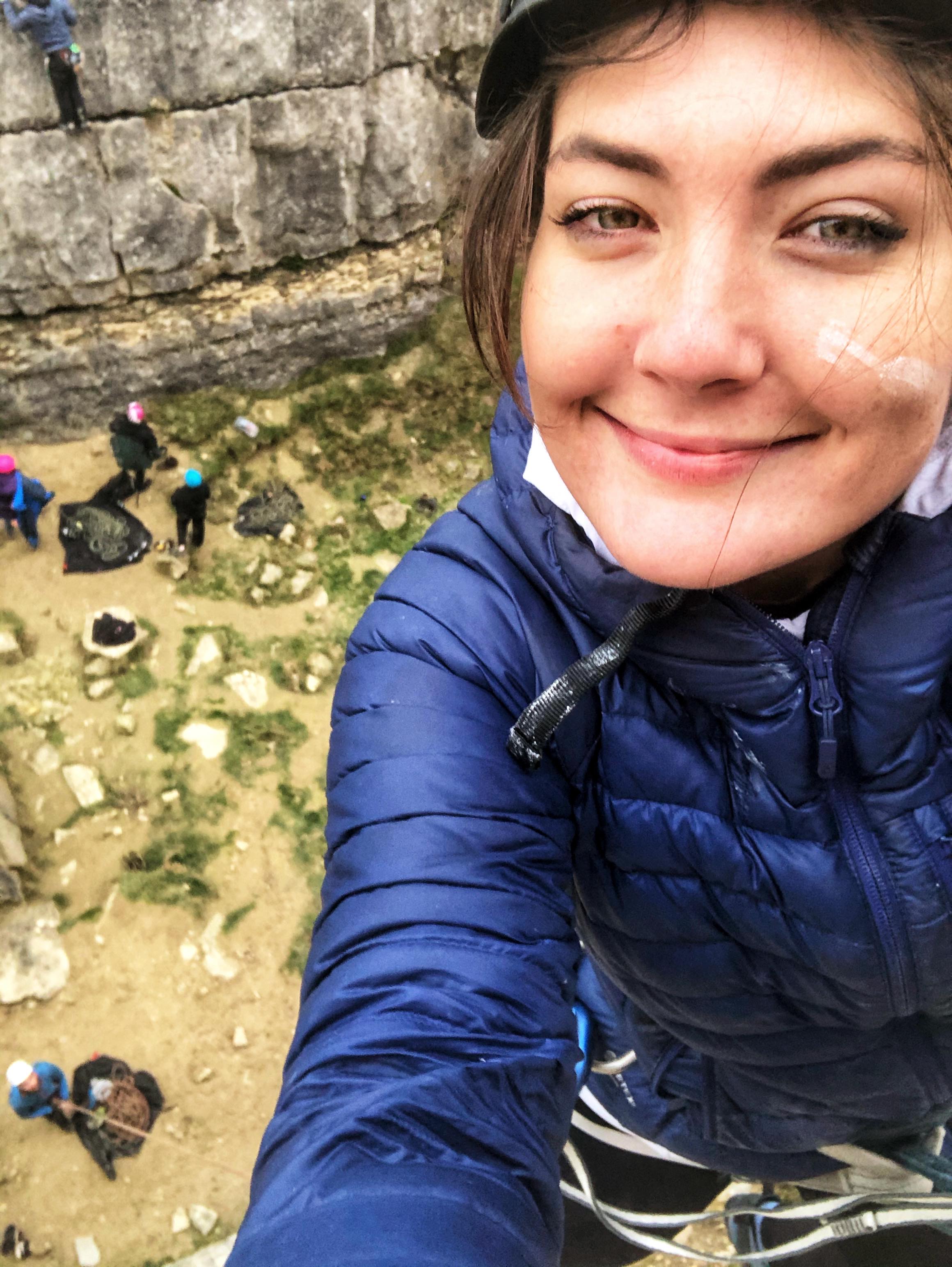
Lake District, June 2022: 9 – Needle Ridge, Great Gable, Kirk Fell

Sunday 19 June

We packed up, had one last breakfast with mum, dad and Angus and left the campsite at 8.30am. Saying goodbye to them always puts a little lump in my throat because I’m secretly a bit soft, particularly when we’d just spent such an amazing week together, so we hastened to plunge ourselves into the mountains for one last day of adventure. They were to drive home that day but we’d booked the following day off work, so the plan was to return to Napes Needle – the iconic rock pinnacle on Great Gable where we’d climbed a couple of days previously – this time to climb the classic trad route “Needle Ridge”, summit the mountain, hike across to tick off its neighbour Kirk Fell, then drive home that evening.

Hike up Great Gable (899m)

We drove deep into the dramatic Wasdale valley one last time and parked again at Wasdale Head. Great Gable loomed ahead in all its distinctive pyramidal glory, its dark, jagged upper reaches calling to us with the siren song unique to high and distant horizons. Loaded with rucksacks full of metal and rope, we hiked the easy, flat mile to its base, then started up its steep southwestern face.

Having already hiked up to Napes Needle, we were prepared for what was coming: a long, steady march up a steep grassy path to gain 450m of elevation in just one kilometre. Green fells surrounded us like towering, frozen, rolling waves, their sweeping, curved edges pitted with rocks, scrub and streams that cut across the surface like long scars. Kirk Fell loomed to the left beyond an impassably steep ravine of grass and scree, which actualised the scale of our undertaking – in terms of vertical elevation gain/loss our first 450m would be followed by a five pitch rock climb for another 350m to the summit of Great Gable, then a descent of 300m to a col between the mountains, then a climb of another 200m to summit Kirk Fell, then a loss of 700m to return to Wasdale. That’s a lot of up and down.

We reached the scree slopes two thirds of the way up the mountain after an hour’s walk, keeping a keen eye out for the practically non-existent path towards Napes Needle. We were eager to take a less treacherous route than we had done previously but I’m not sure if we actually found it. Paths can’t easily be spotted where they run across loose, steep, uneven rocks, changeable terrain where boots leave no mark, so our scrabble along the mountainside was no less perilous and awkward than before. Thankfully we were now vaguely familiar with the triangular pinnacles and seemingly endless grey rock faces of Great Gable’s southern face, so finding Napes Needle was more straightforward than last time and we breathed a sigh of relief as its distinctive form came into view.

Needle Ridge

We scrambled up to the base of the Needle, geared up and as is typical of fickle mountain weather, it started raining – that light but cold and deceptively wet kind of rain. It had been cloudy and dry until then, and we willed it to stop – climbing slippery rock is unpleasant at best. Deciding to push on before it got too wet, Ryan led the first pitch at his own request, which was probably the trickiest due to its polished, slabby nature and seeping rock. Thankfully the rain stopped as he clung to the marginally less slippery left hand side of the slab, struggling a little to find a good gear placement, then pulled through the crux to both our relief. While belaying I chatted to another couple of climbers who had turned up, then I followed up the first pitch, which was easy but admittedly a fairly bold lead due to the polished, damp surface.

The climb was graded a comfortable VDiff so we didn’t bother changing into climbing shoes – our comfy, grippy approach shoes were fine. Rather than belaying at the points shown in the climbing guide, we lengthened the pitches for the sake of speed and ease, choosing the ledges and flat sections (of which there were plenty) that seemed most sensible to us. This made the climbing more natural and allowed us to get way ahead of the other two climbers, reducing the risk of sending rocks tumbling towards them and ensuring we didn’t hold them up. I led the second pitch, an enjoyable venture up a steep crack followed by a scramble over blocky rock, and we continued in this way, alternating leads all the way up the ridge.

We absolutely love classic climbing routes due to their long, adventurous, committing nature, inspiring history, exciting exposure and exclusive views only attainable by those who love the mountains enough to truly immerse themselves. Wasdale sprawled below us, the far reaches of glassy Wast Water almost touching the horizon, and the rugged, hulking Scafell Pike range sat across the steep, deep valley of Lingmell Beck beyond the crinkly, green shoulders of Lingmell. We were so immersed in the landscape that we barely noticed the pitches going by, and before we knew it we were at what is described in the book as pitch 5, a 40m scramble along the final part of the ridge. This last section didn’t really involve any climbing so we de-harnessed, flagged the rope and effectively free soloed along a long, narrow stretch of rock and grass, moving quickly along the undulating ridgeline. It was easy but exposed, with a serious drop off either side, and lots of fun.

We pulled up onto Great Gable, whose summit is a sea of loose boulders, and walked a short way to the top, marked by a cairn and a plaque commemorating local mountaineers lost in the First World War. We sat and stared at the panoramic view of rolling fells, chatted to some hikers, then made our way down the mountain’s east side. The path was steep, awkward and almost indistinguishable among the litany of unhelpful rocks, and our knees were relieved when we reached the relatively flat col between Great Gable and Kirk Fell. We stopped here to talk to a 70+ year old solo hiker with an astoundingly long, difficult-sounding itinerary, passed the nearly-empty Beckhead Tarn, and started up the side of Kirk Fell.

Kirk Fell (802m)

It was a grassy, minimally rocky ascent up an easy but steep path to the top of Kirk Fell, a shapely mountain with smooth, regular slopes in comparison with its jagged neighbour. We made it up in about 30 minutes and stopped at the plateau on top to munch some Grasmere gingerbread, chat to a friendly northerner assessing a small mountain leader group and admire the breathtaking rolling landscape from our last summit of the trip. We looked down on the tiny buildings and patchwork fields of Wasdale Head directly below and reluctantly gathered ourselves for the final descent.

The path led us straight down the south face of the mountain in one sustained line and was long, very steep and at times quite awkward for our well-worked legs. It involved a combination of grassy “steps” and loose rocks, which required careful route-picking to avoid starting mini rockfalls, and was only a mile long but with over 700m elevation loss. Wasdale Head seemed not to get any bigger until the gradient eased slightly and the cricket-to-football-sized boulders were replaced by a sea of ferns split by a wide, grassy path – the home straight. We went through a gate at the bottom, trees rose up around us and suddenly we were back at the Wasdale Head Inn, where the babbling of an idyllic, picture-postcard stream signified the end of our time in the high fells.

We returned to the car feeling quite wistful and started for home about 4pm. It was a lovely drive out of the Lakes across the undulating eastern moors, followed by a brief stop at Broughton-in-Furness (won’t rush back) for fuel and a commiseratory McDonalds to mark the end of a wonderful trip. The drive home was mercifully uneventful once Scabbers (the beaten up old Yaris) stopped making dubious squealing noises, and we made it back in just over 7 hours.

A relatively big mountain day was the most fitting way to conclude a lovely holiday, which is something I struggle to do in words. We had such a good time exploring the Lake District with my family and managed to squeeze in a great mix of activities across the whole National Park, although as always we could have stayed there for a good deal longer – probably in perpetuity. Doubtless it won’t be too long before we’re back.

Lake District, June 2022 – 9/10 overall. Minus one for the fact we had to leave so soon.

Lake District, June 2022: 5 – Climbing at Hare Crags

Wednesday 15 June

Hare Crags

The weather looked dry so Ryan, Angus and I decided to go off and do some climbing while mum and dad explored Eskdale on foot. We’d looked at the climbing guide the previous evening and set our sights on Hare Crags, a southwest facing area set high in the valley just a short drive up the road with a mix of low grade routes. Our first choice was Brantrake Crag as it has a greater variety of routes, but we’d read that climbing is prohibited in June due to nesting peregrine falcons.

We had breakfast, watched delightedly as a red squirrel ran along the drystone wall behind the tents, packed our bags and set off in Scabbers. We drove east for 5 minutes along the narrow road through the scenic Eskdale valley, parked in a little roadside car park and hiked towards the crag through waist-high ferns, following the vaguest of paths. It took us about 20 minutes to find the first area, a huge slab of low-angled granite set high up in the valley in a wild area dominated by bracken, boulders and hardy grass.

The Slab

The low-angled rock was fittingly called “The Slab” and contained four routes from Diff to VS 4B. Ryan and I soloed the Diff, an easy but occasionally exposed scramble up and down the top side of “The Rib”, then Ryan led a combination of the adjacent, poorly protected “Celebration” (VS 4b) and “Easy Slab” (VDiff). While seconding the route Angus somehow dropped his belay device, so while waiting at the bottom I went to look for it among the thick ferns without much hope. Thankfully I caught a glimpse of blue and picked it up. Angus abseiled down and went off to search the thicket while I toproped the climb. At the top I took pity on him and revealed the device, then abseiled down, which took just long enough for him to see the funny side. He’ll never be too old to be taught a lesson by his big sister.

We hadn’t trad climbed for a while and were happy to take the day slowly, so after warming up on the Slab we sat at the bottom and had some lunch – some of those cheap, slightly dubious hot dogs, heated in the tin and stuffed into buns. The weather was warm and sunny and the view was stunning – we were halfway up the northern side of the wide, green Eskdale valley, which was filled with broadleaf woodlands and fields divided up by drystone walls. As we sat there some fighter jets soared overhead, their deafening roar resonating between the rugged ridges of the lumpy southwestern fells on either side of the valley. We hadn’t seen another person since leaving the car, not even from a distance, and it was one of those moments in which time stood still and everything was perfect.

Lower Buttress

Lunch over, we traipsed our gear up to the next section of the crag, Lower Buttress, which involved more bushwhacking and some careful bog avoidance. I geared up and started leading “Fireball XL5”, an interesting-looking VS 4b that started up a crack and was given two stars (meaning it’s a worthwhile climb) and a pumpy symbol by our Rockfax book.

I led the first section without difficulty, but halfway up I came to an awkward bit which involved a committing move away from a pinnacle on tiny holds and little to nothing in the way of good gear. I chickened out of the move once, returning to the relative safety of the solid pinnacle, hovered there for a bit, then gave myself a strict talking to and tried again, this time pulling myself up via a different (but still very small) hold, executing a rockover and finding a good nut placement with relative ease. Relieved but annoyed that I’d fannied around with it, I continued up a high-angled slab, probably not placing quite enough gear, to the top, a grassy ledge 20m up and out of view of Ryan and Angus at the bottom. Ryan seconded, then scrambled down the walk-off and Angus toproped up. Thankfully the others (and later the UKC forum logbook) agreed that it was bold for the grade and “a good lead”.

Our climbing was limited that day – and indeed the whole trip – by the Toegate Scandal, an incident that happened a couple of weeks before the trip whereby Ryan injured his big toe. How? By kicking the toilet while flicking his boxers off his foot while attempting to undress for a shower. Life is chaotic sometimes. The result was a persistent sore toe and accompanying whinge, not ideal for climbing shoes or relatively unsympathetic belayers.

I was keen to carry on climbing but on top of Toegate, the other two were satisfied and ready for a drink at the pub, so I conceded without much persuasion and we packed up. We scrambled back down to the car through the ferns, boulders and undulations, and headed to the well-known Woolpack Inn, only two minutes back down the road towards the campsite.

Lazy evenings in Eskdale

We had a cider in the garden and headed back to the campsite about 5pm. Mum and dad cooked a nice barbecue and we all went for a lovely evening walk, this time heading up the hill behind the campsite, past a little waterfall, and through some rugged moor-like farmland along a drystone wall. We came to an orchard, walked through a farm, watched lots of lambs chase each other round a field then returned to the campsite along the little road that splits the valley in two. As usual we finished the day talking and planning over some drinks in the awning.

Ben Nevis climb via Tower Ridge: Scotland day 2, Sep ’20

We parked in the North Face car park just north east of Fort William and set off through the dense, wild Leanachan forest. We practically trotted through the trees, flailing limbs at the infamous West Highland midges and – although the forest was enchanting – were keen to put as much distance as possible between our as yet unbitten skin and the river by the car park.

We emerged onto a wide sweep of heather dotted with bright green shrubbery and small broadleaf trees, backed by the majestic hump of Ben Nevis’s north face, dark against the clear blue sky. Our next destination, the CIC hut, sat neatly at the head of the valley in a cosy, three-sided bowl formed by Carn Dearg, Ben Nevis and Carn Mor Dearg, looking down the length of the Allt a Mhuilinn river to a north-westerly horizon full of hazy blue mountains. Our path up to the hut was well-maintained and parallel to the river, so there was no real prospect of getting lost. The tricky bit would be determining our target – Tower Ridge.

We had no guidebook and the previous night’s googling yielded little light on the exact location of the ridge, so we were going off a couple of vague diagrams and a singular, hand-drawn map found on google images. At the hut, where a handful of raggedy climbers and seasoned-looking walkers congregated, we munched a sandwich and identified what we were fairly certain was Tower Ridge – a narrow, protruding finger of rock that joins the high, plateaued ridge between Ben Nevis and Car Mor Dearg at a 90 degree angle.

The giveaway was the Douglas boulder, a hulking mass of rock at the base of the ridge. From the hut, we walked, then scrabbled, up the loose, rocky debris that constituted the ground. It was hard work and the ridge definitely felt further away than it had appeared. Eventually we got to the other side of the Douglas boulder, turned towards its vast east face and started climbing, now in the dark shadow of the formidable Ben. This is considered a more sensible way to gain the ridge than from the west, even though the walk-in is longer.

Buzzing at the first real bit of exposure, we stopped once we were straddling the spine of the ridge to take in the view and decide whether to get the rope out. Although the way was steep and either side of the ridge was treacherously sheer, we decided against it for this first section; the holds looked big and solid, and we were confident that it was no more than a steep scramble. It wasn’t long, however, before we got to a more questionable face on the west side of the ridge.

We roped up and I led the first pitch, which turned out to be less technical than it had looked. I set up a quick anchor and brought Ryan up safely, then we scrambled on carrying a few feet of rope between us, coils stored over shoulders, not secured to the ridge but confident with the easy climbing. We moved at a steady pace, sometimes debating whether to use the rope and, more often than not, deciding against it. On our left loomed the intimidatingly dark, sheer face of Ben Nevis, and on our right we were spoilt by seemingly endless stretches of lush heathland, green forests and blue mountains.

There was one sketchy moment when we decided that the best route was to go left around the ridge, only to realise – once I was balancing somewhat precariously above the apparently bottomless east face – that the holds were few and far between and some of the rock was loose, and that we should have gone right. Ryan quickly took the most convincing right hand route and set up an anchor, so I could climb safely out of my uncomfortable, teetering position. I wasn’t happy with my Salomon Quest boots, as they’re thick-soled and chunky – perfect for hiking but not for use as climbing shoes, as I could barely feel the rock between my feet and I didn’t trust the grip. It would have been a little too easy to tread a little too aggressively and misjudge a foothold. Ryan’s LaSportiva XXX approach shoes, on the other hand, were perfect for the purpose – grippy and flexible enough that he could feel holds with accuracy, but without the foot-choking tightness of climbing shoes.

About three-quarters of the way along, we found ourselves squeezing up a narrow tunnel on the left hand side of the ridge. After giggling at the ungainly way we each emerged from the gap, we looked up and realised that our next move wasn’t obvious. Up until now, it had seemed that there was no “right” route along the ridge, apart from that which didn’t take us too close to either of its perilous sides. Here, we were pinned to one side and faced an unlikely-looking climb upwards, or a tight traverse along the left side of the ridge, which seemed to take us downwards. We chose left, but stopped at a strange whistling sound. A moment later, a cheery-looking climber popped out of the tunnel, wearing just a pair of bright yellow shorts, trainers and a small rucksack. We asked him the way and he grinned as he told us it was not left but “up”, then proceeded to float up the wall with irritating ease. He explained that this was the most difficult move of the route, probably around VDiff, but foraged around with his arm in a crack and reassured us that there’s a good hold somewhere.

Bemused by his timely appearance and nonchalent manner, we climbed upwards after him, roped up. He was long gone by the time we’d reached the top of that section, Great Tower. Ahead of us was the bit of the ridge that we’d watched videos of, and which we were looking forward to most. Ryan led the way across the most exposed part of the route, which is a skinny arete about 50 feet long and as wide as a pavement, which drops down hundreds of sheer feet either side. It was exhilarating to walk across, and I picked each uneven step carefully – although I was on belay, the length of the traverse meant that a fall would mean a nasty swing and crash against one of the ridge’s treacherous faces.

At the end of the pavement was the famous Tower Gap, a break in the ridge that required a slight downclimb and committal step across to the other side. The holds were good, and I joined Ryan quickly. From  there, the way to the top was quite straightforward – up and over another high, but solid, grey mass, unroped. We pulled over onto the Nevis plateau elated and to the shock of several hikers.

We walked left along the flat top to the summit, which was teeming with people.  It was as if we’d suddenly plunged back into reality, the timeless thrill of the climb behind us. On the ridge, we’d overtaken a group of three and been overtaken by whistling guy, but otherwise hadn’t seen anyone up close (we could see people on the plateau from the ridge) for hours. We took in the panoramic view of endless mountains, layered on top of each other in an enticing blue haze, had a sandwich and (to our horror) queued for a quick summit picture. People eyed us with interest, and a group asked us whether we’d climbed up. I refrained from telling them that “no, I wear a harness everywhere and the rope’s for show”, and we made our way down the loose, zig-zag pony track before we got too peopled out.

The view over Glen Nevis was stunning, but unfortunately we were busy focusing on each loose, uneven step down to appreciate it fully. We passed a waterfall and came to a fork near the dark water of Lochan Meall an t-suidhe, where most people went left down the pony track. We went right, which took us east around the north face of Carn Mor Dearg and back along a long path towards the CIC hut. Before we reached the hut, we cut left down the bank to cross the river and join the path we’d come up that morning, but not as soon as we could have – we were keen to avoid finding a bog, which we’ve become uncannily adept at.

I stopped to pick a handful of bilberries, which are lovely, sweet little wild blueberries that grow on low, scrubby bushes. The walk back to the van back down the Allt a Mhullain river was beautiful, and we soaked in the wilderness of open heath speckled with lilac cornflowers, pink heather and leafy green bushes, backed by dark forest and countless mountains. Breathtaking, but still we were keen to get back; we were starving, walking on sore feet and eager to find a pub.

Eventually we reached Leanachan forest. In its late afternoon quietness, it took on a sense of mystery that we hadn’t felt earlier; it was as if the trees were watching us pass, but it was peaceful, rather than creepy. Our heightened senses took in the grassy, mossy carpet, the lichen growing abundantly on the dark side of the trees, the fungi nestling in crevices and the intricate detail on the bark of the gnarly birches and towering pines. Every time I’ve been to Scotland, I’ve noted that there’s something magical about the forests.

We got back to the van, shut out the midges and de-booted. A twenty minute drive later and we were at the Ben Nevis Inn, tucked on one bank of the valley of Glen Nevis. We were pleased to see that we could stay overnight in the Achintree Road car park, right by the pub down a dead-end road. Unfortunately the pub was full indoors and booking-only, thanks to covid, but we enjoyed a pint of Thistly Cross cider (delicious) in the garden. I’d recommend the pub – amazing location and lovely looking inside, an old barn I think. That night we cooked and enjoyed a couple of ciders in the van before collapsing into bed, exhausted. We’d been incredibly lucky to have had clear, sunny weather all day – that night, it’d be an understatement to say the rain came.

Portland Climb/Camp, Nov/Dec’19

Apparently Portland is “the” place to go climbing on the central-south coast of England. Connected to Dorset by only a skinny finger of land, it offers long stretches of walk-in limestone cliffs with easy parking and lovely sea views.

We made a last-minute decision to join my brother’s climbing club trip, inhaled some bacon at Hill HQ, threw our gear into the car and headed to Portland. It was a fine day and we arrived at the Battleship Back Cliff area on the west side of the island late morning. After missing the concealed approach down the cliff, we found a fixed rope and scrambled down. On the way down we saw what looked like a red climbing helmet by the base of a rock near sea level. I scrabbled off to look for it/its owner but couldn’t see it again, and we carried on along the cliff to find Angus’s group.

80439363_497839824417765_1635229401186566144_n

They were climbing at The Block and The Veranda, two opposing walls which form a kind of open-roofed, wind-sheltered corridor. The routes on the landward-facing Block side were short and grades ranged from 4 to 6b+. The group had left a few ropes in the wall which, although annoying at a busy crag (which it wasn’t), was good as it meant we could fly up and down quickly. It was nice and chilled as Angus’s friends had mixed climbing experience, so there was lots of milling about/chatting/coaching/milling about. Ryan might like me to mention that he led a tricky 6a+ (hope you’re reading); I climbed four Block routes and a nice, high one on the Veranda side, then helped the club clean some gear before we lost daylight.


We scrabbled back to the car via a near via-ferrata type scramble/staircase, shoes slipping and clagging with clayey mud, said bye to the group (who were staying in Weymouth) and headed off to scout out a camping spot. We found a perfect place tucked between two bolted rock faces on Portland’s southeast side, went to a shop for cider and snacks, then found ourselves in the lovely and cosy Eight Kings pub in Southwell.

Well fed and watered*, we carried our gear into the cold and very windy dark, through brambles, over a gaping crevasse, down a steep, loose slope and round an awkward tight corner to the camping spot. We had the tent pitched and occupied in less than 15 minutes and spent the evening talking rubbish, drinking Old Rosie and feeling happily isolated from the world. Cold November nights spent confined under a thin bit of fabric are tragically underrated.

We laid in on Sunday morning, which I could cope with (I’m not a lay-in kind of person) because camping is worthwhile in its own right. The weather was finer than the previous day – clear and dry, but still windy. It was a lovely spot, a mini gorge tucked away from view and enclosed on all sides, accessible only by a narrow scramble around a corner and wild with brambles. The coastal path runs along the top of the seaward wall, but is just far enough back from the scrubby edge that the gorge is hidden. The view from that path was magnificent – colourful vegetation and scattered rocks covered the gradual slope down to the clear blue sea, and the pale cliffs of the Jurassic coast shone to the east in the low winter sun.

There was no need to look for climbs as the two opposing limestone walls of the gorge were bolted and climbable, so we harnessed up. We rattled through six short bolted routes in a couple of hours, swapping leads. We didn’t climb particularly hard but it was good to get through a handful of climbs. The only really memorable bit was the awkward position I managed to get myself into when I jammed both knees into a big, overhanging horizontal crack, leant back and practically dislocated a shoulder to clip a bolt above.

We finished with a fun, flakey route, which Ryan led and belayed from a top anchor, and were lured home by talk of a fire and Raclette at Hill HQ (thanks to lovely Cam). We returned with rosy cheeks and rock-battered hands, bitter at Monday’s imminence but pleased to have got back on real rock. Portland had shown us its climbing potential and needless to say we’ll be back.


*cidered

Lazy weekend (feat. a 20mile bike ride, a scrapbook and a climb)

Deviating from my usual trip-away-type post, I thought I’d scribble a few words about a weekend spent making the most of a lack of plans, no van and a poorly man.

There were seven of us drinking at Hill HQ on Friday night, which was spent talking happy nonsense about nobody knows what. Ryan was due to play rugby on Saturday but he’d been ill the previous day and still wasn’t in great shape, so after cooking breakfast he spent the morning dying on the sofa while I cleaned up the night’s wreckage, painted a mountain and read a book.

By early afternoon I was twitching with restlessness, so I announced my plan to go out walking in the New Forest. Sicknote gallantly objected and insisted that he accompany me on a bike ride, so we cycled out into the drizzle. We stopped under a graffiti-covered concrete bridge over the wide river Avon, squawked and whistled like little kids in return for an echo, then rode past flooded fields, pretty villages, damp ponies and striking amber beeches, birches and oaks to the Red Shoot pub.

I realised the severity of his condition when he ordered a Coke instead of a beer, so although the pub was lovely we didn’t hang about long. On the way back we passed through (and nearly brought home) a herd of inquisitive pigs, and watched in amusement as they were shooed out of a garden by a boy with a broom. Ryan kept adding bits to the route, either to show me more of the area or to tire me out, and after flying down a long, muddy track we returned as the light dwindled.

The evening was unusually quiet and alcohol-free, but lovely and chilled. We de-mudded, he cooked and I made an adventure scrapbook, sprawled on the floor with a Pritt stick, a wodge of photos and Red Bull TV in the background.

Sunday threatened to be a quiet one and I couldn’t get to rugby because a) I’d made New Forest plans and b) was vanless, so after a morning of cooking, painting and last minute dashing to the shop for Cam’s birthday card, we headed down to Calshot indoor climbing centre to do the first bit of roped climbing I’d done in way too long.

I hadn’t been there for about 18 months, and since then they’ve added a “twiglet” feature, new bouldering cave and more autobelays. We did some toproping, leading and autobelaying, and I messily attempted the twiglet’s crack climb. Having borrowed a mixture of Tom, Adam and Millie’s climbing stuff, we were done fairly quickly due to too-tight shoes and Ryan’s lingering illness, but it was good to get down there and I promised myself I’ll go more often.

The weekend finished as it had started – around the table at Hill HQ, this time over a Sunday roast. To conclude – lovely, relaxing and over-too-soon.

Two Wet Climbers

Great days usually have three things in common: a remote location, a risk of death and a pub finish. Exhibit A – last Saturday…55576787_766649270376210_9170423551180668928_n

We got to West Lulworth earlyish and lugged our gear to Stair Hole, a small cove just round the corner from the more well-known Lulworth Cove. It’s a stunning place, with a secluded beach surrounded by zebra cliffs and could-be-caribbean turquoise water.

We dumped bags on the stony beach and waded across the knee-high water to the big lump of very climbable-looking rock. We scrambled up to the top like kids in a playground, searching unsuccessfully for a route before setting up an anchor and making one up.

Bored of messing around, we scrambled back to sea level. I went an awkward way and had to backtrack, but not before watching a handful of melon-sized rocks tumble past where I’d been standing just a few moments before. A sobering reality check.

We kitted up and committed to The Maypole, a circular trad traverse which should have been a doable HVS 5b. I enjoyed leading the second, third and fourth pitches; the gradient was mostly okay, there were some decent holds and it was super grippy, although it was weird rock – sharp and “horny”, with very few cracks for jamming or placing gear.

The route can be done as a deep water solo, which I would love on a warmer, sunnier day as it would mean less faffing and more climbing. I enjoyed traversing but I was aware of the need to place loads of gear so we wouldn’t swing too much if we fell. I’m glad we didn’t fall as I didn’t place much.

At belay point five (after a quick backtrack to retrieve a stuck nut) we looked at the next section and commented on how straightforward it looked. As if I’d never learnt that lesson before. I lowered down towards the water from the bolted belay, suddenly realising how much the rock leaned over me and how few foot placements there were.

There were two potential ways to get through the cave: up the only crack in the rock or practically touching the water along the coming-out-at-you slab. I tried both and learnt a formula: awkward belay angle + lack of placement + pumped forearms – elevation above water = wet climber. I could feel my partner laughing at me as I flapped about, searching for purchase on the rock and whinging about wet socks.

Then it was his turn, which was pretty much a carbon copy of mine. Being the safer climber and all-round better person, he decided it was his job to get us out. He employed the unconventional method of lassoing a horn of rock past the nasty coming-out-at-you slab, which – when I suggested tying a nut to the sling for a bit of weight (not just a pretty face) – actually worked.

By this time he was out of sight round the corner, so I just responded to his muffled grunts of “slack” and “take”. Eventually he decided that the only way back involved swimming, so I fed him the rope and hoped his drowning noises were for dramatic effect. Fortunately he made it to the beach, and I later found out that he was nearly pulled down by the weight of his jacket and harness.56177033_395067664380598_8633818574965702656_n

Knowing you’re going to get wet and cold when you really don’t want to is horrible. I climbed down as much as I could, struggling to remove the nuts, and resigned myself to the water after fumbling around trying to put my phone in my helmet so it could float safely back to shore. Which didn’t work, as I got tired holding onto the rock and dropped (luckily) my helmet.

Going in was terrible. I was desperate to not ruin my phone and lose all my pictures, so I’d stuffed it as high up in the front of my top as I could manage. I tried staying on my back and failed – I probably looked like I was drowning. The weight of my down jacket and a harness full of metal really dragged me down, and the “swim” back was unpleasant – although I managed to collect my floating helmet.

Back on the shore my partner was shaking and I was distraught at the fact we’d left a load of gear in the wall. Being poor and stingy, I insisted on swimming back to get it; again, mega unpleasant, but well worth it for the sake of a handful of nuts, slings and draws. Meanwhile, onlookers enjoyed the show – not one person seemed concerned!

Wet, cold, hungry and in dire need of hydration (by tea and cider), we shivered back to the van. But it could have been worse – we could have lost a lot of stuff, or died. Just like all other great days, this one finished happily ever after… in the pub.

I can’t wait to climb again.

Ice Climbing for Idiots

What I learned from a session at Ice Factor, the world’s largest indoor ice climbing centre. Kinlochleven, Highlands, Scotland. To set the scene, just picture being inside a 40ft freezer.

Basics50103883_235413044039894_4800773426807570432_n

Ice climbing is climbing up a wall covered in or made of ice. At its most basic, the kit consists of a helmet, two handheld ice axes, a harness, ropes, a belay device and aggressive-looking crampons attached to winter boots. As we stumbled across the floor of “the freezer” all kitted up, our instructor advised us to walk as if there was a football between our feet, which was a great tip that stopped me nearly treading on my own cumbersomely-cramponned feet and faceplanting the ice.

Feet – Using Crampons

We started by practising front pointing, the basic foot technique used to climb ice walls. It involves deciding on a good foot placement – a divot or strong bit of ice – and firmly jamming the toe spike(s) into it, square on. Having got used to rock climbing, which involves the feet usually being turned outwards or inwards, this felt weird – I had to consciously stop myself searching for purchase with the inside edge of my foot.

Regarding body position, you’re supposed to keep your feet level (harder than it sounds) and wide-but-not-too-wide (helpful I know), knees close to the wall and slightly bent. Imagine your feet form two points of a triangle and your body the other point – 50442196_1979578599017896_1329863299524722688_nyou’re supposedly more stable this way. It’s quite an unnatural stance and it was hard to trust that the crampons would hold my weight, although I quite enjoyed ramming the front spike into the ice as you can kick it quite hard.

Hands – Using Ice Axes

Then we practised using ice axes. The trick is to either find a solid indentation made by previous climbers  and “hook” the tip in there, or to find a good spot to swing the axe at and make your own “hold”. You want to aim for a spot as far up as is within comfortable reach, so you can make progress without overstretching.

The hardest part is hitting the exact spot you aim for squarely, so any regular wood-chopping axe-wielders will be at an advantage; it’s really satisfying when you hit the spot, and you can swing the axe quite hard. Top tip: improve accuracy and relieve stress by imagining the face of someone you really, really dislike on the spot you want to hit (Trump did it for me – never a sentence I thought I’d say).

Putting it Together

Full of unwarranted confidence, we tied in and put what we’d learned together. I probably resembled a climbing version of Bambi on ice, all limbs and little co-ordination. It took concentration to move the right arm/leg at the right time, as the process of moving up seemed more methodical and less “artistic” than rock climbing; I kept wanting to stick a leg out to the side, or move one arm when I should be moving the other. It seems painstakingly slow to begin with, as you move your feet up just inches at a time.

Fortunately I got my limbs working with each other before long and settled into a [messy] rhythm of foot-foot-hand-hand, repeat. Like rock climbing, the majority of the effort comes from the legs, so foot placement in particular should be solid; the axes are really just to stop your body falling away from the wall. The lack of obvious holds (usually present in rock climbing) was odd, but in a way it was easier to find placements on ice as the sharp axe/crampons can be jammed pretty much anywhere.

49376434_241411080094141_3817767266586460160_n

The sketchiest bit was topping out, ie. going over the lip at the top of the climb. When the wall is in front of your face it’s quite easy to see placements, but where it angles away from you it feels like you’re blindly swinging the axes or jamming your feet and hoping for the best. But if you’re okay with heights, don’t mind the possibility of falling (why climb otherwise?) and trust your belayer (why climb otherwise?) you’ll be fine.

My Conclusion

Ice climbing is great fun. It seems to lack the creativity of rock climbing as you can “mould” a path in the ice yourself; by way of comparison, there’s no such thing as making new holds in solid rock using brute force and pointy things, so you have to contort your body to whatever shape the rock dictates. However, I’m probably silly to keep comparing it to rock climbing as it’s so entirely different. Ice climbing is a formidable activity in its own right that could take you places otherwise inaccessible, which is surely more than good enough to warrant giving it a go.

On Climbing (and Falling)

I did a lot of falling last weekend. They say if you aren’t falling you aren’t trying hard enough, which I choose to believe because otherwise I’m just a terrible climber.


Scrapes and bruises aside, there’s no feeling like reaching a hold you thought was beyond your capability or getting past that nasty bit of rock that had previously defied your persistence. It’s a wonderful cocktail of frustration, elation and adrenaline; I’m new to climbing but I feel like a dog that’s tasted blood – not just addicted, but desperate for more.


The “climbing cocktail” is full of contradictions. One minute I was ecstatic at having made it past a tricky, technical section, the next I was slapping the flat, featureless wall with frustration. It’s super-cool and super-geeky at the same time – dangerous, exciting and hugely technical. I didn’t realise just how much there was to it until a friend told me about the hours he’s spent on Youtube looking at finger-jam techniques, or until I googled “climbing equipment” for birthday present ideas (30th May, just putting it out there) and was faced with a vast range of unfathomable objects.


Technically I know very little but I’m keen to learn. Stripped to the bare bones, there’s “sport” climbing and “trad” climbing. “Sport” involves clipping into metal bolts along pre-determined routes up the wall, and “trad” involves sticking your own lumps of metal into cracks in the wall in such a way that they’ll hold fast if you fall. It’s a total mind game.


It’s also an entirely different kettle of fish to indoor climbing. There’s something so wild, raw and real about the feel of the unforgivingly cold, hard rock under your fingers, and surrendering yourself to the mercy of the sun, wind and fog is oddly liberating. There’s been no human interference with the surface you’re clinging on to, beyond the route-setter who put the bolts in the wall. Nobody chose where to put the cracks, holds and features, and nobody will choose when or how the next bit of rock will crumble. It’s an exhilarating thought.


I’m fortunate enough to have climbing-savvy friends willing to lend me their patience and equipment, so all I own for now is a harness and a pair of shoes (plus a single quickdraw and wallnut that I was lucky enough to find at the bottom of a cliff). I’ve been down to the Dorset coast a couple of times and I love it.


I had planned to write about my (limited) climbing experiences rather than climbing in general, but I’ll do that another time. Time has run away and I’m off to the gym to make amends for the scones, cake and trifle I went to town on at my gran’s (pretty crazy, thanks for asking) 94th birthday tea yesterday.


So what was the biggest fall I took at the weekend? Not the repeated slips off the same, infuriating, polished bit of rock. Not the sideways, double-overhang, twelve-foot, back-first crash into the wall. I’m cringing as I write this disgustingly clichéd sentence, but I think it was probably falling in love with climbing itself, and all the falls that come with it. Climbing is the perfect metaphor for life in general – it’s not how many times you fall, but about how many times you pull yourself back up.