North Pembrokeshire, June 2021 (2/2)

Thursday 1st July

Newgale Beach

The fog was still thick around our wild camping spot on the Preseli Hills when we woke up. We were due travel to South Pembrokeshire for the second half of the holiday and had arranged to meet mum, dad and Angus at Pembroke Castle at 1pm.  We spent the morning driving down via Newgale Beach on the west coast, with a view to seeing as much of the national park as possible.

We dropped down into Newgale after an hour’s drive through pretty farmland and parked at the large beachfront car park. Newgale is a small village in a basin that opens onto St Brides Bay, with a large, lively-looking campsite set just across the road from the beach. The beach is long, sandy and scattered with smooth pebbles. The weather was strange – still, warm and bright, but grey sea mist stopped sunlight penetrating and gave the sea and sky a serene, dream-like quality. We walked along the shore until we reached some cliffs and caves at the southern end, explored for a little bit and headed back to the van.

Pembroke Castle & Town

We stopped at Morrisons in Haverfordwest for shopping and fuel, then met the others in Pembroke early afternoon. Pembroke is a small, bustling town that still seems to revolve around the castle, which has high, well-preserved walls that tower over a long pond on one side and the high street on the other. Inside, the large, grassy courtyard is contained by walkable walls and several towers which house a lot of interesting information about the castle’s history, including some realistic mannequin scenes and the room where Henry VII was born. It has a “proper” castle feel, with its huge keep (sadly closed), dungeon room, herb garden, scattered flowerpots, battlements, towers and high walls. Definitely worth a visit.

After a thorough poke around the castle we  wandered up the high street, where we looked round an old fashioned convenience store and a tiny shop that sells handmade, surfwear type clothes. I bought a pair of yoga shorts with a honeycomb pattern and a couple of headbands, all made in the shop with organic cotton – would recommend, see the website here – https://www.iseasurfwear.co.uk/. Ryan and I then went on to the Watermans Arms pub and enjoyed a cold cider on the deck, which is raised on stilts over the edge of the pond and has a lovely view over the water, the castle and the town. We watched in amusement as a single, angry-looking swan chased a group of at least 30 much more passive swans around.

Camping, Kiting & Broad Haven South Beach

We drove a little way south along tiny roads to the new campsite, Trefalen Farm, late afternoon. This is another lovely site with sea views, basic facilities and a really remote feel. The first thing we did was find an open field near the cliffs and fly Ryan’s powerkite, as so far the weather had been record-breakingly non-windy (for Wales) and having felt a slight breeze, we were very keen to get it in the air. There wasn’t lots of wind but there was enough to have some fun for half an hour or so before going back to the van and cooking fajitas for tea.

After eating we all tramped down the hill to Broad Haven South, a deep, attractive sandy beach with dunes set way back from the sea and impressive rocks and caves on either side. We walked and footballed our way to the far side, where we explored narrow caves and clambered around on the rocks. Angus was introduced to the slimy delights of large, light-hating cave lice and we found some random sea junk wedged high in damp cave systems, including ropes, buoys, jerry cans and a tyre. Satisfied with a day spent poking around castles and caves, we went back to the campsite and played some stupid card game Angus bought at the castle gift shop, which became hilariously long-winded.

Friday 2nd July

Climbing at St Govan’s Head

Ryan, Angus and I set off from the campsite to climb at the nearby coastal crag of St Govan’s Head. We walked west along a wild section of the Pembrokeshire coast path which had lovely views of dramatic cliffs towering over little rocky beaches and coves filled with clear blue water. We’d definitely chosen the right day for it as it was dry, still and kind of sunny, kind of cloudy, so not too hot or cold. We arrived at some abseil stakes by the edge of a cliff near a military training zone and after a little bit of faff, worked out the right stake to abseil off.

We set up the rope, took what gear we needed and one by one, abseiled over the edge of the cliff. As always the most awkward bit was going over the lip, where your legs go from vertical to horizontal against the wall. The abseil was really fun – about 30m high and against a pleasantly sheer wall, with some free space to hang into in the middle, and with dramatic views of the wild, intimidating cliffs and calm sea below.

The climbs were graded quite high and described as high in the grade, so we went for easy stuff. Angus hadn’t trad climbed for ages and Ryan and I hadn’t done much at all during a year of lockdown. First Ryan led “Exit Corner”, a straightforward VDiff up a blocky corner, I seconded and Angus toproped. We abseiled down again and I led “Lemming Way”, a Severe route up another corner with a fairly exposed, awkward section which had a disconcertingly damp crack where I faffed around with some tricky gear placements.

I belayed the other two up and we abseiled down again. This time Ryan picked “Centurion”, a Severe line up a nice-looking crack with one difficult looking move under an overhanging block. He got to that move without much difficulty but got stuck there, so he came down and I had a go without any real expectation of getting any further. It was an awkward and fairly bold move involving a high right leg and some dubious holds, but I committed to it and to my surprise pulled up over the block. The finish was quite loose but otherwise fine, and I belayed Ryan and Angus up (using a munter hitch as I’d given Ryan my belay plate) feeling quite pleased with myself. As I was doing so I watched a little nervously as a cow approached and sniffed another belayer’s rope anchor at the edge of the cliff –  I didn’t want anyone to have to contend with curious cows while belaying, and I definitely didn’t want a cow to fall off a cliff. Luckily the cow lost interest and wandered back to safety.

Trad climbing always takes longer than you expect, especially when you’re a little out of practice and there are three of you. By this time we’d only done three climbs and three abseils, but it was mid-afternoon and we were getting hungry (having overlooked the value of packing lunch). We were satisfied with our taster of Pembrokeshire climbing (although Ryan and Angus slightly more so than me) so we packed up and headed for the nearest pub.

We walked west and took a detour via St Govan’s Head chapel, a tiny, ancient limestone chapel down steep steps built into the side of a cliff and perched above a small cove. It’s a striking building which merges into the cliff quite naturally, as if it’s always been there, and some of the etchings on the stone altar suggest that it’s drawn interest for a very long time.

We climbed back up the steep steps and walked north for half an hour into the village of Bosherston and found the pub, the St Govan’s Head Inn. Dad had left me a voicemail saying that he’d booked the five of us in for dinner at (unhelpfully) “the local pub” and nobody had any phone signal to find out which pub it was, so we had a couple of drinks there and after a bit of phone-waving, I received a text suggesting that we were in the right one so we stayed.

Mum and dad turned up about 6 and true to form, I was decidedly wavy after two or three ciders while Angus and Ryan were fine. The pub was lovely inside, with wooden beams and low ceilings, and the food was very good – I had dressed crab and some chocolate thing for pudding, and my only complaint was that Ryan promised me one of his prawns but ate them all before I could get there. We split the bill between Ryan, Angus and I and walked back to the campsite along a narrow, hedge-lined road, happy with a good day’s climbing and pubbing.

Saturday 3rd July

Stackpole Gardens

It was mum’s turn to pick something to do, so we ended up at Stackpole Walled Gardens. Entry is free and a lot of the gardening is done by adults with learning difficulties as part of a charity thing. It’s a nice place to go, with long greenhouses, strange plants and sculptures, and it had lots of little corners to explore. Our favourite part was the rows of fruit available to pick for free, including strawberries, raspberries, gooseberries, blackberries and tayberries. We were there for an hour or so, until we ended up getting drizzled on while waiting for mum to finish bumbling around.

Surfing at Freshwater West

Taxi of dad then took us to Freshwater West beach, where we just about found a parking spot. Ryan and I changed into wetsuits and took the surfboard and bodyboard down to the long, sandy beach just down from the car park, and waded into the rough sea. We didn’t get far at all before being batted back by the waves. The surf was beyond our skill level in that we couldn’t even get the surfboard out far enough to catch the longer waves – the ones close to shore were short and ferocious, crashing high above our heads and pulled quickly back from under our feet.

We were washing machined around for a while, which involved getting hit multiple times with the boards and noting that a hard surfboard is considerably more painful than a foamie. One such collision (with my thigh) resulted in one of the three fins snapping off the surfboard and from then our attempts at proper surfing ceased. I’d managed to stand twice, both times in the shallows, and both times for a record-breakingly short duration. Body boarding was good fun though, and less calamitous.

After about an hour of being battered by the sea, we tramped back along the beach. Dobby’s grave, consisting of a lot of stones all piled up, was up on the sand dunes to the left – apparently it’s where the scene was filmed (spoiler – Dobby dies). The sea, and our attempt to find some surfable waves, had dragged us quite a long way to the right, and annoyingly we noticed on our way back that the surf to the left had calmed down a lot to the point where surf schools had started eyeing it up.

Feeling half-starved, we grabbed lunch from the famous Café Mor burger van in the car park. I had the vegetarian burger and Ryan had the classic Mor burger with chips. The people were really friendly and the burgers were amazing, served with some kind of seaweedy pickles and relish.

Powerkiting at Broad Haven South

We went back to the campsite via Pembroke so that mum could grab some bits from (ie. spend an inordinate length of time in) the shop. We helped pack up the awning and for tea mum cooked a strange but very nice mix of bits that needed using up, which included buckwheat, mackerel and salad.

That evening we wandered back down to Broad Haven South beach to show the others Ryan’s powerkite. There was practically no wind but we just about managed to get it up and give dad and Angus a go. It was nice to fly it on the beach regardless and the only downside was that in my enthusiasm to take the mountain board despite the lack of wind, I graunched my heel on the axle while scooting along and it bled quite a lot.

On the walk back up the hill the heavens opened. I’m not exaggerating when I say it was like a tropical storm – we were dry one minute and drenched to the bone the next, so much so that it stopped being annoying and became funny. Once back at the vans and changed into dry clothes, we all huddled in dad’s van and spent the last evening chatting away.

Sunday 4th July

National Museum & Cardiff

We parted and left, a little sad, quite early on Sunday morning. It was grey and wet and we counted ourselves lucky that the Welsh weather had arrived just as we were leaving. Ryan and I came back via the National Museum at Cardiff as I was keen to see the city, having never been before, and thought the museum would be a good rainy day activity.

We parked in the city centre quite cheaply – £5.50 for 4 hours – and walked the short distance to the museum, through an attractive, leafy park and past the grand university and court buildings. Entry was free and it was very interesting. The ground floor was all about the natural history of Wales and housed an incredible collection of rocks and meteorites, dinosaur and prehistoric animal skeletons and information about plants, fungi and habitats. After a lot of reading I sensed Ryan’s growing impatience and we moved upstairs to the art floor.

This had lots of cabinets filled with pottery which was, in our untrained opinion, of uncertain aesthetic value. It was a bit of a labyrinth, with different rooms housing works of photography, paintings and sculptures. The work ranged from very old-looking portraits of heavy-eyelidded, curly-wigged posh people to modern paintings in blocky colours with dubious justifications as to what makes them worthy of gallery status. One exhibition featured huge paintings by a couple of artists which I thought were excellent and very poignant, having read about their cultural backgrounds, but I can’t remember their names.

After a couple of hours we left the impressive building through the large marbled, columned foyer and went for a wander around Cardiff city centre, pleased that the weather had cleared up. I thought it was a very attractive and clean city, with a young, lively atmosphere and lots going on. There were all sorts of shops, cafes and bars in a very small area and the castle was impressive, set near the centre with high, well-preserved walls. After a quick excursion to a phone shop so Ryan could sort out a new phone contract, we grabbed a subway and headed back to the van.

And so concludes our holiday in Wales. We had a lovely, busy week and it was really nice spending some time with my family, especially after lockdown(s). The two van, one tent setup worked well and we got to see a lot of Pembrokeshire, although there’s definitely more to see. I have a feeling we’ll be back…

North Pembrokeshire, June 2021 (1/2)

This blog post (1 of 2) tells the tale of the first half of a week campervanning in Pembrokeshire, a coastal national park in west Wales, spent with Ryan (boyfriend), Mum (mother and chef), Dad (father and taxi driver) and Angus (not-so-little brother).

Ryan and I drove up as soon as he finished work on Saturday evening and we found a quiet wild camping spot near the village of Newport, where we’d be staying. The van was fully loaded with climbing gear, surfboard, bodyboard, mountain board, power kite and other miscellaneous toys, so the week was looking good.

Sunday 27th June

Parrog & Newport

We joined mum, dad and Angus at Tycanol campsite, a basic site with lots of green space and stunning views over the wide, sweeping Newport beach. First on the agenda was a walk along the Pembrokeshire coast path, conveniently accessible from the site, down to the quaint old port of Parrog. It was a tiny, pretty place, where little boats sat moored in a calm quay cut off from the sea by a sand bar and green hills perched above the cliffs and dunes across the bay.

We walked a short way up the hill to the bigger village of Newport, where the busy streets were lined by attractive stone houses, shops and cafes. We grabbed some supplies and walked back along the main road to the campsite, where we took advantage of the wind and flew Ryan’s stunt kite.

Castell Henllys

After a ploughman’s lunch, we all got into dad’s van and went to Castell Henllys Iron Age village. It was worth the £7.50 entry fee – the walk up to the village took us along an ancient stream, through leafy woodland and past the resident pig. The roundhouses were very authentic and the three talks/demonstrations on food, village life and battle were excellent. To my delight, we had a go with the slingshots and I took great joy in lobbing a lump of dough at dad. Remarkably, he still treated us to a drink and a cake at the café.

Nevern & Preselis

On the way back we stopped at a timeless hamlet called Nevern to see the bleeding yew, a remarkable, 700 year old tree in an atmospheric little churchyard which oozes blood red sap. It was simultaneously eerie and serene, a strange combination, and the sap smelt nasty on my fingers. A brief excursion across a stream and up a wooded hill took us to the site of an old motte and bailey castle, now reclaimed by nature, where only earth mounds disclosed its human past.

Still keen to explore, dad then drove us back through Newport and a little way into the Preseli Hills, where the four of us (minus mum, who had a bad knee) walked the short distance up through heathery moorland to the rocky tor of Mynydd Caregog. The plateaued landscape reminded me of Dartmoor, with its distant rolling peaks and scattered granite outcrops, and there were spectacular views over the sweeping blue curve of Newport Bay, tucked between strikingly green Dinas Head to the left and pasture-topped cliffs to the right.

Realising that it was 7pm, we hurried down to Parrog and arrived just in time to order fish and chips. After a long wait and some impatience on my part, we ate them in the van – delicious – then went back to the campsite for some drinks.

Monday 28th June

St Davids

The weather looked wet in the morning, so we decided against strenuous activity. After another bimble around Newport we drove 40 minutes west to St Davids, the smallest city in Britain with a population of 1,600. Grey stone houses and shops lined its bustling streets, which were pretty despite the overcast sky, and the old cathedral was incredible, with flagstone floors, carved and painted high ceilings and perfectly symmetrical stone arches. Ryan and I walked back up the hill to the stone cross at the city(!) centre, queued for ages to get lunch (chicken baguette and a pasty), and met the others back at the modern information centre by the car park.

Whitesands Beach

We realised that we hadn’t planned beyond St Davids, so decided last minute to visit Whitesands Beach just up the (very narrow, twisty) road. An archaeological excavation was going on at the site of an old chapel just above the beach, which is being threatened by erosion. We peered down, fascinated, on people brushing dust from thousand-year-plus old human skeletons, including that of a baby. See https://www.bbc.co.uk/news/uk-wales-57685284 if you’re interested.

While mum and dad sat on the beach, Ryan built stone towers, Angus pottered around the rockpools and I went to explore a rocky promontory. The vertically layered slate was awkward to walk on but the excursion was worth it for the deep, coral reef-like rockpools, sea-filled tunnels and wild, remote scenery. I went over the other side of the big rocky lump, away from the beach, and looked out on a small, empty beach, wild headlands and a calm sea under a moody sky. There wasn’t a boat in sight and all that interrupted the horizon was a few small, hazy islands.

I clambered around the rocky lump and made my way back to the beach via a rockpool-bottomed tunnel, which required a short climb out the other side. We regrouped and went back to the campsite for the evening, where mum cooked vegetarian curry and we sat planning the next day’s hike.

Tuesday 29th June

Hiking in the Preseli Hills

In the morning Ryan, Angus and I were dropped off on a roadside near the village of Crymych. Our plan was to walk the bridleway that runs east to west across the spine of the Preseli Hills (sometimes – dubiously in my opinion – called Mountains) and get picked up from a pub on the other side. Meanwhile, mum and dad went to a woollen mill, much to mum’s delight and dad’s indifference.

The forecast was dry and overcast, but there was a distinctly wet-looking fog hanging over the hills as we approached. We went through a wooden gate which marked the eastern boundary of the Preselis and instantly deviated from the bridleway to climb Foeldrygarn, the first hill – a big, green, rocky lump looming in front of us – that sits slightly north of the path and is topped by a trig point, which we decided made it worth a visit. It was steep enough to break a sweat and once at the top we messed around on the rocks (at one point I got stuck a little too high and needed a spot from Angus) while Ryan experimented with his new gimbal video thing.

We rejoined the main path and headed west across the undulating moorland plateau, which was full of sheep, fog and rocky outcrops. We spotted an enormous red kite (questioning at one point whether it was a lost eagle) and a few skylarks, but it was otherwise quite barren. We stopped to pull on raincoats on account of the wet fog that engulfed the hills and thwarted what was probably a stunning view over north Pembrokeshire. The next four miles was oddly enjoyable and consisted of bleak fog, the occasional bog and passable banter.

We stopped for a strange lunch of pork pie, cheese, lamb pasty and mugshot pasta (I can’t recommend a Jetboil enough) by the edge of Pantmaenog Forest, then headed south away from the main bridleway towards Foel Cwmcerwyn, the highest peak in the Preselis and the last hill of the hike. The sun had started to burn through the fog and it was quite clear by the time we reached the top. The view was incredible, stretching out over miles of quiet valleys, green fields and dark forests, and we looked back to see the Preselis still shrouded in the isolated layer of thick white cloud we’d just emerged from.

The walk down was reminiscent of the hobbits leaving the Shire, with abundantly biodiverse meadows and verges on either side of us filled with all kinds of grasses, wild flowers and trees. In front and to the left was a heartwarmingly pastoral view over peaceful Welsh fields rolling way into the distance, and behind was the lush, fir-lined edge of Pantmaenog Forest.

The path dropped down through a sheep field into the village of Rosebush, where our 8.5 mile hike ended at the Tafarn Sinc pub. The community-owned pub is worth a mention in itself, with its purple corrugated iron cladding, sawdust-scattered floor and timeless décor, which includes various mysterious agricultural implements and several legs of ham hung up to cure. We had a drink while awaiting our taxi, then another when it arrived bearing mixed reviews of the woollen mill.

Newport Beach BBQ

The taxi (dad) drove us onto Newport beach, where we kicked a ball around and explored rockpools, shallow caves, a small waterfall and grassy sand dunes. Ryan and I watched England beat Germany (much to our surprise) on my phone, in terrible quality as signal was bad, while dad cooked the barbecue. We had sausages, burgers and salad (to which my contribution was foraged sea beet and dandelion), washed up in the back of the van and went for a walk along the long stretch of sand towards Parrog, which was cut off by a deep stream. The beach was practically empty and the sunset was lovely.

Wednesday 30th June

Tombstoning at Blue Lagoon

The forecast was good so we decided to get wet. We went west along the coast to Abereiddy, a tiny, pretty coastal hamlet with a small beach and a disused slate quarry which has become a hotspot for swimmers, paddlers and ledge jumpers. The quarry is called Blue Lagoon, which is a lovely if unimaginative name as it’s effectively a large bowl of clear blue water connected to the sea by a narrow channel. On the far side are two man-made platforms, once used as part of the quarry, which drop straight down into the water.

The three of us (mum and dad chose to stay at the beach) walked down into the bowl, changed and clambered over the rocks and into the cold water. We swam across to the other side, dodging swimmers, paddleboarders and a huge jellyfish, and climbed out and up to the platforms. There were a lot of people queuing for the lower one, which is about 4 or 5m high, so we went straight to the higher one, about 12m – nearly the same height as three double decker buses.

Peering straight down into the dark water below was adrenaline-inducing enough, so without hesitating we checked it was clear and one-by-one, jumped off the edge before reluctance could take hold. It’s the highest thing I’ve ever jumped off and the feeling of weightlessness was exhilarating, if a little terrifying – my instinctive fear response sent a “what the hell are you doing” type message through every fibre of my being and it felt like I was falling for an age. I hit the water the right way but it was still quite an impact due to the height of the drop, and – relieved to be alive – I swam to the surface grinning, retrieved the terrible wedgie, and hauled myself out onto the rocks like an ungainly seal. For some reason, I did it several times more.

We were probably in the water about an hour before deciding we should get back to make our pre-booked 2pm kayaking spot, so we swam back across the lagoon to our stuff on the beach. I shivered my way into my changing robe, which provided immense relief, and we walked the short distance around the coast back to the van, parked just behind Abereiddy beach.

Kayaking & Paddleboarding at Llys-y-frân

I’d booked a canoe for dad and Angus, a paddleboard for Ryan and a kayak for myself at Llys y Frân, a lake and country park at the foot of the Preseli Hills. After a brief altercation – I think the only one of the holiday – about washing up and being slightly late, we were out on the water in the warm sun. It was incredibly quiet, wild and peaceful. First we paddled up the smaller, left hand “arm” of the lake, past lush green banks with trees overhanging the water and over roots visible through the shallows – it could have been prehistoric. The only people we saw were a couple picnicking in a clearing at the end and the safety man in his powerboat.

Ryan and I swapped, then we paddled back to the bigger, wider arm of the lake, which gave a good view of the Preseli hills. It was less sheltered here and we were fighting the wind, which was fun as it was quite hard work. On one side the bank was crammed with thick, leafy trees and on the other a grassy slope was occupied by people fishing, walking and sitting on benches. We paddled as far as we could go given the 2 hour hire time, then turned around and came back. Angus treated us to a drink at the clean, modern café, then we headed on to the pub for a meal.

Tafarn Sinc & Bessie’s Pub

The food at the Tafarn Sinc was lovely and service was good, considering how early we arrived. It was a simple, proper pub menu with nothing fancy or unpronounceable (apart from the Welsh side). After a meal and a couple of drinks we headed back to the campsite via Bessie’s pub, properly called the Dyffryn Arms, nestled in the thickly wooded old valley of Cwm Gwaun.

I’ve never known a pub so cemented in time. The bar is a tiny hatch in a room with a tiled floor and granny-style floral wallpaper, filled with a hotchpotch of chairs and decorated with what would be, if hung up anywhere else, a naff old bunch of pictures (including a painting of Queen Elizabeth in her 20s, probably the most modern object in the pub). They do approximately one ale and one cider, mysteriously extracted from somewhere behind the hatch, and the unlit outside toilets are charmingly ancient, cold and dark. Our pints just about stayed upright on the wonky bench as we overlooked the field, stream and woods on the other side of the narrow valley. I think it’s one of those places that should never change.

It was our last night in North Pembrokeshire and the end of the first half of the holiday. When we got back to the campsite, Ryan and I packed up our stuff and went wild camping for a night on the Preseli Hills, where we found a small, pull-in car park hidden in thick fog. We watched Jeremy Clarkson’s Farm on my phone and planned the next day, where my next blog post begins…

Torridon, Inverness and Aviemore: Scotland day 5, Sep ’20

Following the previous day’s physical and emotional rollercoaster of a bike ride, we decided to have a rest day. We had breakfast in a quiet layby overlooking the lovely Upper Loch Torridon, backed by dark pine forest and the vast, dark gold Torridon hills, and decided to travel across Scotland towards the Cairngorms, ready to climb Ben Macdui the following day.

Our first stop was Torridon village, a tiny, pretty place on the edge of the loch where we picked up a few snacks (including a bottle of Irn Bru and haggis crisps) from the local shop before heading east through the belly of the great Glen Torridon.

We needed something to do during our day-long abstinence from any arduous physical pursuit, so we decided to explore Inverness. The journey from Torridon took about an hour and a half, and I was very sad to leave the dramatic glens of the west Highlands. As we drove east wild hillsides turned into huge cattlefields, fences turned land into property and the scenery softened into more gentle, habitable shapes. As we came into the city, fields gave way to concrete and bricks and we felt a thousand miles away from the wild, western glens we’d spent the last few days exploring.

We found a cheap central car park and got out for a look around. I’m not really sure what to think of Inverness. I’d been there twice before but couldn’t remember it that well. The middle is nice, with some pretty old buildings and a bustling high street, but some bits feel a little sad and run down – I suppose like most cities. The River Ness splits Inverness in two, connecting Loch Ness to the Moray Firth and the North Sea. We walked up to the castle, which was unfortunately closed due to covid and/or building work, and looked over the city’s rooves to the hulking blue mountain plateau on the horizon.

Next stop was Aviemore, perhaps the mountaineering hub of the Cairngorms, about 40 minutes south east of Inverness. It was bustling with people, many dressed in the signature bright colours of Mountain Equipment, Rab, Arcteryx and the like, and the main high street was lined with outdoors shops and cafes. We wandered round a few of the outdoorsey shops, stocked up with supplies from Tesco and drove the short distance to Loch Insh for a drink at the cosy lochside bar, where Ryan’s family had spent New Year a couple of years ago.

Keen to climb Ben Macdui (1,309m and the highest summit in the Cairngorms) and Cairn Gorm the next day, we left the bar, drove towards the mountain and found a big flat, car park overlooking Glenmore, the Rothiemurchus Forest and they Spey Valley. It was a lovely spot to watch the sun go down, cook dinner and plan our hiking route.

A quick(ish) reflection on 2020

Well that was a year I didn’t see coming. I thought global pandemics were far-fetched works of fiction and cinema, not real, inescapable beasts that tether our ankles and incarcerate us in lonely little microcosms.

I’ve been luckier than many in that I’ve been living for the most part in a house of eight lovely people, I’ve been able to see my family and a few friends a handful of times (but not nearly as much as I’d like), and I’ve been working from home since it all kicked off in March. I’ve been unlucky in that I moved work from Reading to Bristol (same organisation, different office) in February, which meant renting a little cottage in Warminster for a grand total of three weeks before the pandemic started and I moved in with (ie. was adopted by) Ryan’s family in the New Forest.

I’ve done less “gadding around” than usual this year, although I’ve still managed a few escapes…

January: week-long trip to the Alps in January, which I’m extremely happy to have squeezed in before anyone had heard of covid. Skiing, snowboarding, winter hiking etc… amazing

February: overnight stay in the South Downs before a social trip to Butlins; a trip to London to see Touching the Void in theatre, followed by a few days in the Peak District

March: last pre-lockdown night in the van on the Dorset coast

April: nothing really, thanks lockdown (although I did spend a lot of time in and around the New Forest)

May: tried coarse fishing for the first time, went cycling and kayaking for my birthday, stayed local

June: took a week’s leave but couldn’t go far – couple of days’ bikepacking, walking and mountain boarding in the New Forest, slept in a cave on the Dorset coast

July: VAN TRIP! Great week hiking, climbing, mountain biking and canoeing in the Lake District

August: was supposed to camp in Snowdonia with the Hillbillies but weather said no so we camped in the New Forest and explored Avebury stone circle instead

September: Made it to my favourite place… Scotland! An amazing week in the van exploring the Highlands, Cairngorms and Edinburgh. Climbing, hiking, scrambling, mountain biking etc

October: Four days in Cornwall with the other Hillbilly children, exploring around the Lizard. Climbing in Dartmoor en route home

November: Lockdown #2 stifled my dreams, incarcerated once again. Managed a day’s climbing in Dorset with Angus and an overnight fishing trip

December: Lovely, much-needed van weekend away to Exmoor. Christmas was supposed to be on the Isle of Wight but last-minute-Boris said no

I’ve spent much of my “free” time running, walking, cycling, doing the odd bit of art and generally trying to a) be productive, and b) not go crazy. My blog has been neglected because the vast majority of my non-working laptop time has been spent working hard on an environmental project that I hope to launch fairly soon, but as always the intention to write about all of my adventures listed above remains. Hopefully soon.

I have some good news – I was worried that keeping my beloved campervan Bjorn would be financially unviable because of the rust underneath, but a lovely local garage has given me a reasonable welding quote and booked him in for the end of Jan. I have everything crossed for our future together. In other good news, unless I mess something up I’ll qualify as a lawyer in March, which is kind of scary. I still plan to use this to save the bees, trees and seas from meddling humans.

If anyone reads this (and I don’t mind if nobody does – I write to keep a personal record of what I’ve been up to, unless anyone decides to sponsor me, in which case I’m available for negotiations) then I hope you have a happy, healthy, more certain 2021. I can’t wait for more freedom and more adventures.

Endnote: I would find some photos of highlights from this year, but quite frankly there are too many and I can’t be bothered right now (classic lockdown). Here are a couple of pictures taken on Christmas/Boxing day, just so you can put a face to these ramblings:

Glencoe: Scotland Day 1, Sep ’20

We drove up to Scotland with ten days of freedom, no concrete plans and enough tinned soup to keep an army going for a week, and we came back (reluctantly) with twinkly eyes and tartan hearts.

The drive up from the New Forest was uneventful and went unusually quickly, for a seven-hour journey. We stayed in a layby on a quiet road about half an hour into Scotland and woke early the next day to drive to the West Highlands, stopping briefly on the bank of Loch Lomond to admire the mountains and the vast, choppy blackness of the water. Our planning had been as comprehensive as “let’s go to Glencoe and see where we end up”.

Glencoe

As we approached the Highlands, hills turned into mountains and foresty, swampy, heathy wilderness crept up all around us. The horizon grew higher until rugged slopes towered over the smooth road, which snaked around the valley floor as if frightened of treading on the toes of the giants. We had reached wild country, where hulking masses of great grey rock reign over dramatic glens carpeted by reddish-purplish-brown heather and the kind of yellow-green grass that thrives on harsh weather, poor soil and general hardship. My favourite place.

No words could do justice to the drama and excitement of the route that is flanked by the impossibly mountain-shaped Buachaille Etive Mor, the towering Three Sisters, and the strikingly insignificant whitewashed Lagangarbh hut, which looks imminently susceptible to being devoured by its barren backdrop. Despite having visited a couple of times before (the very reason I insisted on returning), I gawped all the way to the visitor centre at the far end of the glen.

Here we learnt about the history of Scottish mountaineering, mountain rescue, avalanches and the infamous 1692 massacre of Glencoe, in which the McDonald clan were murdered by the same soldiers that they’d housed and fed for two weeks. The centre is newly refurbished and really interesting, and the big relief map shows how Glencoe is just one part of an immense landscape.

We drove back the way we’d come and parked by a waterfall just up the road from the Three Sisters to take in the scenery. I was keen for a decent hike but Ryan wanted a bit of a rest as we wanted to climb the following day, so after a few photos we drove back towards the visitor centre. We parked off the road and did a short, waymarked trail through a fairytale-like forest of towering pines and lush broadleaf trees that took us to Signal Rock, a big mound purportedly used by the McDonald clan as a beacon. I squinted through the trees in an unsuccessful search for a pine marten, and after a bit more gawping at the wild glen we drove through its western “entrance” to Glencoe village.

The village is a funny, quirky little place with a small shop, a couple of cafes, a museum and a village hall. We parked on what I suppose is the high street and paid £3 each to visit the folk museum, a heather-thatched old croft cottage with some really interesting displays of Highland weaponry, clothing, toys, trinkets and tools. The bulk of the exhibits were in the two big rooms that made up the entire building, and a couple of outbuildings housed some other interesting bits.

On the way back to the van we stopped at a Himalayan market held in the unlikely location of Glencoe village hall, which was a deluge of colour and exotic ornaments, jewellery and clothing. Then, after a brief search – it’s not signposted – we found the impressive Glencoe massacre memorial monument.

Having decided that we’d climb Ben Nevis the next day due to a one-day window of clear weather, we drove half an hour north and camped in a quiet, pretty spot just outside Fort William. We had a humble dinner of pasta and spam in a tomato sauce and planned our route up the mountain’s North face, which would be a scramble/rock climb up the famous Tower Ridge. I look forward to writing about that…

Endnote: having researched mountaineering in Glencoe, Buachaille Etive Mor in particular has moved right to the top of my list of mountains to climb. We’d have liked to have done it this time but decided that Ben Nevis via Tower Ridge took precedence, so rather than travel back on ourselves (we wanted to head further north) we’ve firmly resolved to return at our earliest convenience…

Lakes Rampage 2020, Day 9: Climbing at Langdale, Home

Faced with the end of our adventure and a six-hour drive home, we woke quite reluctantly on Sunday. However, we had a saving grace: during my waiting-for-Ryan-to-wake-up perusal of our Lake District climbing guide, I’d come across a crag that was on the way back and only a five-minute walk-in from the road and on our way back. Naturally, it was impossible not to incorporate it into our morning.

The discovery of Raven Crag at Langdale almost made up for the fact we’d missed out on climbing Corvus (see previous posts – I’ve probably lamented this fact in all of them). We left Glenridding early, made our way to Chapel Stile and tucked into the tiny roadside parking spot, from which we could see the crag just up a bracken-covered hill. The bare rock face lured us up, the unmistakeable clink of trad gear rattling noisily.

We chose a 37m, two-pitch climb, Route 2, graded HS 4b and supposedly “one of the finest at the grade in Langdale”. I led the first pitch, which went up a corner groove and pulled out over a corner to an arête. It was quite straightforward and the rock was solid, and I found a nice thick tree on a ledge to belay from. I brought Ryan up and he led the second pitch.

It turned out that this pitch was a little more exposed, and one section in particular was quite hairy – a traverse of several metres, diagonally across and up a blank face with teeny little holds and zero gear placement. Ry made it up without issue, although there were a couple of disco-leg moments when I expected to catch his fall. He took a long time setting up a belay at the top, and it was only when I joined him up there that I saw that the anchor-building opportunities were very few.

Once I was up we took a moment to rave about how good it felt to climb, and another moment to admire the sweeping, green Langdale Valley. It was a walk-off crag, so we half-walked, half slid through the ferns to retrieve our stuff from the bottom of the climb, then plodded back to the van.

We twisted along the narrow roads to Grasmere village and bought a load of the famous Grasmere gingerbread for our families. I could go on about this gingerbread – a work colleague once brought some in and having tasted its chewy, sweet, gingery goodness, I wasn’t going to leave the Lakes empty handed. There was a queue for the tiny, old-fashioned shop, right in the middle of the pretty village of Grasmere, which – although a bit touristy – was once home to poet William Wordsworth, and is probably worth returning to with a bit more time.

Satisfied with having found a multipitch climb and loaded up with gingerbread, we reluctantly left the Lake District. We fuelled up at Kendal early afternoon and arrived home just in time for tea, having killed the driving time by listening to the excellent audiobook of Aron Ralston’s 127 hours. So concludes a wonderful adventure – and we were fortunate enough to return with all eight limbs.

Lakes Rampage 2020, day 4: Recovery

We’d hoped to finish the previous day’s epic hike in the Wasdale Head Inn, a classic climber/hiker’s pub at the end of Wasdale valley’s dead end road, but our late return thwarted this plan so it was first on Tuesday’s itinerary. We woke later than usual from our camping spot on the edge of Wast Water and enjoyed a pint in the lovely old pub, which is decorated with cool old mountainey pictures and maps. A sign states emphatically that there’s no wifi and that we should talk to each other instead, which I liked – although it would have been useful to let Ryan’s dad (who’d followed yesterday’s progress live until my phone died) know that we’re alive as there’s zero phone signal in the valley.

The most frog-like photo of me ever taken but it kind of shows the Wasdale Head Inn

We were suffering from mobility issues due to seized quadriceps and in Ryan’s case, potentially damaged knee ligaments/cartilage, so didn’t expect to do anything remarkable that day. We’d studied our climbing guidebooks in the pub at Wasdale and had decided to travel to the Borrowdale Valley to mess around at Raven crag and climb Corvus, a famous multipitch route graded Diff. The drive up the northwest side of the National Park felt a bit adminney in the middle of the day, but we’d planned well as in contrast to yesterday’s generally dry, clear weather, it was now wet and claggy.

Mountains, lakes and forests reappeared as we headed east through Buttermere, an area I’d never visited before. It was serene and beautiful, even under the grey sky. We went to Buttermere village for lunch and found the Bridge Hotel, a nice whitewashed, beamed, stone-floored bar, but it was eerily quiet and the whole facemasked waiter, disposable menu thing seemed a bit awkward. Ryan spotted a couple of big cherry trees out the window and we filled our pockets with juicy red snacky-snacks, then set off east to get closer to tomorrow’s climbing spot. The cherries didn’t make it to our next camping spot at Honister Pass.

Honister Pass is a winding road through a deep slate valley – the type you get on car adverts – which rises gradually as it runs parallel to a wide, shallow river, then steeply. After a brief stop to let the engine cool down (steep slopes set the overheating alarm off) we parked in a pull-in a couple of hundred metres down the road from Honister slate mine, high up at the head of the valley and overlooking the long road which snakes between its V-shaped sides. To my frustration we found a gash in the front passenger side tyre, probably caused by a sharp bit of slate. We changed the wheel and spent the evening admiring the sweeping, rock-strewn valley, drinking gin, cooking pasta, singing badly and looking down the picturesque road at a stunning, pink-orange sunset. Today had been quiet but we were happy knowing that tomorrow, we would climb.

2020

New Year, the Dorset coast

2020 is a satisfyingly round number so I like this year already. It started well – I spent New Year’s Eve making burgers, drinking cider and talking rubbish in the van on the Dorset coast. Our parking spot overlooked Weymouth Bay and the night was warm enough that we kept the side door open to watch the fireworks across the water and breathe in the sea air. I think going out for NYE is overrated – too busy, too expensive and always anticlimactic.

We had a chilled morning in the van on New Year’s Day, then walked around the deserted village of Tyneham. The village is situated on a military range and was cleared out for WW2 training purposes, so all that remains are empty cottages, a pretty church and a very cute school.

After a quick wander we took the donkey track down to Worbarrow Bay, a lovely self-contained curve of the Dorset coastline, which was picturesque but far too peopley. To make the walk circular we climbed the steep cliff and took the much less busy, much more scenic route back along the SW Coast path, and before we knew it we found ourselves in a Wareham pub.

Other news

I didn’t take any time off over Christmas as I’d rather save my leave for adventuring, so I don’t have anything particularly notable to share. So far this year I’ve ran around the rolling valleys of Wiltshire, got back in the bouldering centre, done some much-needed admin and caught up with some unforgivably neglected friends.

I would have done more but my usual style of living fast while trying not to die young were abated by a rugby-induced hospital visit in Guernsey on Saturday 4th Jan. Fortunately I hobbled away with just (annoyingly lingering) whiplash and fond but blurry memories of gas and air. Guernsey was cool, though – rocky, quirky and pretty similar to Jersey.

In other other news, I object to “new year’s resolutions” because I’m always unrealistic and inevitably disappoint myself, but the one thing I’ve thought about lately (the fact it just so happens to be the turn of the decade is coincidental) is how I’d like to write more on my blog. So I suppose writing about writing on my blog is a start – great success.

Upcoming excitement: The Alps

The real breaking news of January 2020 is that Ryan and I have booked flights to Geneva with the intention of exploring the Alps at the end of the month. We’ve even been organised enough to have booked four out of seven nights’ accommodation (near Chamonix) and a hire car. This might be more advance planning than I’ve ever done before, so smug is an understatement. (I only realised today that we’re off next Friday – I thought we still had about 3 weeks to wait – but that’s by-the-by).

Beyond that we don’t have a plan, which is cool. Activities on the cards are skiing, snowboarding, snowshoeing, hiking, rock climbing, ice climbing, summiting a summit or two and kayaking on Lake Geneva. We’ll think about it soon, but I’d love recommendations if anyone has been in or knows about the area, especially in winter. Would also accept charitable donations and/or winter kit, as it turns out the lifestyle I’d like is more expensive that the lifestyle I can afford.*


Thanks for reading this far, more to come soon as per my strictly non-new year’s resolution.

Love, a (very) Curious Gnome x


*Obviously tongue-in-cheek, the world is in turmoil so please redirect all charitable donations to the Australian bush fire effort or similar

Dartmoor, October ’19

We left for Devon on Friday evening, undeterred by the miserable forecast and keen to escape the week. After a drink in the Ring O’Bells at Chagford and a sketchy drive along some flooded back roads (sketchy because of the flooding, not the drink), we spent the night in an empty roadside car park on the moors near the Warren House Inn. The wind howled outside and sideways-rain thrashed relentlessly at the windows, making the van extra cosy and the thought of a Saturday hike extra unappealing.

Fortunately the 9am England vs New Zealand World Cup semi-final provided a watertight excuse to chill out in the van. That morning I discovered the best way to watch rugby: tucked in bed, coffee in hand, storm raging outside, on a phone held by two karabiners onto a bungee cord strung across the ceiling of the van. For those 80 minutes the world was perfect, and England’s 19-7 victory topped it off with icing and a cherry.

Reluctant to waste the day, we drove across the bleak, blustery moor. I’d hoped to wander over the old clapper bridge at Postbridge but it was flooded, so we went on to Princetown and went round Dartmoor Prison museum. The prison itself is a foreboding, horror film-esque building, but that morning it was swallowed and obscured by oppressive, thick grey fog. The museum was really interesting; highlights included escape stories, improvised weapons, cleverly concealed contraband and all sorts of prison-made matchstick models.

The weather was still grim so we wandered round the National Park visitor centre, turned down a (strangely?) friendly shopkeeper’s invite to a Halloween party, found a good overnight spot in Princetown, chilled out in the van for a while, planned Sunday’s hike and spent the evening eating and drinking in the cosy Plume of Feathers pub. I assume we had a good time as I don’t remember returning to the van.

We were up quite early on Sunday morning, thanks in part to the clocks going back. We watched South Africa beat Wales during breakfast at the Fox Tor café, a buzzing little outdoorsey hostel/café in Princetown, and plodded (mild hangovers prevented exuberant movement) out onto the moors to make the most of the dry weather.

I’d plotted a rough route by circling tors on the map and joining them up. We walked past the towering Princetown TV mast along a long stretch of bridleway, then scrambled down a rocky edge into disused Foggintor quarry. This is a big granite playground containing a lake, lots of bouldering/climbing/scrambling/camping potential and a few sheep bones. After messing around like children we carried on to King’s Tor as the crow flies, which involved scrambling down a huge pile of boulders and wading through knee-high tufts of boggy grass.

It was pleasantly dry at the top of the hill and we scrambled over the tor, admiring the view. Rugged moorland surrounded us on three sides, punctuated by granite tors which towered like huge stacks of elephant poo, and in front rolling countryside marked the edge of the National Park. We climbed down and carried on, following a curved track once used by quarry carts round to Ingra Tor. After a bit more scrambling we bore east and headed uphill past a group of hardy-looking Dartmoor ponies towards the scree-sided Sharpitor, but it was a little out the way and looked pretty similar to the other elephant poos so we turned left at the B3212 and headed back towards Princetown.

This section took us parallel to a slab-lined stream which we’ve decided to revisit in summer – it’s practically wasted as a water supply as it’d make a perfect lazy river. We walked along this low-lying bit of moor, past dark fir forest, reddish ferns and scrubby bushes, found a tucked-away spot by a waterfall for next time’s pre-lazy river camping, and climbed the gradual slope up to Hart Tor. Here the surrounding moorland is covered by rippling golden grass which touches the horizon on three sides, broken only by the blue haze silhouette of Sharpitor and Tryfan-shaped Leather Tor to the southwest. View admired and Hart Tor being our last circle on the map, we descended across the wild, yellowey moor and followed the road back into Princetown.

So far I’ve failed to mention my idiocy the previous afternoon, perhaps in the hope that anyone reading has got bored by now. I had been enjoying van’n’chill so much that time spent listening to music with the ignition on had flown by and drained the battery. We realised this on Saturday but prioritised the pub (which I do not regret), so we were left with the job of organising a jump start post-hike. I was devastated to find out that a) we couldn’t jump the main battery with the leisure one, and b) my breakdown cover doesn’t cover campervans, but found an alternative service (Kev from Plymouth) which arrived quickly and sorted the problem.*

And so we left Dartmoor, half ashamed, half amused, fully satisfied with a lovely weekend (despite the weather) and fully disappointed that it was over.

*NB – I’ve since written to the insurance provider and received a full refund plus the cost of Kev’s callout, so you can sleep tonight knowing that justice was served.

Cheddar Gorge, October ’19

After a sedentary couple of weeks due to the complicated removal of two awkward wisdom teeth, I was twitchy-restless. The weather looked grim so we decided to have a gentle weekend away and travelled the shortish distance to Cheddar Gorge, part of Somerset’s Mendip Hills AONB, on Friday evening.

We found a perfect roadside camping spot between the high walls of the gorge and graced a couple of lovely little pubs with our presence: the Gardeners Arms, a cosy old bar, and the White Hart, which did really good food at really, really good prices.

It rained heavily overnight but was okay by the time we were awake, caffeinated and stocked up with painkillers for my still-chubby cheeks. After a brief wander round Cheddar we set off on a 4-mile hike around the gorge. Starting from the town, we walked up a steep, muddy wooded section to gain the high north edge, then through rugged goat fields along the West Mendip Way.

73482766_429838307940953_1386903308483952640_n

I laughed at Ryan when he saw a “budgie” fly up from the forest across the gorge, which I suspected was some pale brown bird lit up by the sun but later turned out to be (maybe, I’m 50/50 convinced) a yellowhammer. We descended into a wood crammed with hazelnuts, crossed the road at Black Rock and climbed up the steep wood to the gorge’s long, scrubby, mushroom-scattered south edge.

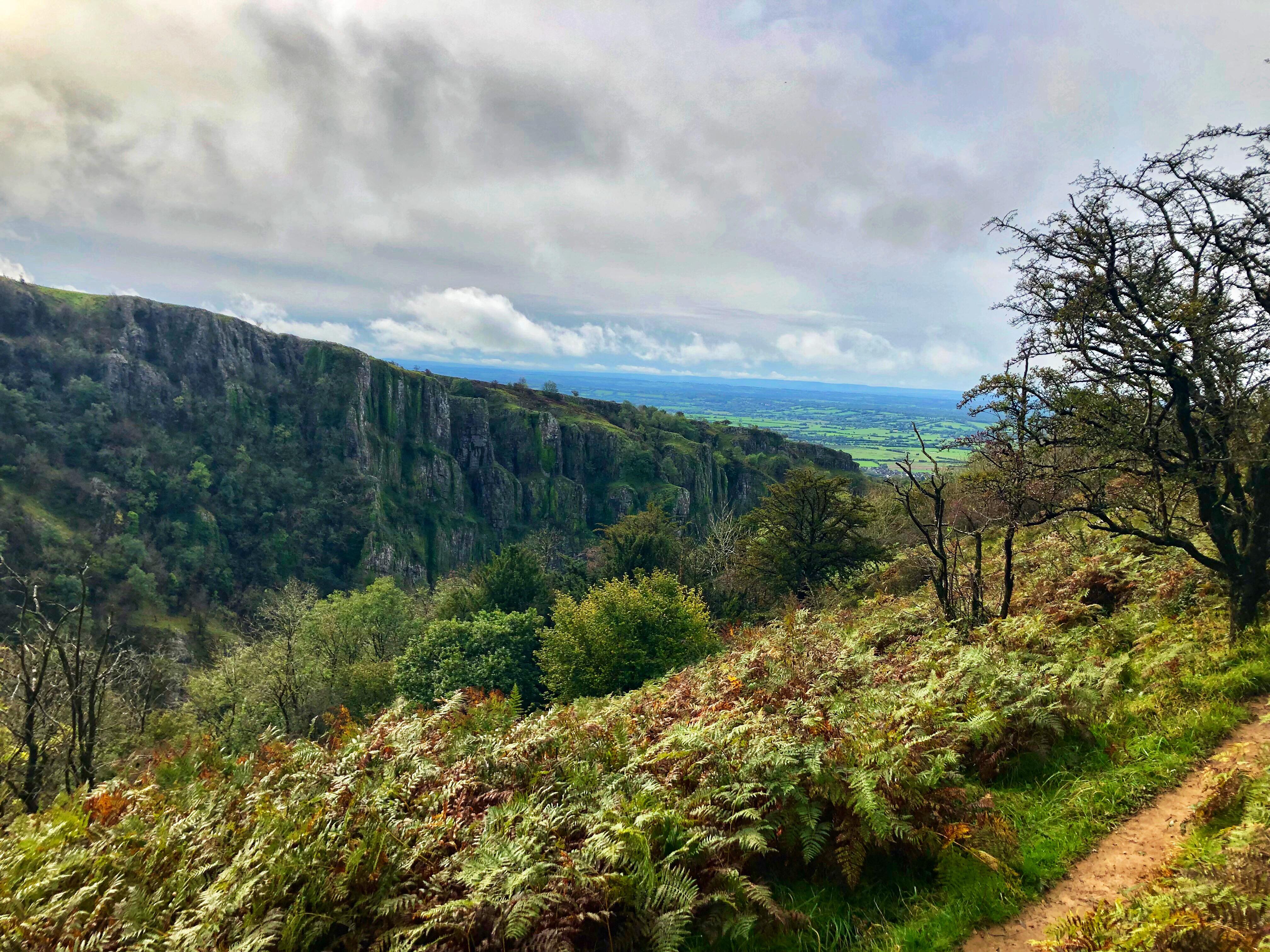
The vertical limestone faces on this side are without doubt the most impressive part of the gorge, towering over the tiny road that winds through the middle. We wandered onto the huge grass-covered fingers of rock jutting into the shadowy valley, regretting that it was too wet to climb – nice looking, partly bolted rock stretches down for several pitches. There’s something exhilarating and unsettling about how the suddenly the ground drops away here, and I was fixated by the ant-like cars snaking along the pass hundreds of feet below.

This south edge offers the best view of the gorge, which abounds in three things – lush vegetation, rocky outcrops and goats. Funny little coarse-haired faces pop up all over the place, from high up sheer rock faces to roads down in the town. Looking across the valley over the crevasse-like edge, the north bank slopes comparatively gently and is carpeted with scrubby, hardy grass, punctuated by smaller rock faces and wind-beaten bushes. A mixed forest thrives at the shallower top end of the gorge until its arrest on the south side by the huge grey rock faces, too sheer to be penetrated by roots.

The landscape around the gorge is strikingly flat in comparison. Miles of green fields stretch out in all directions, lined by straight hedges and interspersed with clusters of reddish rooves. The perfectly round Cheddar Reservoir and Brent Knoll stand out from the otherwise uninterrupted flatness, and the rough, rugged edges of Cheddar Gorge contrast starkly with its cultivated, inhabited, carefully constructed surroundings.

We climbed down the steps of Jacob’s ladder back to Cheddar town and spent the afternoon/evening buying cheese, drinking cider and playing pub games. Cheddar has a decent variety of shops and (more importantly) drinking establishments – we went from a sports bar to a wild west style saloon to a traditional, cosy pub. Choosing to bypass the hairdressers-by-day, nightclub-by-night, we stumbled back clutching kebabs and chasing goats.

Come Sunday the weather was less agreeable and my chubby, partly toothless face was hurting, so we loitered in the Costa tucked into the side of the gorge before heading to Wells, England’s smallest city. I was keen to see the cathedral and wasn’t disappointed – it’s a vast, beautifully detailed and satisfyingly symmetrical building situated in lovely grounds next to a moated bishop’s palace. There was a food festival thing on so the town was swarming with people, but otherwise it looked old and very pretty. We found a quirky old gaolhouse pub, rehydrated and headed reluctantly home.

NB: we didn’t do any caving due to very wet weather (so much so that some of the commercial caves were shut), one sore face and less disposable income than we’d like, but it’s definitely on the to do list for next time.