Brecon Beacons: 3 Days, 4 Waterfalls, 5 Mountains — Day 2

I was up with the sun and raring to hit the mountains, but the weather had other ideas. It would  have been do-able in the wet, but I was interested in visibility more than anything and my Met Office app told me it was due to clear in the afternoon. I’ve been up Pen y Fan in the fog before and done enough beautiful mountains in poor conditions to barely differentiate between them, so I fancied taking the chance to appreciate the scenery.

I’d found out that Brecon had a cathedral and I’m interested in historic buildings (don’t tell my cool friends) so we killed some time wandering round there, then found a pretty, wooded walk by the river. I’d expected (and half-remembered) Brecon to be a bustling, outdoorsy hub like the Fort William of the Highlands or the Betwys-y-Coed of Snowdonia, but it was fairly quiet on Saturday night and totally dead on Sunday morning.

Given the saving we made on dinner the previous evening (see Day 1’s post), we returned to Wetherspoons for breakfast and route-planning. I picked a circular route based very roughly on one described in an outdoorsey magazine that started at one of the car parks in Taf Fechan forest and encompassed the “Big Four” peaks: Fan y Big (719m), Cribyn (795m), Pen y Fan (886m) and Corn Du (873m). It’s an interesting area, geographically speaking: a big, semi-circular ridge linked to six smaller, semi-circular ridges, each with sweeping, sloped sides and long, smooth spines. If anyone ever wants to talk about maps and landforms I’m just a geeky message away.

On the way there it p***** it down and I thought of all the waterproof clothing I didn’t want to wear, but as we drove uphill and into the forest it eased and we were enveloped in thick, blinding fog. We set off in waterproofs but didn’t need them. The first part of the walk took us up a cycle path and along a bit of road. We turned up a steep, rocky footpath past some misty waterfalls, which plateaued onto a foggy, steep-sided ridge. Although we were on the Beacons Way, the route turned off the path and (according to the map) across an open area of land with just “pile of stones” and “stones” marked to prevent us wandering into the middle of nowhere.

Fortunately it was quite easy to follow and we ended up along Craig Cwmoergwm, headed towards peak number one – Fan y Big (behave). Unfortunately we missed the path that led straight there and ended up skirting along the side. After realising we were heading downhill when we should be going up, a quick map check revealed we’d taken a parallel path that took us past the peak; a few paths converged at Bwlch ar y Fan, so we decided to carry on and take a different path up from the other side.

We had jam sandwiches and salad (pre-prepared and super pretentious: quinoa, avocado, beetroot – you get the idea, but mega-nutritious) where the paths met, just as the sun was breaking through. Turning back on ourselves we took the short, steep path up Fan y Big, past a sluggish DofE/cadet group, and only recognised the summit by a distinctive, diving board-esque ledge we’d seen in a photo and a small, easily-missable metal plaque engraved with a picture of some hikers. We admired the smooth U-shaped valley, the river nestled between its shoulders and the long, sweeping sides of Bryn Teg ridge opposite, then realised we were being eaten by nasty black flies and turned back down the steep path.

When we were halfway down, the loud, bleak caw of a couple of ravens reverberated around the valley, so when they landed on the opposite ridge I ran off to take photos. I’d forgotten how large, wild and impressive these fairytale-villain birds are; they cruised and swooped around the valley like majestic, jet-black rangers who didn’t want to be photographed.

Next up (and I mean very up) was Cribyn. Standing opposite Fan y Big, this sharp ascent was the toughest of the route. We powered up earthy footholds that had been toe-punted into the steep side, taking short, aggressive steps and settling into steady, silent rhythms. At the top there was sadly no trig point, and we were sadly attacked once again by hundreds of bitey little f***flies so we didn’t hang about. We didn’t miss the view as we’d wandered into cloud almost as soon as we left the trough of the valley.

We headed to the left and downhill, along the long, steep path between Cribyn and Pen y Fan that follows the curve of another horseshoe ridge. No navigation was necessary, so as soon as we descended below the cloud we could enjoy the sun and the rich, springtime green of the surrounding landscape. What seemed like the “main” valley was to our left, broad, long and shouldered by the horseshoe ridges of Fan y Big & co on one side and a long, straight ridge – Craig Gwaun Taf – on the other.  The glassy water of Lower Neuadd Reservoir was nestled in the valley’s wide, smooth trough, and the black pines of Taf Fechan forest seemed to mark the distant end of the long basin. In contrast, the valley to our right was shrouded in cloud, which crept towards us but was driven upwards in a towering, misty wall by the protective sides of Cribyn.

The adjoining sides of Cribyn and Pen y Fan are like a giant’s half pipe skate ramp, smooth and gently curved. The path is rocky and (in my opinion) easier to climb up than down. Approaching Pen y Fan from the Cribyn path, the last section is a half-scramble up some steep rocks before popping up onto the plateaued summit to surprise the mass of “tourists” who had ambled up from the Storey Arms car park via the heavily-trodden, straight-up-straight-back-down route.

Once again, the summit was swarming with f***flies. I don’t know why but they only seemed to hang about right at the very tops of the mountains. They’re jet black, chunkier than mosquitos and live on a diet of human. A couple of obligatory summit photos later we were keen to get away from flies and people, so headed along the busy ridge at the “head”  of the valley to Corn Du. The section between Pen y Fan and Corn Du is so short and relatively flat that it seems like cheating to count it as the fourth summit, but it’s marked on the OS map so I’ll take it. Again, too many flies/people meant we didn’t hang about for long, so we hit the long, straight ridge of Craig Gwaun Taf (or Rhiw yr Ysgyfarnog?) that lies on the opposite side of the valley to Fan y Big & co.

This was one of my favourite parts of the walk. We came across four people in about an hour (a fell runner, a photographer and a hiking couple with a dog – more my kind of people), ate more jam sandwiches, the sun broke through, we’d escaped the day’s fog and the views were magnificent. The path runs along the top edge of the ridge so I could really enjoy the panorama; the long U-shaped valley that I’ve waffled on about was on the left, cradling its reservoir, opening out onto swathes of dark green-black forest and sided by the foggily elusive horseshoe peaks. A meandering, river-veined valley was on the right, the gracefully sweeping sides of the ridge were ahead and brothers Pen y Fan and Corn Du watched over the valley from behind. All around, the distance was filled with gentler hills, blacker forests and grassy, green-yellow plains.

We eventually came to the steep “footpath” that cut left down the side of the ridge and back towards the car park. From a distance it looked more like a steep rockfall than a path, but we made it down and into the belly of the valley. We walked past the half-drained Lower Neuadd Reservoir, which was surreal as it was bordered with bright pink rhododendrons and some unknown shrub with vibrant yellow flowers. The air was as still as anything, not a soul was in sight and a derelict dark stone building on the edge gave the place a Call of Duty-esque eeriness, but it was equally serene and beautiful. The late afternoon sun highlighted the tall pines against the distinctive blue silhouette of Pen y Fan, the bushes were every shade of green and the water remaining in the reservoir was black and as smooth as glass. The only sound we’d heard all afternoon – beyond our own voices, the scuffing of walking boots and the click of my camera – was birdsong; not one road or aeroplane.

The track back to the car park was lined by trees and rugged sheep fields. Sitting down and de-booting after a day’s hiking was (as always) wonderful. It was about 7pm and my head was swimming with the thought of pub grub and a pint, so after a brief and picturesque goose chase (we accidentally found ourselves in a Thai restaurant disguised a pub, still in hiking gear – we realised we made a mistake when the waitress lit a candle) we ended up at the Three Horseshoes near the campsite. The steak and ale pie and cider went down way better than the bar karaoke, and I slept like a log. Little did I know that the following day I’d play around in waterfalls and get lost on Lord Hereford’s Knob… Day 3 to follow!

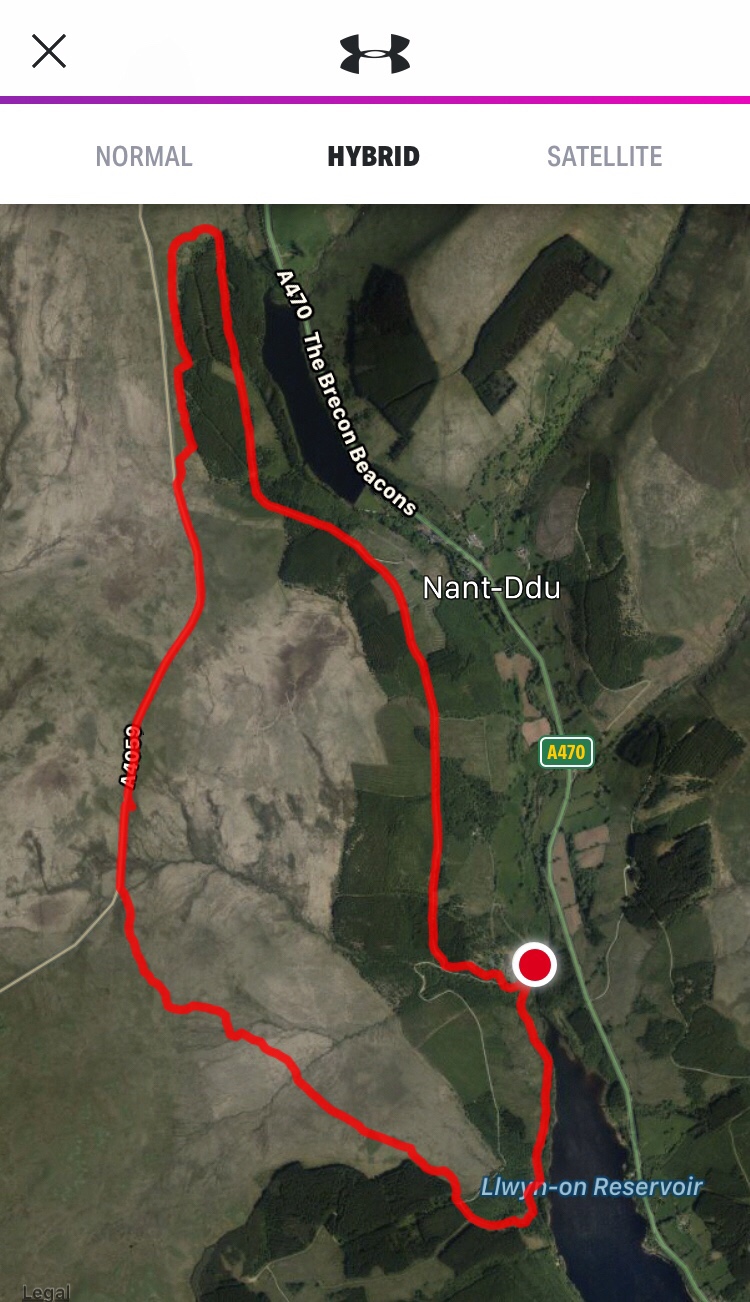
Mapmywalk reckons we did 19.4km in 4 hours 18 minutes, if anyone is interested. Google / walking forums said that similar routes take about 6 hours, but we do maintain a decent steady pace so I wouldn’t say they’re necessarily wrong. Generally we walk briskly but were by no means rushing – I often faffed around taking photos, having a snack or admiring some bit of nature. I have a feeling the app might take that into account, as it felt like we were out longer. Fitbit reckons I did 35,773 steps.35151289_10216632388587715_7897664822563569664_n

Parkrun #1 (and why you should try it)

I thought I was relatively fit until this morning. I haven’t ran for 5-6 weeks due to injury (see Too Much Too Soon) and my leg was okay tramping round the Brecon Beacons last weekend, so I figured it’s time to get back to Ultramarathon training. I headed down to Winchester Parkrun for 9am, expecting a casual 5k bimble alongside gentle, chatting joggers enjoying a spot of exercise before coffee and brunch.

That was a misconception. There were easily 400ish people milling around in parkrun t-shirts, running club vests and colourful sports kit, talking, grinning and looking (almost uncannily) delighted to be there. I asked a marshall how it works and he explained that everyone will set off together, run around the fields a couple of times and collect a token at the finish line that gets scanned with the barcode I’d printed out at home. A nice, straightforward setup.

After a speech and a few rounds of applause (John’s 100th parkrun, welcome Bruce from Sydney etc) a whistle went and the colourful mass swarmed off. There were pacers in orange high vis vests; on my own I’d usually do 5k in about 25mins, so I thought I’d push it and stick as close to the 23min pacer as possible.

Having not run for a while, I felt so good at first that I sped off like a gazelle (or so I thought), overtaking lots of people – including Mr 23mins. I had a lovely time for about a mile, then I realised I’d been way too optimistic. My legs started feeling heavy, I started getting overtaken and couldn’t settle my breathing into a steady rhythm. Exactly what I deserved for flying off at an unprecedented pace on my first run back from injury, and as usual I knew I only had myself to blame. I felt less gazelle, more moose.

Mr 23mins glided past me as I sweated and puffed away, wondering why on earth I ever thought taking up running was a good idea. The next mile dragged, and it only started getting easier as I turned the final corner towards the finish line. Annoyingly I’ve often found that it takes a few miles before I can get into a rhythm, so the run was practically over by the time my breathing started to settle. I crossed the finish line, collected my token and stretched my leg (which barely twinged!) among the still-grinning, sweaty, colourful finishers.

My Nike Run app says I did 5.5k in 23:55, averaging a pace of 4:21 per km. That’s 5k in 21:52, which I’m pleased with, and it would explain why I struggled, given that I usually stick to a fairly relaxed 5min/km. That made me feel better. Parkrun’s results say I was the 11th female out of 153 and 1st in my age group, which gave me another boost. But given the tens of people ahead of me I’m still not quite happy, so I’ll be squeezing some training in alongside exams and assignments (which I should be doing instead of writing this) – and I’ll definitely be back!

It was extremely well organised and the volunteer support was incredible. The marshalls were really positive and helpful, the token system ran smoothly despite the huge volume of runners and I was e-mailed and texted with my results within a couple of hours. It made me realise just how fortunate I am to be able to take part in such a community-led, efficiently organised and fitness-oriented… event? thing? phenomenon?… for free.

What struck me most was that despite the incredible diversity – small children, grandparents, teenagers, pram-pushers, dog-draggers, lean, muscly, round, tall, tiny, black, white, two-legged, one-legged, no-legged – everyone wore huge, ear-to-ear, idiot grins (including me, I realised at the end). I heard countless words of encouragement, cheers from onlookers and just a little bit of friendly competition – not a hint of hostility.

It was a lovely feeling, being amidst this huge, supportive community. Having experienced my first taste of parkrun, I’d urge anyone – and I mean literally anyone, no matter how unfit you think you are – to get up on Saturday morning and give it a go. I get the feeling that running is just a part of it.

Brecon Beacons: 3 Days, 4 Waterfalls, 5 Mountains — Day 1

This trip concluded in an unusual way: we accidentally climbed Lord Hereford’s Knob twice. I’ve had worse Monday evenings.

There were some strange bits in the middle too: once we ended up in a field with a bull, twice we got lost (not so unusual), thrice we found ourselves in Wetherspoons (even less unusual) and we got swarmed by “f***flies” four times. If nothing else, I learned to count.

We left about 6am on Saturday and got to Go Outdoors Gloucester for when it opened at 9. I could spend so much money in that shop, if I had so much money. We got to the campsite about midday after cursing our way through the Hay-on-Wye festival traffic and were pitched and heading to Brecon within half an hour, hoping to get some afternoon inspiration from the visitor centre. Turned out the visitor centre had moved, but eventually we ended up parking near Garwnant (a lovely eco-tourist-information-car park-café-woodland-centre thing) and planning a rough route over the car bonnet.

We set out at 3ish in the sun, heading South and admiring the serene black water and idyllic fishing spots of Llwyn-on Reservoir. Before long we veered off the road, across a stream and onto a windswept, golden plain. A little way in we realised the path went slap bang through the middle of a group of cows. Having grown up in the countryside, this didn’t faze me until I spotted an enormous “cow” with rippling muscles, a tree-trunk neck and an unmistakeably un-udder-like undercarriage. We thought it unlikely there would be a bull in a field of cows, but there definitely was. To spice things up there were a handful of calves in the melée, and anyone who knows anything about animals will know that mums don’t like blundering, invasive humans getting near their babies.

Regardless, we gave them a wide-ish berth, survived and came across our next, often-frequented challenge: the elusive, disappearing footpath. As usual we took a blasé approach and headed in “roughly the right direction”, North West across the knee-deep tufty, grassy, boggy, extremely untrodden plain (I had flashbacks to my last Dartmoor trip). I nearly lost them to the suctionney, hidden, black mud a few times, but apart from that my trusty flip flops served me well.

The sun was warm and despite some haze, the visibility was pretty good. Although frustrating to cross, we’d found an extremely picturesque bit of Wales. Pen y Fan and its horseshoe-shaped brothers lay to the North East, ahead and on our right, and an anonymous green ridge sloped and curved protectively behind us and to the West. Black forests broke up the rugged, green mountainsides and we were surrounded by the rippling, golden (deceptively deep and tufty) grass of the open plain, interrupted only by a few anomalous trees and whispering streams. I spent a while fiddling with my Nikon, trying to capture an arty close-up of pretty little pastel pink flowers which cropped up occasionally, alone and peaceful.

I think we crossed the Nant Ffynnonelin, the Garwnant Fach and the Garwnant Fawr streams, as well as about 2km of this wild, beautiful, slow and hugely irritating terrain, before we reached the A4059 and plodded a few kilometres North along the roadside and past a lot of (surprisingly photogenic) sheep.

We’d hoped to be able to cut down into the forest to the East via one of the footpaths marked on the map, or even over the fence and down a firebreak, but the map was a few years old, the fence looked a few years new, it looked like new trees had been planted and naturally we couldn’t see even a trace of a path. It was coming up late afternoon and the pub had been beckoning for a while; it wasn’t the first time I’d half-formed a plan ready for if/when we were lost, hungry, miles from anywhere and facing a cold, dark night.

We ended up pulling away from the road, cutting across more nasty ground and down a steep hill to the East, right along the North-Western edge of the forest that had been taunting us for over an hour. Halfway down the valley, it was a huge relief to find a gate and a disused-looking track heading back into the forest, criss-crossed by fallen pines and lined by half-uprooted trees whose earthy, rooty bases yawned and groaned as the wind pulled the branches back and forth.

Having kept half an eye on the mist that had been creeping up the valley from Pen y Fan way, we pulled waterproof coats on when we felt the sudden, pre-rain temperature drop and stillness of the air. Fortunately it didn’t materialise and we followed the track a long way through the forest, straight back to the car. 13km and just under 3 hours later (it felt like longer, bearing in mind we’d expected to do half that) we headed to the pub, dizzy at the thought of a pie and a pint.

Unfortunately it wasn’t that simple – several pubs had stopped serving food by the time we arrived (to our horror), so we had to backtrack to Brecon and resort to Spoons. It’s not often I feel underdressed in a Wetherspoons, but half the population of the town seemed to be dressed up and congregating in there while I sat and people-watched in my second hand hoodie, outdoorsy trousers and flip flops. Nevertheless, it hit the spot and saved us enough pennies to warrant returning for breakfast the next morning… Adventures of Day 2 to follow!

Tip of the day: as any other ex-army cadet will tell you, a map is only accurate to the day (the minute, in fact) that it’s drawn!

On Climbing (and Falling)

I did a lot of falling last weekend. They say if you aren’t falling you aren’t trying hard enough, which I choose to believe because otherwise I’m just a terrible climber.


Scrapes and bruises aside, there’s no feeling like reaching a hold you thought was beyond your capability or getting past that nasty bit of rock that had previously defied your persistence. It’s a wonderful cocktail of frustration, elation and adrenaline; I’m new to climbing but I feel like a dog that’s tasted blood – not just addicted, but desperate for more.


The “climbing cocktail” is full of contradictions. One minute I was ecstatic at having made it past a tricky, technical section, the next I was slapping the flat, featureless wall with frustration. It’s super-cool and super-geeky at the same time – dangerous, exciting and hugely technical. I didn’t realise just how much there was to it until a friend told me about the hours he’s spent on Youtube looking at finger-jam techniques, or until I googled “climbing equipment” for birthday present ideas (30th May, just putting it out there) and was faced with a vast range of unfathomable objects.


Technically I know very little but I’m keen to learn. Stripped to the bare bones, there’s “sport” climbing and “trad” climbing. “Sport” involves clipping into metal bolts along pre-determined routes up the wall, and “trad” involves sticking your own lumps of metal into cracks in the wall in such a way that they’ll hold fast if you fall. It’s a total mind game.


It’s also an entirely different kettle of fish to indoor climbing. There’s something so wild, raw and real about the feel of the unforgivingly cold, hard rock under your fingers, and surrendering yourself to the mercy of the sun, wind and fog is oddly liberating. There’s been no human interference with the surface you’re clinging on to, beyond the route-setter who put the bolts in the wall. Nobody chose where to put the cracks, holds and features, and nobody will choose when or how the next bit of rock will crumble. It’s an exhilarating thought.


I’m fortunate enough to have climbing-savvy friends willing to lend me their patience and equipment, so all I own for now is a harness and a pair of shoes (plus a single quickdraw and wallnut that I was lucky enough to find at the bottom of a cliff). I’ve been down to the Dorset coast a couple of times and I love it.


I had planned to write about my (limited) climbing experiences rather than climbing in general, but I’ll do that another time. Time has run away and I’m off to the gym to make amends for the scones, cake and trifle I went to town on at my gran’s (pretty crazy, thanks for asking) 94th birthday tea yesterday.


So what was the biggest fall I took at the weekend? Not the repeated slips off the same, infuriating, polished bit of rock. Not the sideways, double-overhang, twelve-foot, back-first crash into the wall. I’m cringing as I write this disgustingly clichéd sentence, but I think it was probably falling in love with climbing itself, and all the falls that come with it. Climbing is the perfect metaphor for life in general – it’s not how many times you fall, but about how many times you pull yourself back up.

Ultra Training Update: Week 4.5

Anyone who read Too Much Too Soon will know that I was (predictably) too enthusiastic about having signed up to an ultramarathon as I managed to injure myself within a week. Having seen the lovely Hampshire rugby physiotherapist, I have suspected tib post tendinopathy. I won’t bore you with the details but it kind of falls under the umbrella term shin splints. This means that, since week 1 of training, I haven’t been running – not the best start.


Unfortunately I’m the most impatient, gung-ho person on Earth so this has been mega frustrating. However, it has encouraged me to diversify my training. I’m still yet to develop a consistent exercise programme as I’m more of a “wing it” person than a person capable of sticking to rules and schedules, but (like my uni work) I know this is something I should really do.


It turns out there’s more to cardio than running. In the gym I’ve spent a lot more time on the cross trainer, ventured onto the exercise bike and dabbled with the rowing machine, as well as trying to maintain my weights routine. The cross trainer was particularly good as I managed to get some uni reading done and watch a few things on iplayer, but I had to limit my time on it after it started to make my shin ache. Cycling also got my heart rate up and rowing is surprisingly tiring but, like anything, seems to get easier once you’ve pushed through the initial tough 15 minutes or so.


I also dipped my toes into the pool, as you may have read in Swimming Rediscovered. I’ve only gone three times, for which I blame my pain-in-the-backside knot-forming, slow-drying hair (a rubbish excuse I know) but each time I’ve done at least a mile and it’s felt really good. I also swam in the river at Shawford (very cold) and the quay at Bosham (almost balmy), which were both invigorating experiences that I’d only recommend if you’re okay with unseen things touching your feet.


Over the early May bank holiday a miracle happened: the sun got lost and ended up in England. I dug my beloved and too-long-neglected Specialized Rockhopper out the shed and treated it to a beautiful ride in the New Forest. I’ve always considered myself a through-and-through mountain biker, but this 20-ish mile route around the North West of the Forest showed me the light of road cycling (but that’ll be another post).


Two days later I cycled the short (16 mile round) distance from Winchester to Alresford and back and was reminded of the simple formula that prevented me ever achieving regular cyclist status: saddle + bottom = ouch.


Between these bike days I braved the sunny Sunday traffic down towards West Wittering beach – big mistake. Over an hour’s worth of traffic later we launched the kayak at West Itchenor and spent a glorious afternoon paddling 6-ish miles around the creeks – the good, steady workout which inspired On Kayaking.


I went to rugby training last week to try a gentle jog on grass, and I was delighted that it felt okay – barely a twinge. I plan to start running again this week, and this time I really do intend to take it uncharacteristically gently and slowly.


All in all, I’m equal parts furious and exasperated at myself for causing this first hurdle, but also a little bit pleased to have had so much fun with other forms of exercise. I’ll definitely be incorporating cross trainers, rowing machines, bikes, kayaks, pools, rivers, seas and anything else I can get my hands on into my cardio regime, and fingers crossed I’ll be running around like a clueless, grinning idiot again soon.


On Kayaking

There’s something so liberating and solitary about kayaking on the open water, suspended between the earth and the sky and just existing. Keep still and you’ll feel simultaneously numb and hypersensitive; weightless and isolated, but acutely aware of sound, light and the feel of the air.


Perhaps my favourite thing about it is having the freedom to move without diversion.  On land our direction of movement is constantly influenced by paths, roads, walls, barriers and landforms, but on the water there are no waymarkers or boundaries beyond boats, buoys and the occasional rock. Without these predetermined “invisible arrows”, you have 360 degrees of glassy expanse to carve your way through before the water swallows up your trail. You could be the first and last person to ever take that exact route; echoing the eternal Fleetwood Mac, you go your own way. You’ll know what I mean if you try it.


Being in such a small vessel enables you to explore places you’d otherwise never see and discover creeks, beaches, woodland and countryside you didn’t know existed. At risk of sounding like the Youtube “Gap Yah” guy (I wonder what happened to him?), you’ll feel at one with nature as you immerse yourself in a new, bustling world of plant, bird and marine life.


Nature, enlightenment and self-discovery aside, paddling is great for core and upper body strength because it uses muscles that are often neglected, particularly in the shoulders and back. There’s something so satisfying about stretching out your arms and pulling yourself through the water, feeling your strength translate into each powerful stroke, and the burn in your muscles is one of those oddly “nice” aches. You also use your legs a surprising amount to stabilise, brace and manoeuvre the kayak.


Once you settle into a rhythm the repetitive motion is really therapeutic. This, combined with the healthy dose of fresh air and gentle lapping of the water, makes it both relaxing and invigorating. I particularly like messing around on tidal rivers as there’s something refreshing and restorative about the tang of salty air – it works wonders at blowing out cobwebs caused by one too many drinks the night before.


All that said, it’s a surprisingly versatile activity which doesn’t have to be all about flat water and balmy air. Getting out on a choppy sea or a fast-flowing river affords plenty of opportunities to try some whitewater action, which is understandably less relaxing but (depending on your outlook) more exhilarating.


I got out on the water last week for the first time in a while and it reminded me how much I love everything about it, so I thought I’d pay tribute to kayaking on my blog. If I convince one person to hire, buy or borrow a kayak I’ll be delighted and I’m sure they won’t regret it. And if anyone wants someone to go with, count me in.

Swimming Rediscovered

I’m probably the most impatient and restless injured person on the planet, and unfortunately suspected “tib post tendinopathy” has sentenced me to an unknown period of no running. Desperate to keep my fitness up, this week I’ve been cross training, rowing, cycling and – for the first time in way too long – swimming.


I used to be a really ungainly swimmer. I learnt quite quickly but messed around in swimming lessons and was never interested in technique. After getting a part-time job as a lifeguard in 2011 I decided to get better, so I slipped (literally) into the pool a few times and worked on my stroke, kick and breathing. Hours of lifeguarding swimming lessons and being forced to watch people swim (the most monotonous job you could imagine) probably helped, and now I’m marginally less ungainly.


I haven’t been for ages and have some poor excuses. My hair is really long and I’m certain there are little pool-demons that tie it in the most inextricable knots. I know the lifeguards so I’ll end up chatting and/or being made fun of. Pool water is really disgusting – full of people’s body oils, skin cells, wee, hair and dissolved farts (by far the truest and most legitimate excuse).


Excuses aside, I turned up at the pool on Thursday intending to do a mile (64 lengths) and expecting to struggle with fitness and boredom. Stretching my arms and legs out in a relaxed front crawl felt great for about 10 lengths, until I felt unfit and bored. Then I found myself secretly racing the fastest person in the fast lane, a 50-something year old swimmer with a super-efficient looking technique.


Safe to say he was out of my league, so I got tired, frustrated and splashy. I rested and chose to stick to the slightly slower pace set by “swim hat lady” as I had no idea how quick I should go. She helped me a lot, and I started to settle into a (slightly messy) rhythm.


Two things slowed my progress, both involving my cheap H&M bikini bottoms: my waist-length hair kept tangling in the tie-strings, and I didn’t trust them to hold fast as I kicked off from the wall. It would  be no fun for anyone, least of all me, if they decided to go whereabouts. Tip: buy actual swimwear designed for actual swimming.


As the pool became less busy, I focused less on whether I was getting in anyone’s way and more on my technique. I’ve always breathed on every fourth stroke, always on my right side. I have a bad habit of holding my breath rather than blowing bubbles under water. I decided to try breathing every third stroke as I’d heard something about muscles developing/tightening non-symmetrically if you only breathe on one side. It felt unnatural and awkward but more doable than I expected, and my stroke became a bit smoother the more I lumbered through the water. Breathing this way actually felt more natural after a while, so perhaps every fourth stroke had  always been too long.


I finally felt I had settled into a good rhythm at about length 55, despite getting foot cramp and swimming a couple of half lengths looking as if I’d been shot. I felt so good after a mile that I decided to bump it up to 100 lengths (I’m a bit obsessive about round numbers) and oddly enough it only got easier as I relaxed more, despite calf cramp kicking in at length 87.


Every time I lost count I rounded down, so I ended up doing 106 lengths (2.65km) according to my borrowed Swimtag band. I felt so good that I’d have kept going if the pool didn’t close. I just couldn’t believe that a) it took 50-60 lengths to settle into a comfortable rhythm, b) after 64 lengths I felt less tired than after 10, and c) changing my breathing stroke helped so much. Okay it took about an hour, but I did keep pausing to de-mist goggles, untangle hair and have a drink.


I know this is probably a really boring post but I wanted to document my return to swimming. Despite the arduous fight to detangle my hair in the shower I really enjoyed it; there’s something so therapeutic and solitary about being in the water, particularly once you push past the initial “wall” and settle into a rhythm. I recommend giving it a go. I’m glad to have rediscovered a low impact, non-self-destructive way to keep fit, and I think I’ll invest in more suitable swimwear and (maybe) a swim hat. Even though my heart is in the lakes, rivers and seas, sometimes the pool just has to do.

Time to ditch our running shoes?

In Christopher McDougall’s Born to Run, a guy called Barefoot Ted swears by running with minimal foot protection and it kind of makes sense. Our feet evolved over millions of years to transport us everywhere, and we’ve have been running the entire time. Da Vinci called the foot “a masterpiece of engineering and a work of art”, and McDougall compares it to a complex, super-strong suspension bridge. It has 26 bones, 33 joints, 107 ligaments, 19 muscles and some tendons (thanks Google). Thousands of nerve endings make the feet mega-sensitive to stimuli (hence they’re ticklish).


Such acute responsiveness to pain taught our ancestors to run the way evolution intended, not the way running trainers enable us to. In contrast with the super-long-term evolution of the foot, the cushioned, supportive, “corrective” running shoe has been around less than a century. 80% of trainer-clad runners strike the ground heel first, whereas we naturally run with a forefoot strike – as illustrated by the Tarahumara running people of Mexico and other runners from non-Westernised cultures. Try it; the impact on the uncushioned heel makes it too painful on the foot and the shock shoots up the lower leg, jarring the knee.


McDougall is critical of the corporate giants pushing the latest state-of-the-art, mega-cushioned, super-corrective miracle running shoes on unwitting consumers (I’m guilty as charged). He points out that the best tried-and-tested models are often pulled from shelves to encourage runners to stockpile favourite shoes, and that there’s always some brand new “technology” to entice buyers with its promise of easier runs and faster times. Not to mention any names, Nike (again, guilty as charged), but the big names definitely have a vested interest in convincing us success comes from the purse.


McDougall describes how a top running coach at some American university experimented on his runners. He bought one group top-of-the-range, big bucks, high-tech running shoes and another group cheap, minimalist trainers. He found that the expensive shoes caused the runners to tire quicker and suffer more injuries than the cheapie ones. Similarly, another running  expert advocated the use of worn out, battered old shoes that  had lost much of their spring over brand new trainers. Hmmm.


Born to Run highlights the lack of injuries suffered by native runners with minimal or no footwear. It suggests that joint problems associated with repetitive pavement-pounding are more likely to be caused by the poor technique and unnatural gait which result from the over-compensation and over-protection of modern trainers. Constant support, particularly under the arch of the foot, weakens the soft tissue as it’s no longer needed to do its load-bearing job.


Running shoes enable us to run faster and further than our bare feet would, and prevent us feeling the pain that we evolved precisely to respond to. It’s easy to run too much in trainers, particularly when beginning a training programme as I recently have. The cushioning prevents our feet telling us when enough is enough, so our joints, muscles, tendons and ligaments end up absorbing way more shock than they’re accustomed to, resulting in injury.


I tried running barefoot on the treadmill and was amazed at the difference. My arches ached very quickly and my feet were much more sensitive to what was underneath them; I trod really lightly and much slower than usual. It’s the sort of thing you’d have to build up really slowly (remember that our ancestors started building up shoeless foot strength and tough soles since they learnt to walk) but I imagine it’s really liberating once you get there.


So perhaps trainers weaken our feet and make us run wrong. Perhaps they don’t. I just wanted to write about this because I found it really interesting. All in all, I won’t be ditching my Nike Pegasus Air Zooms just yet but I do plan to invest in some of the funny-looking five-toed running shoes that act as a second skin (once I find some money) to give barefoot running a go. I’m by no means an expert in anything foot, running or anatomy-related, but the barefoot theory seems logical to my keen little brain, and I could do with saving a small fortune on my next pair of shoes.

Too Much Too Soon

These four words sum up my life. I’ve always had a propensity to jump into things headfirst, blindfolded, at the deep end, hands tied behind my back. In 2008 I went on a bike ride, decided I loved mountain biking and (aged 13) saved up about £550 for my trusty Specialized Rockhopper. Then I spent £60 on a full face helmet. Within 6 months I rode down the steepest side of the steepest hill I could get to, resulting in an irreparably buckled wheel – a further £60.


I think I’ve done it again. After my last naively optimistic post, which gushed about how I’d fallen in love with running and run almost 40 miles in 5 days, I semi-rested on Friday, Saturday and Sunday. On Sunday I walked 7.5miles around the New Forest (in flip flops, of course) and noticed a sharp, twanging pain shoot occasionally through the inside of my left shin. I had noticed a slight ache on last Thursday’s 9-mile run but thought nothing of it.


Yesterday I went for a gentle run and noticed it hurt about half a mile in; I applied my normal “rugby attitude” and decided to “run it off”. I only intended to do 2-3miles but the pain went away and I felt great so I did 6. Fitness-wise I felt unstoppable but knew I should turn towards home when it started to hurt again at about mile 4.5; I realised I had altered my gait to compensate for the pain.


Google helped me self-diagnose shin splints but I’m not 100% sure it’s that. I’m quite surprised as I’m a forefoot runner – the ball of my foot hits the ground first – and from what I’ve read most runners are “heel strikers”, which places more stress on the legs as the foot doesn’t absorb the shock. Also I’ve always done a lot of sport, run roughly every 2-3 weeks, go to the gym three times weekly and play rugby most weeks, so I thought I’d be fit and strong enough to not pick up a silly injury so soon.


The pain is bearable at the mo and I’m desperate to run it off, but I’m terrified of making it worse and having to rest properly. I’ve bought compression socks, kinesiology tape and ordered insoles (instead of paying uni fees) and I’m weirdly excited to try them out.


I’m concerned for the sake of my ultramarathon training, rugby-playing and general hyperactivity, so if anyone would like to offer help, advice or shin splint-related services please get in touch, Facebook has proved invaluable already. Just one proviso – if you’re going to tell me to rest, do it as last-resort-advice and please break it to me gently. And mention the words “stress fracture” at your own peril. #prayfornay

Ultra Training Update: Week 1

It’s been almost a week since I signed up for an ultramarathon at 2am after an impromptu drinking session and for some reason I haven’t cancelled my booking. Friends have told me I should postpone it until another year to give myself enough time to train (alongside study and work), among them a personal trainer and an ex-marine.


Perhaps that’s why I’m keen to give it a go; being told I can’t do something triggers my resolve and makes me dig my heels in, absolutely determined to do (or at least attempt) whatever silly thing it is. So far it hasn’t proved fatal.


Anyway this week I started “training”. I’m reluctant to use that word as it seems too formal and serious, when really I’ve just been running a few times. I looked up 4-month 50-miler training plans, but a) they were aimed at seasoned marathoners, and b) I didn’t like them anyway. So instead I just ran. Maybe I’ll devise a written plan at some point, but for now I’ll focus on putting one foot in front of the other and not dying.


After last Saturday’s 13.1 miles, I ran 2.5 miles on Monday (with a friend, otherwise I would have gone further) followed by 10mins barefoot on the treadmill. I’m keen to train my body to run barefoot after reading Christopher McDougall’s Born to Run, but that’ll be another blog post. I did 7 miles on Tuesday followed by 12mins barefoot treadmill, 5 on Wednesday (with another friend) and 9 on Thursday. I probably shouldn’t have run Weds or Thurs because of the blisters on the balls of my feet – from the treadmill, although I’m reluctant to admit it – but I have an addictive personality and I was addicted.


Unfortunately yesterday and today I admitted that I should let my feet heal (and my legs rest, although they’re itching to run) before I make them worse, so no running. Somehow one blister has extended to between my big and second toe, where the flip flop strap goes, and has left a sore, red split in the skin. This is super annoying as you’ll rarely catch me in anything other than flip flops or barefoot from April to October. If it wasn’t for that I’d be running now. I hate resting.


So far I’ve found that the first couple of miles are easy, the next three-ish are the toughest, then it gets easier again. At the end of each run I thought I could happily carry on, but stopped because I had plans or felt I should go easy on my body to begin with. I’m the most impatient injured person ever to have existed. My breathing has been fine, I’ve had no joint pain and the initial calf soreness seemed to ease after going barefoot on the treadmill, stretching and using a foam roller. I’m being kind to myself by focusing on distance, not pace, and enjoying each run.


Blisters on the balls of feet are particularly irritating as plasters don’t do much, seeing as you put pressure on them every time you take a step. I’d never burst a blister running until Thursday’s 9-miler, when I was happily into mile 7 and all of a sudden it felt like my left foot landed on one of those washing machine liquitab things. I didn’t even realise that blister was still there until then, but it was horrible. Would not recommend.


We’re coming to the end of a mini heatwave which started on Wednesday, so the 5 and 9-milers were  balmy. The meadows, fields and streams I stumbled through on Thursday’s run were picture-postcard lovely, but I felt like I attracted, inhaled and swallowed enough flies to hit my protein target for at least the next week. At one point I tried and failed to extract one from my eye mid-run, only to come across it later as I attempted to apply mascara on my way to the pub.


Another thing I noticed on that run was that when I went exploring and ended up on rocky, rooty, hard mud-ridged narrow paths, it got easier and I got quicker. I was amazed that I’d been struggling a moment before on the smooth road, yet I hit more technical terrain and ran better. I suppose that goes to show how significant the mental aspect of running is – despite considering myself relatively resilient and self-aware, I was sub-consciously focusing on my tired legs until I was forced to concentrate on my footing in order to not break a leg.


So that’s where I am with four months to go. I’m hoping to get a run in tomorrow, foot-dependent. In other news, I finished Born to Run and started Eat & Run by Scott Jurek, an ultramarathon legend who featured in the former book, I’ve got a couple more blog posts planned (very loosely, in my head), and today I swam in a cold, dirty river. Uni is boring and I’m still poor.


31093351_10216239742051797_2866265417330982912_n