Girona, Spain: Cycling City to Coast

9 July 2022

I got up early and had a life-shortening experience washing and de-knotting my sea-salty, matted, impossibly tangled hair. I returned to the bedroom two hours later, a broken woman, to find Ryan half awake and wondering if I’d died in the bathroom. I think part of me did. We left the apartment and headed through Old Town to Eat Sleep Cycle, a modern, reassuringly English-sounding bike shop, intending to hire bikes and spend the day pedalling away the trauma.

They didn’t have any standard mountain bikes to fit Ryan, which I suspect was to his relief as we ended up with a couple of gravel e-bikes. We nipped down the street to a Spar for food and drink while they prepared the bikes and set off on our ride about midday, pleased with the helpful, friendly service at the bike shop. They recommended taking the Via Verde (green path), a disused railway line turned into a cycle route, southeast towards the coast, and joked that they’d buy us a beer if we made it to the beach and back by the time the shop closed at 7pm. It was game on.

Girona to St Feliu de Guixols (25 miles)

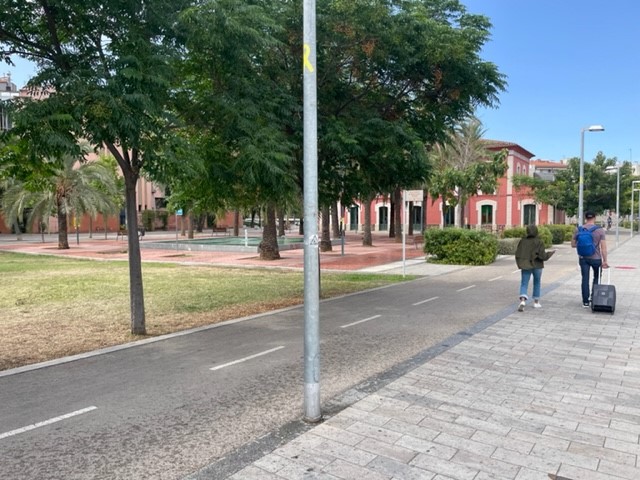
We headed out of the city along cycle paths (the cycling infrastructure seemed much more comprehensive than in England) and followed the river south. We were so excited to get going that we hadn’t really listened to the directions and struggled to find the start of the route, so we carried on along the river until we found a Via Verde sign. We managed to go wrong again at a slight fork in the path and ended up heading towards a different part of Girona, so after cycling up a twisty hill we turned around, went back to actually look at the sign, and righted ourselves onto the route.

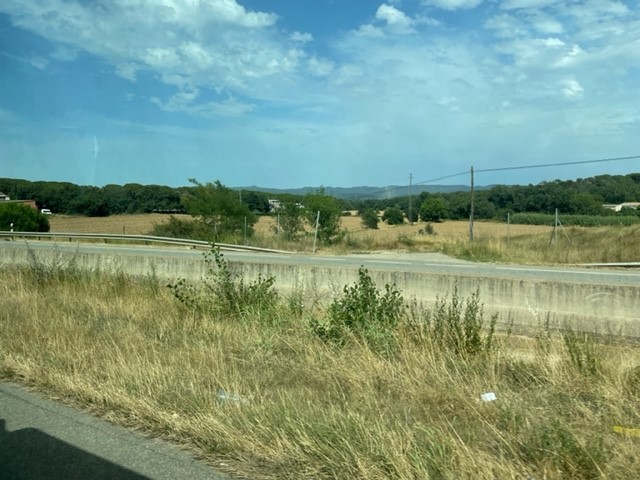
Finally back on track, we rode out of the city and through hot, dry, golden fields on a wide, flat dirt path. We passed through a residential outskirt of the village of Quart, which was very clean and eerily quiet given that it was midday on a Saturday – what we think of as prime time for people to be out enjoying their gardens, but the hot Spanish sun lacks the novelty of its English counterpart and seems to inspire indifference. We popped out at the other side of the village and rode south for several miles through more open fields.

The landscape was a patchwork mosaic of golden wheat, tall green corn, orderly vineyard and leafy woodland with the occasional farm or miscellaneous building scattered at random, separated by rows of thriving trees and hedges. The horizon was dominated ahead, behind and to the right of us by a long chain of rolling, hazy blue mountains, which must have been the Massis de les Cadiretes, Massis del Montseny and possibly the easternmost Pyrenees. It was stunning, tranquil, and very hot.

We loved the electric bikes. They had three power modes which we used conservatively, saving the battery for the way back, but we tested them a few times and the controlled acceleration of high power mode was a real buzz as I pushed down on the pedals. For the first time ever, I understood the appeal – it meant we could still have a long day of pedalling while being able to travel much further than on normal bikes, and I liked that I could turn the power off to make it harder.

We went slightly wrong at the town of Cassa de la Selva as “we” assumed directions instead of stopping to properly look for signs, and ended up cycling along a fairly busy road through the slightly shabby town. Luckily we spotted the flat, straight path across some fields after passing through, rode along a dusty drive past a memorably lovely house looking over fields and mountains that reminded me of something I might once have built on the Sims, and continued back on track through the agricultural patchwork.

About halfway along the trail we were tempted by a café at Llagostera, a pretty, quiet town with tree-lined streets and some impressive allotments, but decided to press on to get to the coast and back. After Llagostera the landscape changed from flat farmland to undulating forest. We cycled east parallel to the main C-65 road that cuts between the Gavarres and Cadiretes massifs through the Ridaura valley, then down a long, fast, curving hill into the thick trees. The forest was loud with the panoramic, cricket-like buzz of cicada insects and lush with vegetation, including bark-shedding eucalyptuses and partly stripped cork trees.

We emerged from the forest at a small town called Santa Cristina d’Aro, where we managed to get lost thanks to a poorly signposted section of the route. We rode through the quiet, dusty streets out to a large roundabout, turned around instead of joining the main road, explored all exits of another roundabout, cycled past the same bar four times – probably to the great amusement of the customers – and realised that if we’d gone straight on from the forest we’d soon have found the signs. Frustration turned to bemusement and we continued on the route, which now took us through a patchwork of residential streets, small industrial estates and little patches of farmland as we approached the coastal town of Sant Feliu de Guixols and the end of the Ruta del Carrilet. I was particularly taken by the view to our left, where an array of houses nestled sporadically in amongst trees high up on the thickly forested hillside.

We continued through this urban sprawl towards the town centre and decided that Sant Feliu looked too large and busy for our liking, so we took a left and cycled down a road to Platja de Sant Pol, a small beach that follows the curve of a pretty, C-shaped bay enclosed by land on three sides. The beach and all the little seafront restaurants were pretty but all very busy so we snapped a couple of photos, grabbed some cold Fantas from a shop and headed back the way we came.

Return to Girona

We made our escape from the peopley place and opened up the power on the bikes to get back to Girona for 7pm. It had taken us about three and a half hours to cycle the 26.5 miles there and the time was 4pm, so we had 3 hours to get back and were feeling the pressure a little – there was no room for error. Luckily we were flying, and now that we knew the route we were less likely to get lost. We went back through the forest, up the long hill to Llagostera, back through the fields (notably past an old farmer pootling along on an ancient red tractor – a postcard-worthy image) and towns and into Girona. The panoramic mountain views in the hazy afternoon light were stunning, and although we’d cycled past several other bikers on the way there was barely anyone coming back. It felt like a fairly substantial distance – I mistook a couple of urban areas a few miles out for the edge of the city and kept being surprised that we weren’t back yet. The additional power took the brunt out of the hills and allowed us to really open up on the flats, and by the end of the day we were enamoured with the electric bikes.

53 miles later, we made it back for 7pm. We dropped the bikes off and went back to the room to relax, listen to the Catalonian song we’d heard a couple of nights ago and wash the thick layer of dust off our skin. We headed out for dinner at 9ish, wandered around deciding where to go, and settled on the Indian restaurant recommended by a friendly man who’d chatted to us about Bournemouth in an ice cream queue. It was a tiny place in one of the narrow streets of Old Town, and we sat at a table out the front. The toilet was hilariously quirky – the smallest room in the world with a nail and a twisted paperclip for a lock – but the curry was amazing.

After dinner we walked through the bustling streets of Old Town, crossed the river and returned to Placa de la Indepencia  one last time. I decided that I couldn’t have an abroad holiday without a cocktail, so I indulged in a fruity, rum-based “Rastaman” from Fockviu, one of the many bars spilling along the edge of the large square. We sat, people watched and drank, feeling very satisfied. Full and tired, we left the square, crossed the river at the red cage bridge, paused halfway across to watch the lights of the pretty buildings dance and shimmer on the calm black water, walked back through the warmly lit little streets and collapsed into bed about midnight.

Girona, Spain: Snorkelling on the Costa Brava

8 July 2022

I woke in pitch darkness wondering why I felt so awake, until I realised it was 9am and the window shutters had completely blocked the daylight from our room. I suggested hiring a car for the day to go and see the mountains and national parks north and west of Girona – Les Guilleries and Parc Natural de la Zona Volcanica de la Garrotxa. After a couple of biscuits and a peach kindly provided by our AirBnb host, we headed through the warm streets of Old Town and across the river to find the car hire place.

The city west of the river is newer and less charming than the east, but the streets were clean and quiet. We walked between tall buildings and through the large plaza by the station in an unsuccessful search for a convenience shop selling sandwiches – it seems that Catalan businesses have quite sporadic opening hours, and there’s certainly no such thing as a meal deal. We grabbed paprika crisps from one shop, sun cream from another, and eventually found the car hire place in a strange, dead quiet residential area – all shuttered up.

Platja d’Aro Municipality

A little exasperated, we decided to head back to the station to catch a bus to the coast. We walked along clean, quiet main roads past a busy corner café (presumably full of car hire people) and a couple of telecoms engineers working on a pop-up table under a parasol, to the amusement of Ryan (the telecoms engineer.) At the large, air-conditioned bus station, a lovely English lady helped us find the right bus and we waited in the queue for the 11.45 departure to Platja d’Aro.

Rather than the low, long, slightly oppressive box full of people, handrails and stop buttons that I’m accustomed to as a not-very-regular participant in the English public transport system, the bus was what I’d consider a touring coach. It was comfortable and nobody paid attention to the face mask signs. The journey took us through quiet, dry towns with pale buildings and low-angled terracotta rooves and past flat, golden fields backed by distant mountains. It was interesting to see some of rural Catalonia, and we arrived in the large coastal town of Platja d’Aro after 40 minutes.

We checked the return times and walked through a large, palm-lined plaza towards the sea. This town felt more modern and touristy than Girona, with lots of beach apartments and an almost Miami-like vibe – to us, anyway. We turned off a street onto the beachfront, which was crammed with outdoor bars and restaurants looking out over pale sand and clear, blue water.  Platja Gran d’Aro beach was busy enough but far from crowded, and we walked for 20 minutes along the wide, paved promenade to the quiet northern stretch of sand.

Platja Rovira Beach

The path curved and narrowed into an open passage as we walked between a rock face and a low wall, which took us up some steps and through a tunnel. We emerged at the back of a sandy cove where interesting rock formations punctuated the sand a little way below us, including an upright pinnacle that begged to be climbed, and verdant shrubs spilled from the wall where the land dropped away. We carried on and the path arced around to the left revealing Platja Rovira, another small stretch of sand separated from the cove and main beach by rocks jutting into the sea. We liked the look of this beach, which was also busy but not rammed, so we wandered down to find a spot.

We set our towel (Ryan didn’t bring his) down at the far end below more high, vegetation-topped rocks, and buried our valuables ready to go in the sea. The “sand” was more like extremely fine, smooth, almost white gravel, which felt nice underfoot and was blissfully easy to brush off. We managed no more than a few minutes “relaxing” before grabbing our snorkels and trotting off to the sea, which shelved steeply and provided respite from the burning heat, which thankfully was tempered by a light breeze.

The water was clear, deep and incredibly blue. We swam over rocky worlds absolutely mesmerised by the unfamiliar fish – colourful purple-yellow-green wrasse, large, bottom-feeding mullet, some kind of piranha-shaped things with fine stripes and thick lips, snake-like red and black things, huge shoals of tiny shiny things and small bright orange things, all hovering around the anemone, urchin and grass-like weed covered rocks.

We snorkelled for half an hour, swam across to a floating pontoon for the sole and fully legitimate purpose of jumping off, and headed back to the beach for a second attempt at relaxing. That didn’t last long, and we ended up packing up and walking back to Platja Gran d’Aro in search of some lunch. We found a medium-sized supermarket on a street behind the beach and were bemused to find only four sandwiches in the whole shop. We left with a strange combination of snacks – a sandwich that was half omelette, half ham and cheese, some dubious looking ham and cheese toasties, paprika Lays, a couple of mojito beers, a litre of sangria and a quarter watermelon.

Platja Gran d’Aro Beach

We stopped to eat at a grassy, shady spot along the beachfront. The watermelon, sangria, crisps and ham and cheese sandwich were lovely, but the omelette sandwich was a serious undertaking – heavy, vinegarey and generally unpleasant. I’d expected Ryan to share the melon but he didn’t want any, so having decided to return to a different part of the beach, I waddled back to the north end of Gran Platja d’Aro feeling very full. We sat near the rocks at the end, buried our stuff in the gravelly sand and pulled on snorkels ready to go and find some more fish.

We spent another half hour mesmerised by the colours and shapes of the underwater world, where undulating rocks formed foundations for cities of fish, spiky black urchins, huge anemones and grassy weed. We braved taking my waterproof iPhone 12 Pro in the water and despite the immense difficulty of simultaneously clutching it with one hand, constantly rearranging our cheap snorkels, not kicking rocks and staying afloat, we got some great footage (in amongst the mass of blurry, noisy, shaky footage). We headed back to the sand about 7pm on deciding that in our attempt to take videos, we’d swallowed way too much seawater.

We buried my legs in the sand for no good reason, drank sangria and messed around on the rocks, then set off back to the bus station along the still buzzing promenade. We caught the 8.30pm bus back to Girona and enjoyed the sunset over the distant hazy blue mountains, golden fields and quiet towns.

Back in Girona

We went straight from the bus station to our apartment, dumped our bags and quickly changed before heading out for dinner. We walked through the narrow streets of Old Town, which were lit warmly and colourfully by the various restaurants and shops, to the Konig restaurant by the tall, beautifully lit Basilica. We sat outside in kind of a courtyard by the open, carless street and were once again amazed by the lateness of life in Catalonia – we didn’t start eating until 11pm but the restaurant was busy with people, including young children. Feeling still full of melon and salt water, I had a prawn, egg and avocado salad with bread and Ryan had a lovely risotto with prawn and scallop skewers and grilled courgette. Satisfied, knackered and still salty, we headed straight back to our room and dropped off to sleep.

Girona, Spain: Exploring the City

7 July 2022

We decided to spend our first full day exploring the city after the fiasco we’d been through to get into Spain (read here). We left the room quite late, about 10.30am, and walked through the beautiful, quiet, cobbled streets of Old Town to the cathedral, which was barely 10 minutes from our apartment.

Cathedral

We wound through medieval stone streets, past a large round turret, under a huge arch and into a castle-like courtyard. Girona Cathedral loomed above us up a flight of about a hundred wide steps, a vast, majestic building with a clean-lined, simple shape but incredible intricacy in the stone details and carved figures that watch over the city. I could see why it was chosen as a set for Game of Thrones, with its perfectly preserved, timeless grandeur.

We climbed the stairs and paid for entry (€7 each), which included a free recorded audio tour – this turned out to be well worth doing. We entered the enormous, striking Gothic nave and learnt how it was the widest of its kind in the world: the architects had decided to forego the two columned aisles usually found on either side of a cathedral. An enormous wooden organ stood in the middle behind models of the cathedral’s development, and the edges were lined with 28 different chapels dedicated to saints. They all had unique stories and contained varying styles of carving, painting and sculpture, some dramatically ornate and some strikingly simple.

After about 45 minutes walking around the nave listening to the audio tour, we went through to the cloisters, the columned walk that encloses a grassy outdoor courtyard on all four sides. My favourite part was the several wide columns pointed out by the audio guide, each of which were engraved with 360 degree carvings telling biblical stories. We went up some stone stairs into a room featuring pieces of stained glass from different periods, then back down and out of the cloisters into the tapestried, chandeliered Chapel of Hope, where the lavish, gold-gilded “bed of the Assumption of Mary” sat under a high-ceilinged tower.

The last bit took us into the cathedral treasury museum, which contained various religious artefacts – sculptures, paintings, silverware, chests and manuscripts – and notably the fascinating 12th century Creation Tapestry, depicting the months and seasons. It was all so interesting that I almost wish I’d taken notes to remember it all. We left through a corridor back onto the façade overlooking the medieval square and the red-tiled city rooves, nearly two hours after we’d entered, and went off to find some lunch.

Lunch

We walked through the pretty, cool stone streets of Old Town, crossed the river and went to Placa de la Independencia, the large, restaurant-lined square we’d found the previous night. We sat down for lunch at Konig, a reasonably priced restaurant (we decided it was possibly the Wetherspoons of Girona, but no complaints), and I had a smoked salmon, avocado and ricotta bagel while Ryan had some kind of rice, pepper and calamari salad. A couple of glasses of sangria made me quite tipsy – I blame the heat – and we relaxed (to my initial agitation) there for a while before heading off to find the city wall walk.

Medieval Walls

We went back across the river, through the old streets and behind the cathedral, where incredibly tall, thin cypress trees stood over high stone walls, little public gardens and criss-crossing footpaths. On our way up some steps we bumped into a friendly local who told us his favourite spot in Girona to get a good view of the city, so we followed his directions down the hill and up some steep steps onto a high, narrow wall near the John Lennon gardens. We walked along this wall to the highest point, where we stopped to look over the city. The cathedral sat on a hill, the highest point in Girona, and dominated the foreground, along with the high stone tower of the San Felix Basilica. Tiled rooves sprawled between swathes of bright green trees, and the horizon was shaped by distant, hazy blue mountains. It was as stunning as the heat was stifling.

We backtracked along the wall and through the peaceful John Lennon gardens, then headed east along a path set between tall, lush trees towards the main medieval wall, pausing to look at a pair of striking green monk parakeets perched on a branch above us. We got to a large stone tower by the Jardins dels Alemanys and climbed the stairs inside to the top. We stood on the tower and stared across the terracotta rooves of Old Town, large modern blocks beyond the stone buildings, and layers of rolling mountains spanning the skyline, all interspersed with leafy vegetation.

The wall ran in a long, straight line with several towers spread along it, almost all of which we climbed. The views of the city were incredible, a mix of old and new, and somehow – despite the sprawling streets and mass of buildings – it seemed small set beneath the thickly forested hills. We bimbled along the length of the medieval walk, which took about half an hour with the tower stops, and climbed down the stairs at the other end, returning to the southern part of old town.

Old Town & Tapas

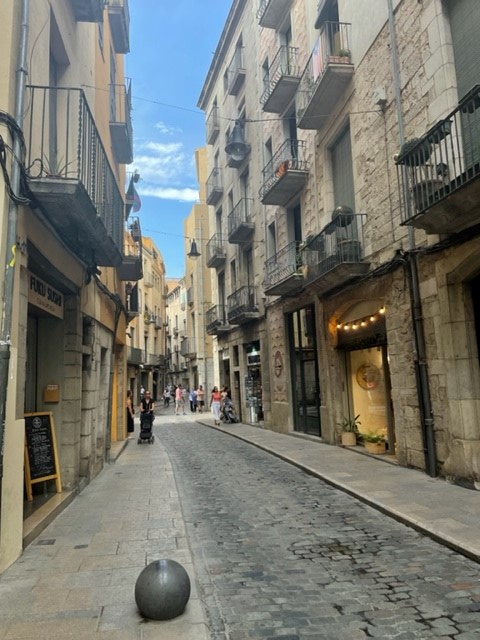
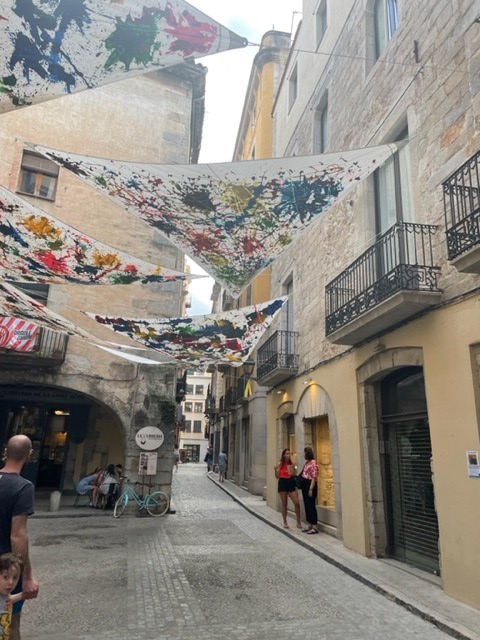
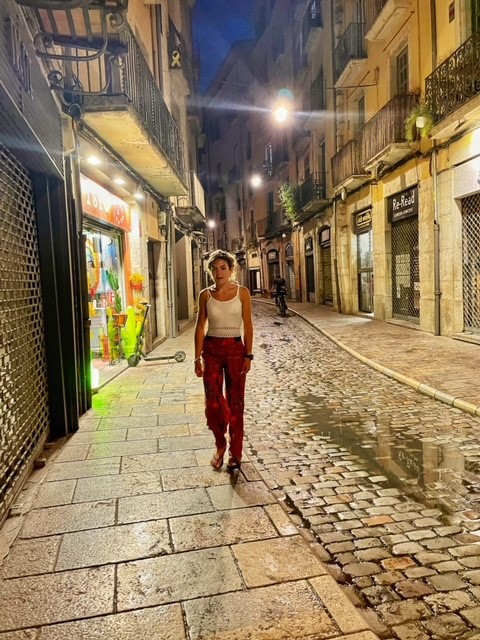
We took a rambling route back to the apartment through narrow, cobbled, litter-free streets, admiring the pretty, balconied, shuttered five-storey buildings of pastel orange, beige and bare stone that sat above a diverse array of little shops and restaurants. We got back about 5pm and went for a late siesta, exhausted by the heat. We headed back out around 8pm having realised the previous evening that the Spanish eat very late.

We crossed the carp-filled river and returned to the Konig bar on Placa de la Independencia for tapas. We shared potatoes with truffle cheese sauce, squid and scallop croquettes, beef strips with peppers, prawns in coconut, ginger and lime sauce, iberian ham croquettes, grilled octopus and a little bread basket, which seemed to come free with meals as standard. I wouldn’t normally order as much meat but I was desperate to try the local dishes. It was all very nice for only €40, including half a litre of Sangria and two pints of San Miguel. We ate, drank and people watched, charmed by the social, relaxed atmosphere – people of all ages were out until late and there was a nice, quiet buzz around the square.

We crossed back to Old Town over the bridge by the Basilica and walked through castle-like streets to see the cathedral at night. A bright, warm light accentuated its geometrical edges, detailed carvings and hundred steps, making it look even more striking than in daylight. It was lovely walking through the narrow stone back roads – although the bars and restaurants were bustling, particularly in the evening, there were plenty of quiet, timeless, totally empty little alleys and streets that we could dive down, where it felt as if we had the city to ourselves.

We shared a delicious vegan ice cream (one scoop each of passionfruit, snickers and caramel) on our way back to the apartment and found ourselves in a little square listening to a Catalonian three-man band, who sang and played guitar in that distinctive twangy, lively Spanish style. The music was lovely and we sat on a little wall behind the tables that spilled across the square, where people sat, sang and waved napkins to some well-known song. I was amusedly watching a chocolate labrador hoover the floor and be retrieved by its owner for the third or fourth time when a lady suddenly appeared in front of us offering a tray of small disposable cups, so we took one each and thanked her. It was some kind of hot, thin, strong, coffee flavoured alcohol, and after one sip I donated it to Ryan.

We went back to the apartment as the band packed up, amazed by the friendliness of people – the local who stopped to tell us his favourite spot in the city, an English-speaking man we befriended in the ice cream queue who recommended the Indian restaurant where we had our last meal of the trip and the lady who’d given us a free drink, despite us obviously only stopping in the square to listen to the music. I was quite taken with Girona.

Girona, Spain: First impressions

5 – 6 July 2022

Poor planning

I had an extremely stressful evening on Tuesday 5 July. We went indoor climbing as normal and on the way back I decided it’d be a good idea to check the covid requirements for our flight to Spain at 12:25 the following day. It turned out that although we were double vaccinated, we could only enter Spain if our second vaccine had been received within 270 days of the flight, we’d had the booster (which takes up to 5 days to register on covid records), or we had a negative test result. Negative (by about 25 days), negative, and negative, respectively.

After hours of googling, despair at realising most test centres (including the one at Bournemouth airport) had 24-hour turnaround times, and a small degree of extremely sceptical relief at having found a centre in Southampton offering £22.50 lateral flows with 2-hour results and an 8am appointment slot, we packed at 1am, hoping that we weren’t tempting fate. We went to bed at 2am and were up by 6.

Ryan’s dad rushed us into Southampton for 7.30, we had our lateral flows at the test centre – surprisingly busy for 8am – and we went to a nearby walk-in vaccination centre to get our boosters at 9am, just in case the covid app updated on time. Miraculously our negative test results were emailed through as we were queuing, to our immense relief, but we were still slightly anxious that they wouldn’t be accepted at the airport.

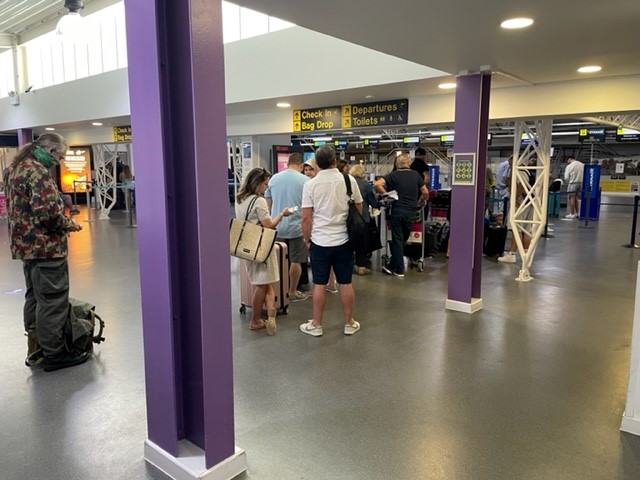
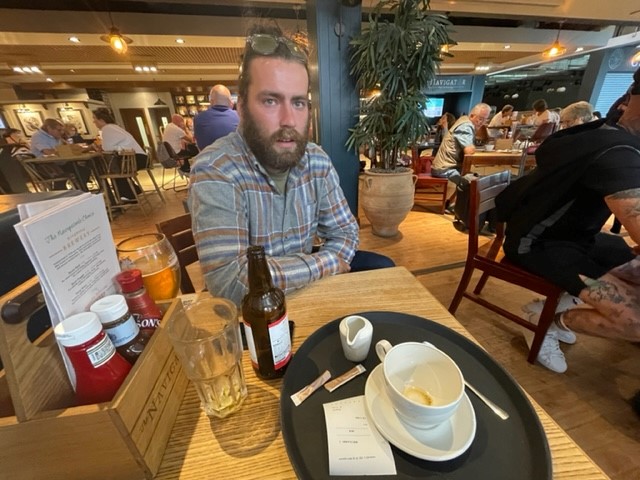
On the way to Bournemouth airport I filled out our Spanish government issue entry forms, uploaded our test result documents to our boarding passes, and breathed for the first time in 12 hours. We went through security, had a drink in the bar, bought a phrase book from the shop and boarded our busy flight without any hassle.

Arrival in Girona

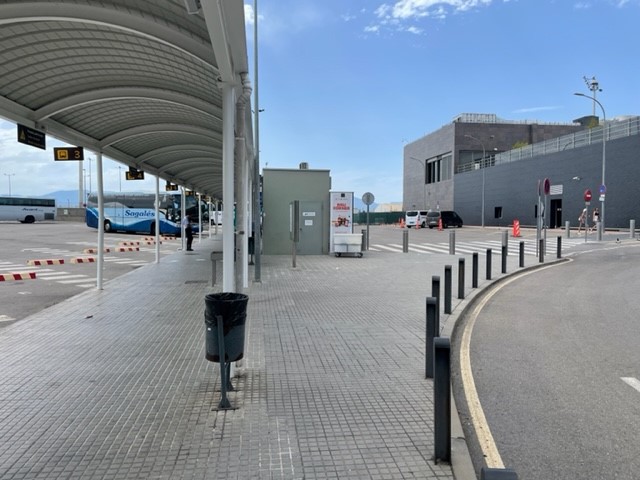
We stepped off the plane to that intense, slightly stifling wave of heat that marks the beginning of a hot summer holiday. We left the airport, slightly incredulous that Spain had let us in without batting an eyelid, and waited half an hour for a bus in the searing heat. I was delighted to find a vending machine at the bus stop selling impossibly processed ham and cheese sandwiches and paprika crisps, which kept us going until the bus came.

The 30-minute trip to Girona bus station took us past dry, golden fields, dusty buildings and the industrial southern end of the city, which seemed to be full of car and motorbike dealerships. We left the large, air conditioned station building and were once again hit by the heat of a Spanish summer as we walked out onto a large, open, very clean plaza. We headed east through intermittent, warm rain towards our airbnb past slightly tired-looking offices and flats, then along a long, straight, smooth-cobbled street flanked by tall, six-storeyed buildings with a variety of narrow shops underneath.

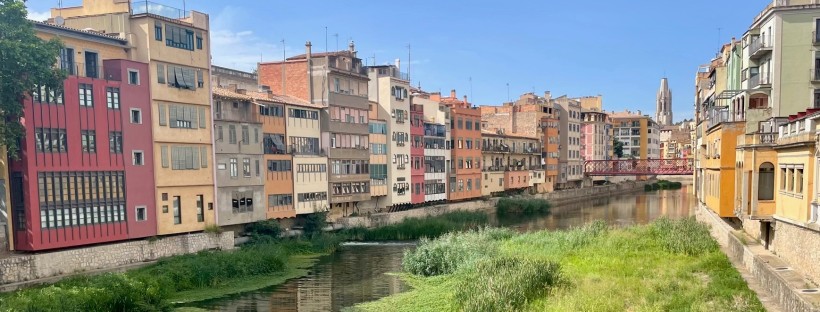
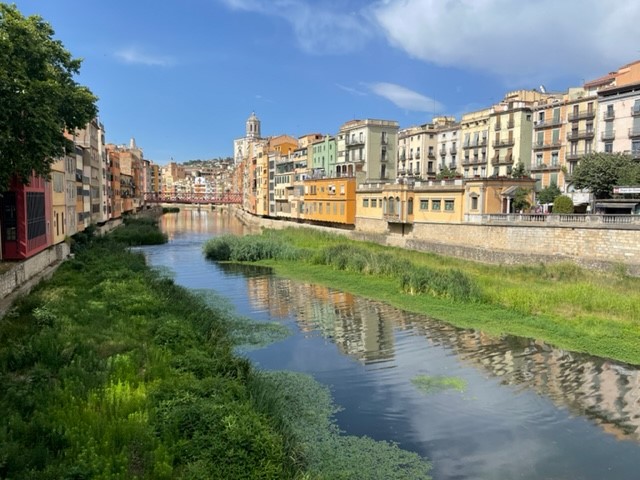
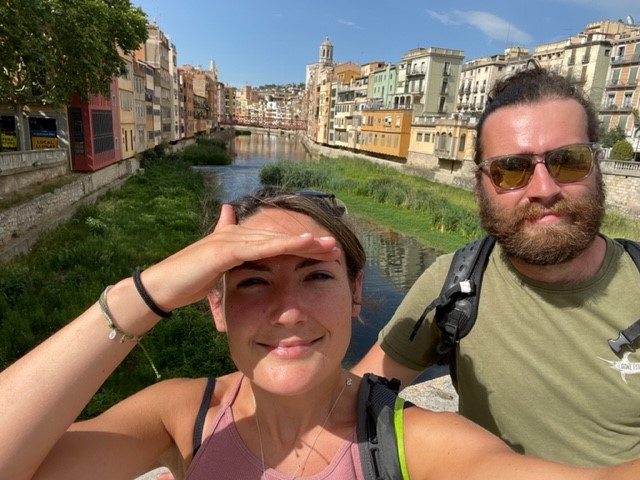
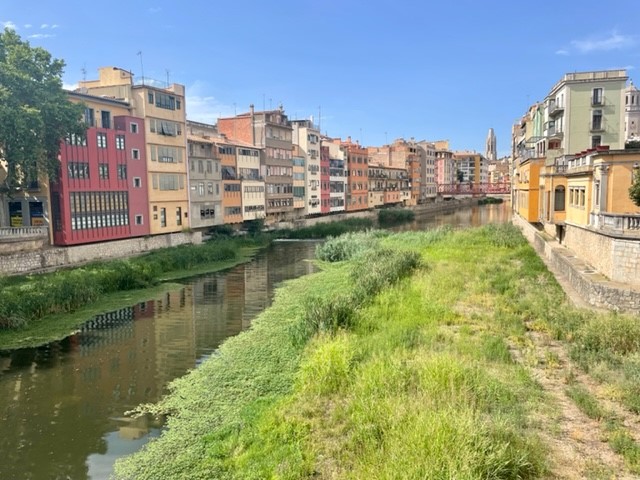
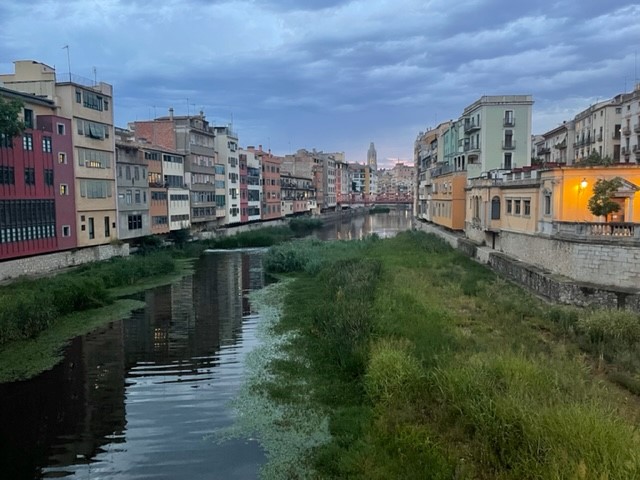
Then we reached the river Onyar and realised what Girona was all about. We stopped on the wide stone Pedra bridge to admire the river, which consisted of a barely flowing channel of clear water between two lush green strips of grasses, reeds and wetland plants, set about 15 feet below street level. It was incredibly clean, and large carp swam lazily around the weeds directly below us, to Ryan’s delight. The river was lined on both sides by pretty, flat-fronted buildings two to six storeys high, painted in a striking array of oranges, yellows, reds and creams, and the elegant grey towers of the cathedral and basilica soared above the flat rooves on the right bank. This was the view that came up when we’d google imaged Girona, but it was even more beautiful.

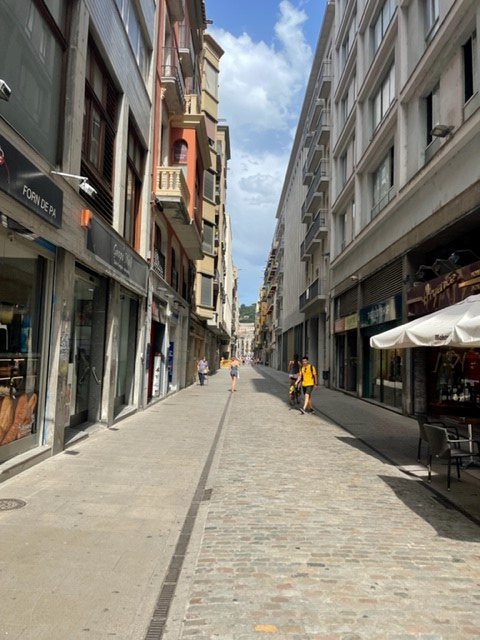
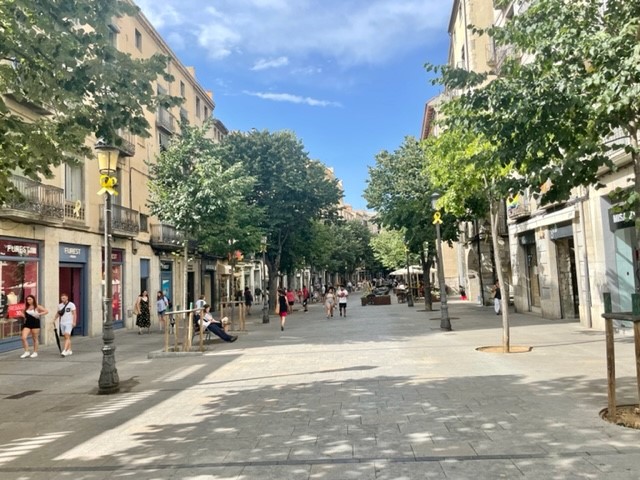
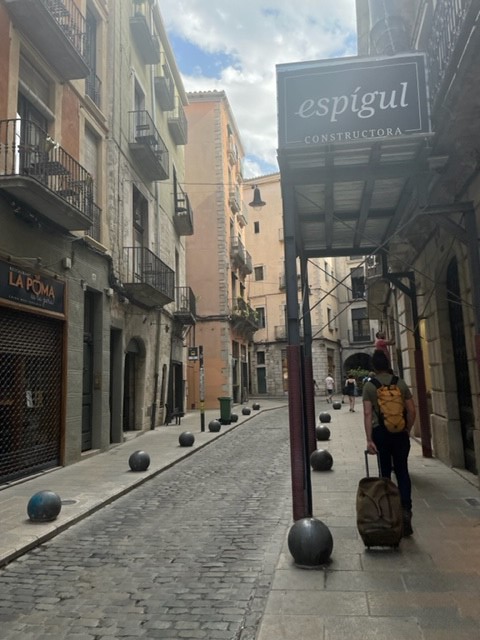
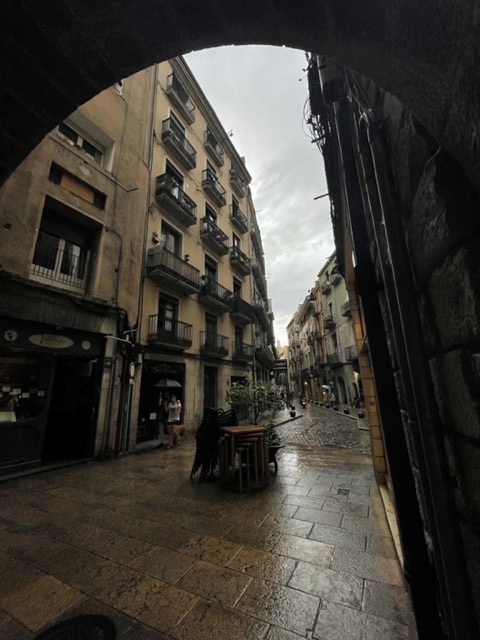
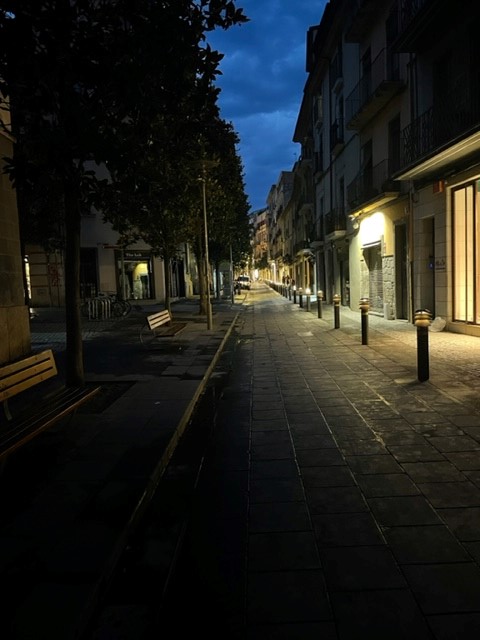
We crossed the bridge and wandered down the cobbled, tree-lined Rambla de la Libertat, which was bustling with pretty shops and little restaurants with tables spilling across one side of the street. We turned right at the end onto a narrower street squeezed between attractive, five storey high buildings, some painted pastel oranges and some bare-stoned, all with pretty balconies and shutters or blinds to keep out the heat. The streets brimmed with all kinds of little shops and restaurants and it was remarkably clean and tidy – not a speck of litter. Old town had delighted us already.

Accommodation

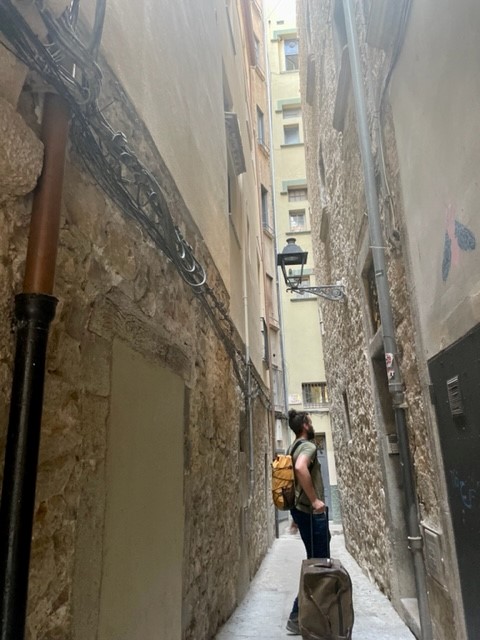
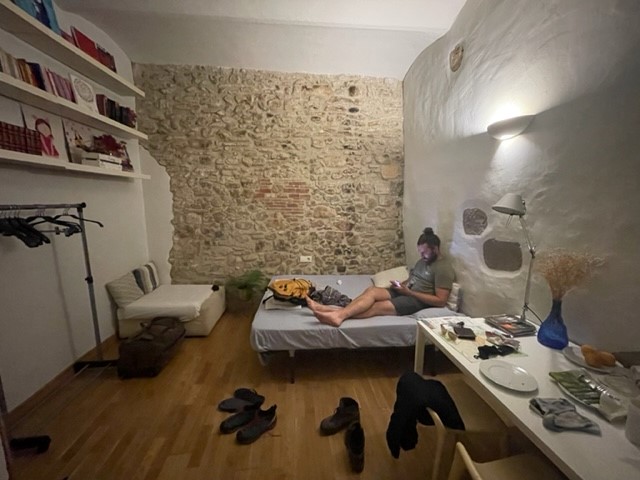
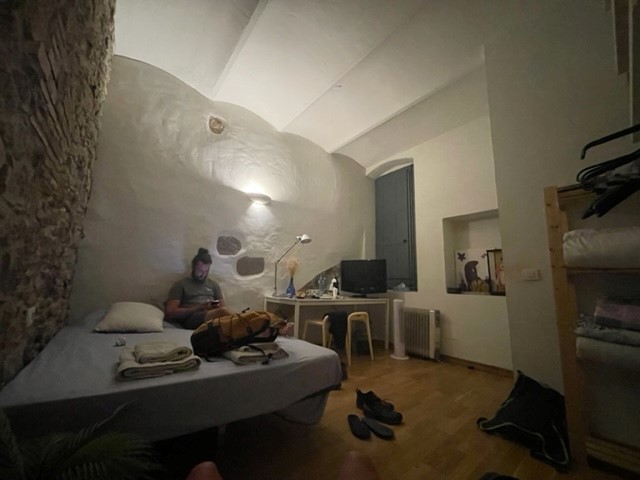
Our airbnb was in a third floor apartment right in the middle of old town, down a narrow alley on the Placa dels Raims, the smallest square in Europe. It took a little bit of finding but we were delighted with it. Our host – despite barely speaking a word of English – was extremely welcoming and our room was along a corridor in a separate part of the apartment to the main bit where she lived with her family. It was high-ceilinged and timeless, with whitewashed walls and a lovely stone feature wall, shelves full of books, towels and trinkets, a tall shuttered window opening out onto a narrow gap between the tall buildings, and our own large, clean private bathroom. It was lovely to be spending the trip in a Catalonian home, rather than a common-or-garden hotel room.

Paella & Chill

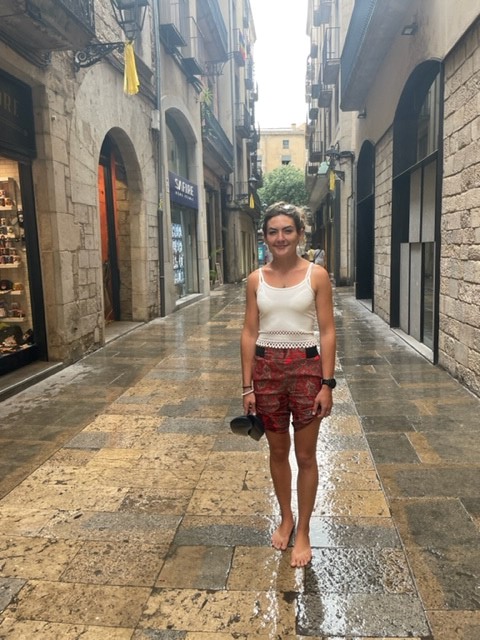
We took some time to settle and relax in the room following the stress of our poor-planning-related near miss, then got changed and went to explore a little. We had a little walk around the picture-postcard narrow, cobbled streets, enjoying that distinctive summer smell of warm, fat raindrops (none of that nasty British drizzle) hitting the stone floor. My flip flops were slippery on the smooth slabs so I walked around barefoot with my silky trousers rolled up. We went back to the tree-lined Rambla de la Libertat for dinner and found a reasonably priced (we later found out that most restaurants were reasonable) Catalonian restaurant with street seating under large stone arches and grappled – probably quite poorly – with ordering our dinner in Spanish.

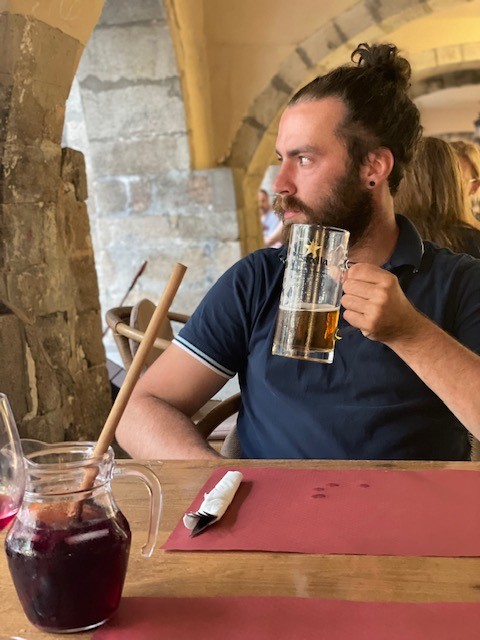
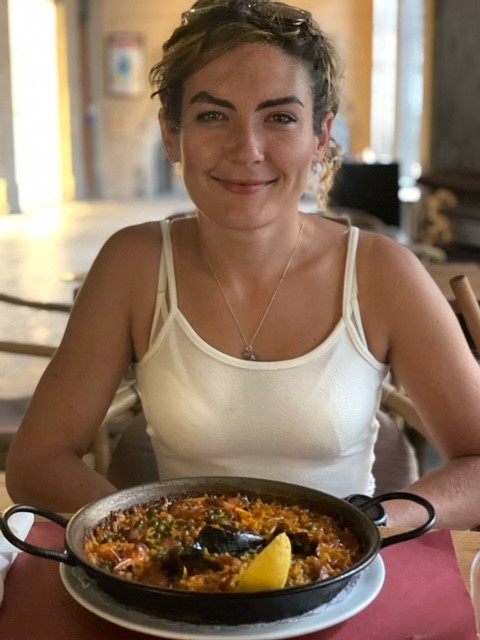
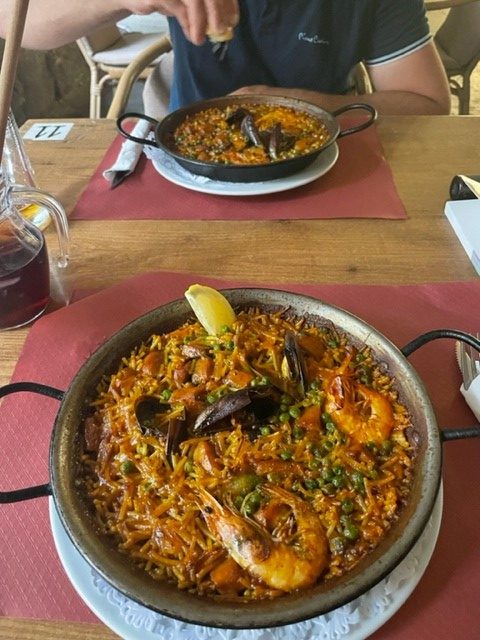
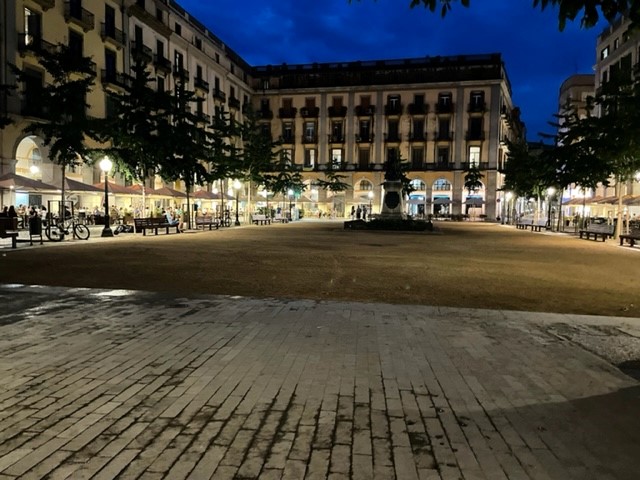
We shared a lovely seafood paella and “fideua”, a similar dish but with noodles and a different sauce. I enjoyed my first ever (!) sangria and we sat people watching, drinking in the unfamiliar and refreshing lack of English-ness. The rain subsided and we went for an evening walk. We crossed back over the Onya, which was equally beautiful under a fading, grey-pink sky, and wandered around the clean, more modern, slightly wider streets on the west side of the river, intrigued by the randomly situated but bustling small eat-and-drinkeries. We found the large, buzzing Placa de la Independencia square, lined on all four sides by long, tall, balconied apartment buildings above a multitude of bars and restaurants, and decided to return for lunch the following day.

We crossed back over a bridge further down the river and returned to our little flat in the middle of old town. We were extremely pleasantly surprised by Girona’s charm and atmosphere and planned to spend the next day exploring the city more thoroughly. My biggest qualm was my aching left arm from the booster jab that morning and the warm temperature, which made getting to sleep difficult, particularly as I was concerned about jab side effects. After some tossing and turning I drifted off, probably thanks to the air con unit in the room and the thin sheet instead of a duvet, excited for the rest of the holiday.

Scotland, Feb ’22: The Cobbler

Monday 14 February

We woke in Glencoe, happy to be in my favourite place but painfully conscious that we only had one day left in Scotland. The last thing on our to do list was hike up the Cobbler, an iconic small mountain in the Trossachs range near Loch Lomond. We had poached eggs on toast and drove out of dramatic Glencoe one last time – I’ve probably over-described it in previous posts so I’ll spare the gushing detail of how beautiful it is. We headed south across marshy Rannoch Moor, where the vast, sprawling wilderness was accentuated by the rugged, rolling mountains all around.

The drive down to Loch Lomond was very scenic and I saw my much-anticipated red squirrel, although sadly it was flat as a pancake in the middle of the road. We drove along the long, winding edge of the loch and turned off towards Arrochar, a village which sits at the head of unimaginatively but accurately named Loch Long. We parked in the lochside car park and booted up, leaving the van about 12.30pm.

The first section took us on a long, steady hike up a switchback path that climbs above Loch Long and through thick birch and evergreen forest, then pops out onto open, undulating moorland covered in golden grass, brown heather and the large, grey, randomly strewn Narnain boulders. The distinctive form of the Cobbler appeared as we emerged from the trees, its dark, gnarled rocks distorting the horizon and standing in stark contrast against the pale, cloudy sky and patchy white snow.

The Cobbler, otherwise known as Ben Arthur, is so called because of the distinctive, tall, dark lump of rock that sits on the central summit of the hilly mass, which is supposed to look like a cobbler bending over at work when viewed from the east – the way we were approaching. Personally I’m not sure I see it, but it certainly is a peculiar shape.

With that iconic figure straight ahead of us, the steady hike up the hillside moor was stunning, with far-reaching views across the rolling, golden peaks of the Arrochar Alps rising all around us. We passed vast boulders and followed the gently flowing Coire a Bhalachain river for about a mile to the base of the imposing, obscure obtrusion, where snow started to appear on the ground in patches. Here we took a right fork to approach the summit from the obvious path to the north. The alternative option was a shorter but steeper route that looks on a map like it goes west up a wide gully, which looked snowy – we hadn’t taken ice axes so didn’t fancy climbing, nor ending up in an avalanche.

The path continued gradually up and northwest along the river for another kilometre to the small Lochan a Chlaidheimh, which sits in the col between the Cobbler and neighbouring Beinn Narnain. Suddenly exposed to the westerly wind, able to see the deep, rolling valleys over the back of the mountain, and stood just below a thick grey curtain of clag, the place took on a whole new character – wilder, more ominous and more exciting.

We took a left fork at the col and began the steeper climb up stone “steps”, now heading south up the mountain’s north face. The snow thickened and spread as we climbed up, and the icy rocks became quite awkward to move across; luckily sensible Ryan had brought his hiking poles. Once we’d gained some height the path levelled into a narrow, slippery traverse below the lumpy North Peak, which was a little sketchy but afforded good views over the undulating brown valley below (the summits of Beinn Luibhean and Beinn Ime had been absorbed by cloud) and the Cobbler’s snow-covered northwest side, which rolled down in a vast white mass that was quite different to the iconic grey cliffs on the sheer eastern face.

We reached this white mass and made our way up, which was difficult given the steep gradient and slipperiness of the compacted snow and the unpredictable sizes, shapes and locations of the rocks hidden underneath. The snowy summit (884m) was about a kilometre on from the Lochan where we’d branched left, and we were relieved to gain it after the awkward climb. Once up there I was keen to “thread the needle”, a famous move which involves climbing through a hole in the highest pinnacle onto an exposed ledge on the sheer east face, then scrambling up to stand on the narrow rocky peak. I went partly through the hole but the conditions were way too windy and icy, so I decided against it – Ryan had already had kittens.

Pleased to have reached the top but slightly amused and exasperated to once again achieve a summit with extensive views of the inside of a cloud, we took a few photos and headed back down the way we came. It was just as awkward as the way up, if not more so, and we were relieved when we returned to the Lochan and the easier path back across the golden moor.

The walk back from there was lovely, with excellent views over the rugged hills all around. For some bizarre, probably food-related reason, Ryan, who hates running, decided to start jogging back, which we did for a few hundred metres before I became concerned about a potential shin splint (an old injury) and becoming unnecessarily sweaty. We crossed the boulder-strewn moor, looking back wistfully at the wild hills, entered the forest and took the switchback path back down to the car park.

We got back to the van about 16:30, de-kitted and drove south along the bank of stunning Loch Lomond to the town of Balloch, where we treated ourselves to a mayo chicken from McDonalds and looked for a half-decent overnight spot. Having not found anywhere, I used the Park4nite app and spotted a perfect little pull-in between Dumbarton and Helensburgh on the bank of the wide, tidal River Clyde, a 20 minute drive west. It was on a very quiet road by a sandy beach, which was a lovely, bird-rich nature reserve, and as the day faded it overlooked the twinkling lights of Greenock on the far side of the river.

I cooked vegan mince stew for dinner with bulgur wheat and veg, and to mark Valentine’s Day we lit a candle – a bit extravagant, I know. We spent a long time watching the lights of Greenock dance on the water, looking up at a clear, starry, unusually bright sky, listening to the strange wading birds, and reflecting on our lovely trip. We went to bed reluctantly, not wanting our time in Scotland to end and half-considering just living wild.

And just like that, it was over. To conclude the trip, the drive home the next day was long and uneventful – we left about 9.30am and got back to the New Forest about 6pm. As usual, I think I left my heart in Scotland. Must go back soon.

Scotland, Feb ’22: Hiking Buachaille Etive Mor

Sunday 13 February

This was to be our biggest mountain day of the trip. Buachaille Etive Mor is Britain’s most photographed mountain due to its perfect triangular form and solitary position between the heads of Glencoe and Glen Etive. It stands tall over wild Rannoch Moor, and although it looks like an archetypal mountain when approached from the east, it’s actually an undulating ridge with four separate summit peaks rising along its 5-mile length, two of which are Munros.

We’d hoped that the conditions would be favourable enough to ice climb up that triangular eastern face, but the wind and avalanche forecasts didn’t look too good so we decided to “hike” up the steep north face. I got up at 6am, had porridge and coffee and got ready, and eventually managed to rouse the morning-phobic Ryan. We drove the short distance up the Glen Etive road to rejoin the Glencoe road and parked in a roadside car park due north of the Buachaille.

We set off south at 8am, just as the morning light crept in. We crossed a footbridge over the river Coupall and passed the iconic white Lagangarbh hut, a tiny cottage set low against the dramatic mountain backdrop that the Scottish Mountaineering Club use as accommodation. We followed the footpath south across heathery moorland, which rose gradually towards the base of the mountain. We reached a rushing stream that flowed down to the Coupall from Coire na Tuilach, the corrie whose back wall we would be climbing, and started the ascent up its wet, rocky bank.

It was a steep hike up the little river, and as is so commonly the case, the path disappeared about halfway up. We hopped between rocks as snow started to appear, thickened, and eventually covered the ground. After what felt like a long time the river disappeared and we reached the bottom of a very steep snow slope at the back of the corrie. Ice axes in hand, we hacked our way up through the knee-deep, soft, yielding neve, which felt so solid that we decided there was no need for crampons or ropes.

It was dramatically steep and very exciting, like nothing we’d ever done before. At the top the gradient quickly levelled out and we pulled over the edge onto the foggy ridge just after 10am, exhilarated by the climb and eager to see what was next. There was a marked difference in temperature once we were no longer sheltered by the corrie walls, so we pulled on coats and quickly headed east towards the summit of Stob Dearg, the Buachaille’s highest and most easterly peak – the top of that perfect triangle.

The cloud hung in a low, flat curtain just above our heads, and as we climbed it swallowed us up. We eventually reached the summit just before 11, having tramped up a kilometre of awkward, bleak terrain that varied only between thick snow and uneven rocks, having seen none of the surrounding landscape – which we knew would have been breath-taking – due to the increasingly damp clag. Pleased to have summited but slightly underwhelmed by the cloudy Stob Dearg, we headed back (depressingly) the same way. We passed a small group following our tracks to the top and agreed that it was nice to have been the first up the peak that day.

We passed our own footprints coming from Coire na Tulaich and continued southwest along the claggy ridge towards Stob na Doire, which was about a mile away. I was furious at myself for breaking my own rule – don’t let a down jacket get wet – as I’d underestimated the light snow and done just that, so I pulled on a waterproof and accepted that I deserved any damp-related suffering that would doubtless ensue. The most interesting things we saw (snow, rock and clag had all ceased to be interesting) were animal prints – most likely fox, ptarmigan or grouse and excitingly, given the immense size of them, golden eagle. Eager not to fall off the edge of the ridge, we walked on a bearing across flattish snow in near white-out conditions – the only distinction between the ground and the sky was the slight grey tinge of the all-consuming cloud.

The gradient increased steadily as we approached Stob na Doire, then steeply, requiring some awkward clambering over large rocks and careful guesswork as to whether each footstep into the snow would meet solid ground or a gap between boulders. This section seemed to last forever, and I distinctly remember noting that just then I wasn’t having a particularly enjoyable day. Time seemed a distant concept, and we were relieved when we suddenly appeared at the summit at 12.10pm.

We hurried down the peak’s long, steep, rocky southwest face into a col between Stob na Doire and Stob Coire Altruim. Pleased to feel like we had finally made some ground and noticing that the clag was just starting to thin a little in places, we crossed the col, keeping a safe distance from the obvious cornice that had formed over the ridge’s north side. The short climb to the third summit was over nice, predictable snow, which was much more enjoyable than the uneven rocks going up Stob na Doire. We reached the top at 1.10pm.

There was less elevation difference between Stob Coire Altruim and Stob na Broige, so the kilometre between the two summits felt fairly relaxed after our Stob na Doire ordeal. Here the rocky, snowy ridge narrowed significantly in the middle, making for quite an exciting and aesthetically pleasing traverse between the peaks, and the cloud occasionally lifted slightly to afford us dramatic views over the stunning, bleak glens a long way below. We reached the small, circular stone shelter at the summit of Stob na Broige at 1.30pm, then retraced our steps back to Stob Coire Altruim and the col.

The path back started somewhere in this col but it wasn’t obvious where, so avoiding the cornices we took the most agreeable-looking way down. We scrambled down into a huge, sheltered bowl and decided it was time for some food, so we stopped to share a hot flask of Ryan’s special spicy noodle-couscous mix, the perfect winter mountain snack. Feeling significantly perked up, we continued north down the steep snow slope, found a lone set of footprints and what looked like the path, and eventually descended to rockier, grassier ground.

From here the way down was just as awkward for a while, necessitating the use of ice axes for stability as we climbed down wet slabs. We were glad to have descended below the cloud line, which meant that we finally had clear views over the dramatic, immensely proportioned golden-brown glen. We were careful to keep left of the steep river that flowed white next to us, not fancying a difficult crossing or a long tramp across boggy ground at the bottom.

The slope levelled as we reached the wide valley base, and the obvious, narrow path arced right across undulating grassy, mossy, heathery ground, following the white River Coupall northeast. We walked for about 2km through the valley, feeling very small between the hulking golden masses of Buachaille Etive Beag and Buachaille Etive Mor. At one point the path ran along a narrow ridge with a sheer 6m drop-off either side, making for an interesting and varied walk back to the van, and I was excited to spot a herd of well-camoflagued red deer munching away low down on the slopes to our right. Eventually we reached the main road and walked along it for a fairly unenjoyable kilometre, keeping as far out of the way of the whizzing traffic as possible.

We got back to the van about 4pm, just before the daylight began to ebb away. Delighted with our successful big mountain day, we drove back through the Pass of Glencoe to the Co-op at Ballachulish, grabbed some snacks and went back to the Signal Rock car park (see post from our previous trip for more on Signal Rock) in the Glencoe pass – I just can’t get enough of the place. The car park is owned by the National Trust for Scotland and quite refreshingly, they allow respectful overnight camping. Surrounded by trees and tucked into a corner, we sorted out some kit, then walked a short distance along a well-pathed forest track to the Clachaig Inn for a celebratory pint.

The pub was modern and cosy, with some interesting mountain art and old ice climbing gear. I assume they do well from just our car park, let alone the actual hotel guests. We enjoyed a cold cider, managed to resist the food, and walked back to the van through the dark trees for a tasty dinner of tortellini in tomato sauce with leftover veg. Safe to say we slept well that night.

Scotland, Feb ’22: Steall Falls, indoor climbing at Kinlochleven

Saturday 12 February

The weather was not on our side, so we planned some rest day activities. We left our little Fort William hotel room at 10am and drove southeast for 20 minutes to the car park for Steall waterfall and wire bridge, which we’d found in the Wild Guide. The drive took us on a winding road through high-sided, picturesque Glen Nevis, with Ben Nevis towering over our left side and the thickly forested slopes of lower, but no less wild, peaks on our right. We arrived at the small, dead-end car park and set off along the well-walked, rocky path for the waterfall.

An Steall waterfall walk

The path ran above and parallel to the Water of Nevis, which flowed fast and relentless along its rocky course. Little waterfalls fed it from all around, some flowing under wooden bridges built into the path. Our 150-200m elevation gave wonderful views over the rushing white river and the deep, dramatic glen, whose high, undulating sides were a colourful patchwork of yellow grass, green pines, lilac-pink birches and orange heather under a thick grey sky, which absorbed the snowy upper reaches of the steep slopes and made the valley feel very self-contained. The path ran for a mile through leafless trees connected by lush green mosses, then curved with the river and dropped down to just above river level, where the valley floor widened slightly into a grassy plain set in a long, steep-sided basin.

We turned a corner and An Steall waterfall, the third highest in Scotland, burst from the huge, craggy valley side ahead of us, a 30 foot high, furious deluge of charging white horses. A few minor falls sat thinly either side of it like veins, but An Steall was the queen of the valley, the magnificent, roaring centrepiece. She fed the Water of Nevis with an endless torrent, giving it the energy to push its way over the rocks and around the twists of Glen Nevis.

Steall wire bridge

Steall wire bridge was on our right just before the waterfall, suspended 10 feet over the river. We waited for a couple of others to cross, then approached the pebble river bank. The bridge consists of three thick steel cables about 20 feet long, two for hands and one for feet, held across the water by a sturdy metal frame at each end. We took turns to walk out over the bridge and back, placing our feet very carefully on the wobbly metal tightrope. It was more nerve-wracking than I expected as the wires move quite a lot and there is nothing below other than a substantial fall, the rushing white river and a lot of cold, hard, wet, uncomfortable-looking rocks, but that meant it was also a lot more fun than I expected.

More people turned up so we left the bridge and retraced our steps back to the van, through that almost lower Himalayan valley. We left Glen Nevis and went back to Fort William for fuel and snacks. At the petrol station the clouds unleashed a sudden deluge of rain, possibly the most savage I’ve ever seen, and we had to wait a few moments for it to ease as it was heavy enough to obliterate all visibility. Once we could see again (only just), we decided to head towards Glencoe via Kinlochleven to climb at Ice Factor, the National Ice Climbing centre. The ice wall was fully booked but we were quite happy to squeeze some indoor rock climbing into the trip and avoid the weather.

Ice Factor, Kinlochleven

The journey south along the bank of Loch Linnhe, then east along Loch Leven, took about 40 minutes, and although the clag obscured the mountains it was nice to get a good view of the lochs. Ice Factor is oddly situated in the quirky, remote village of Kinlochleven, nestled cosily at the head of Loch Leven and closely surrounded by mountains, in a high-ceilinged, old stone aluminium works building. It’s a buzzing, modern, warm place with an indoor ice wall, climbing and bouldering wall, outdoorsey shop, cosy café and soft play area.

The climbing area wasn’t huge but it was plenty big enough, and we led (up to 6b, notably on which I slipped off above a bolt and took a pleasant little fall), toproped and autobelayed some interesting routes. The natural, rock type feature walls were particularly fun as they enabled us to practise crack climbing, which is difficult to replicate with bolt-on holds. We stayed a good couple of hours, had a coffee in the café, snuck into the small bouldering room and left before we lingered long enough in the shop to buy something unnecessary.

Glencoe

We drove west along the south bank of Loch Leven and into Glencoe, my favourite place. Sandwiched between the distinctive, imposing Three Sisters to the south and the hulking ridge of Aonach Eagach to the north, the Pass of Glencoe snakes through the dramatic valley next to the rocky River Coe. Yellowish grass grows up the lower swathes of the mountains either side but the higher reaches deny it access, their harsh, dark faces being too steep and inhospitable for anything but bare rock and snow. As usual in that vast, wild place, I felt incredibly small.

We continued east, took a turn onto the small road to Glen Etive and parked in a quiet pull-in by a wooded stream below the impossibly triangular east face of Buachaille Etive Mor, whose four colossal summits we planned to take on the following day. Ryan cooked vegan burgers for tea (delicious) and we did some planning then had an early night, buzzing for the hike.

Scotland, Feb ’22: Mountain biking at Nevis Range, Fort William

Friday 11 February

Following the previous day’s disappointment at ruling out climbing due to the avalanche forecast, and subsequent later night than planned, we didn’t rush to get up. Our plan was to leave the van in Ben Nevis’s North Face car park and ride through Leanachan forest to the Nevis Range centre to ride its renowned mountain bike trails. We hoicked the bikes off the back and set off east along a wide gravel trail through the forest.

Nevis Range ski and bike centre was more substantial than we imagined, with a large car park, café, several bike trails and a big Gondola lift up to Aonach Mor. We started in the little skills area with a few laps of the mini runs, then rode up the hill to the start of the trails. The way up started on a wide gravel track, then branched into a twisty dirt singletrack that took us on a sustained climb through the forest to reach the top of the blue (intermediate) Voodoo and Blue Adder trails and the red (difficult) Top Chief’s Wild Goat trails.

Morning – Voodoo, Blue Adder, Blue Uphill, Wild Goat

We did the Voodoo first, a really fun, flowy, open trail with sweeping berms and some quick sections. At the bottom we headed back up via the Blue Uphill Access trail, another slightly technical blue route just off the gravel track that made the way up a bit more fun. We passed the Voodoo and started down the Blue Adder, just a little way on. This was a fast, technical, twisty trail with boarded berms and tight little turns between tall pines. The bottom bit was flowy and particularly fun, and we shot out of the woods back at the Nevis Range centre.

We slogged up the hill once again (and, as Ryan insisted, for the last time) and headed down the red Wild Goat trail. This was really, really fun, with technical rocky and rooty sections, fast, sweeping berms and a BMX-type 4X jump track. Despite its relatively short length, this was my favourite trail of the day.

Wild Goat ended back at the café, so we nipped in for lunch. It was a modern, cosy, cabin-like, MTB/ski-themed place, with stunning mountain art, a wall full of mounted skis and an expensive-looking full sus bike hanging from the high ceiling. As we sat, thawed and snacked, we decided to book a cheap room for the night in Fort William so we could have a shower and a holiday treat – dinner out, albeit in Wetherspoons.

Afternoon – World Champs, Broomstick Blue

Warmed, fed and looking forward to an evening out, we left the café slightly reluctantly and headed up the hill the other way to the World Champs red trail, a long route that starts quite high up. We pedalled through the forest, only going the wrong way once, and emerged onto a track above the trees which afforded stunning views over the vast, rolling, snow-capped mountains around Ben Nevis. We reached the trail after a substantial climb, which was worth it for the views alone.

It was a long, fast, varied singletrack route created for the 2007 XC mountain bike world championships with avoidable drop offs, quick corners and technical rocky sections, which my poor old hardtail clunked and bucked over. I actually found the rocks and roots quite annoying as it would otherwise have been a nice flowy trail, but that’ll teach me (it won’t) for refusing to buy a full sus. The first half of the trail was above the forest and it felt more exciting than the second half through the trees, but it was all great fun and we popped out on the track that heads back to the North Face car park.

We branched off onto the Broomstick Blue trail, a singletrack blue that runs parallel to the gravel track back to the car park. It was fairly flat but flowy and quite fun, with a few long boardwalk sections, some little climbs and the occasional technical rocky/rooty bit. I was keen to keep riding and try some more trails but Ryan vetoed, citing the pull of Fort William and the pub, so back at the van we loaded the bikes and headed into town.

Fort William

We parked in the central car park and walked the short distance to Bank Street Lodge, the cheap and cheerful hotel we’d booked on a whim. It turned out I’d actually stayed there previously when I did the Three Peaks Challenge, but it’s since been converted from a hostel into a small, basic hotel. We showered, I washed my hair (a strenuous task) and we headed out along the surprisingly quiet for a Friday, cobbled high street for a cheap meal at the familiar Wetherspoons and a drink in the cosy Tavern bar. We disagreed about whether we should stay out (I was team “out out”, Ryan was not) but decided not to, so we went back to the hotel for a strange night’s sleep in an actual bed.

Scotland, Feb ’22: Skye Fairy Pools to Fort William

Thursday 10 February

We had breakfast overlooking atmospheric, moodily grey Dunvegan Loch and drove down Skye’s pretty eastern edge for 40 minutes to the Fairy Pools. On the way Ryan spotted a huge white-tailed sea eagle soar high above the van and dip below some tall pines, and to my absolute delight I just about caught a glimpse of it before it disappeared.

Our plan was to hike up to the Fairy Pools, then leave Skye for the Ben Nevis range in the hope of some half decent climbing weather the next day. We wound along a remote road, parked in a free car park near the start of the Fairy Pools walk and headed down to the wide, well-maintained tourist path.

The Fairy Pools (extended edition)

The Fairy Pools are a series of waterfalls and clear pools on the Allt Coir’ a’ Tairneilear river, which snakes up to the base of the infamous Black Cuillin mountains described in the previous day’s blog post. The pools are set beneath the vast ridges of Sgurr Thuilm, Bidein Druim nan Ramh and Bruach na Frithe, which curve around the river in a protective yet imposing C-shape. These great giants form a wild, open-ended bowl carpeted with golden grass and brownish heather, and directly in front of us at the head of the bowl stood Sgurr an Fheadain, a perfectly triangular, dark grey, child’s drawing of a mountain tucked neatly between two sloping ridges as if quietly watching over its territory from a throne. Low cloud hanging over the mysterious, snow-spangled peaks gave the place a self-contained atmosphere that made it seem like the rest of the world simply didn’t exist.

We got rained on as we started up the path, which follows the river’s left bank. I didn’t mind as it meant there were few other visitors. The deep, round, extraordinarily blue Fairy Pools sat below low, rushing white waterfalls, some wide and low, some narrow and high, and the meandering river carved relentlessly over, around and through solid rock in an endless torrent. The pools were a beautiful, crystal clear blue-green colour, and if the air temperature had been in double digits I’d have jumped in. We instantly understood its popularity as a tourist destination, although I wouldn’t want to visit on a busy summer’s day. Even beneath a cloudy sky it was worthy of a Herbal Essences advert.

The path along this extraordinary river continued for about 2.5km up to the base of the Cuillins. Our plan had been to see the pools and head back the same way, but having eyed up the map I had new designs on making the hike circular (triangular) by taking a path that follows the base of the immense ridge northward, then west across the moor and back to the van. I entreated Ryan, who rolled his eyes and followed me onto our new path.

As is standard, the rocky path became muddy then boggy, to Ryan’s great disgruntlement. We trudged and slopped along wet, tufty grassland, trying desperately to keep our feet dry. After a mild bout of whinging we suddenly spotted the dark forms of several red deer a short way ahead of us, well camouflaged against the boulder-strewn, yellow-brown heathland, and our agitation evaporated. They were such majestic animals, easily large and powerful enough to do us a mischief, yet they warily kept their distance as we blundered through their territory, and idled casually up the sleep slope to the right as we approached. Then we spotted more over to our left, watching us quietly from about thirty yards away as they chewed rhythmically in peaceful little groups.

The path had been absorbed by the wild terrain so we walked carefully through heather and bog until we reached a small river, the Allt a’Mhaim, and a parallel path which would take us southwest back towards the road. We followed it all the way down the gently sloping moorland, admiring the rolling brown wilderness that was now illuminated in the golden glow of the soft winter sun, and more red deer appeared from nowhere on either side of us. The bluish clouds over the Cuillins and the dark shadows of the undulating high ridges accentuated the warm light that fell on the mountainous bowl, giving the landscape an other-worldly, dream-like quality. It was a harsh, thriving, unadulterated place.

After walking along this path for about 2km we reached a fairytale-like waterfall set just below a thick fir forest, took a wistful look back towards the Cuillins, and rejoined the road back to the car park. What a beautiful place.

Back to the mainland

It took us an hour to reach the Skye Bridge via Sligachan and Broadford Co-op, a drive that involved a lot of “wow look at that”s, referring to various lofty peaks and wild islands. Back on the mainland we drove southeast along the main A87 Old Military road that follows the length of long Lochs Alsh and Duich, then  cuts through the belly of vast Glen Shiel and past lochs Cluanie, Loyne, Garry and Lochy. As we passed wonderfully named Loch Lochy the sun set over golden water, sinking below the distant peaks in a soft haze.

Almost two hours after leaving Skye we arrived at Fort William and nipped to the familiar Morrisons, then drove for 15 more minutes to Ben Nevis’s north face car park. For dinner we had a strange combination of leftover vegan bolognese, bulgur wheat and stovies – a Scottish dish made of beef, onion and potato, all minced together in a delicious (if unsightly) mush – then had a very serious discussion about what we should do the following day.

We both really wanted a big mountain day on or around Ben Nevis, either ice climbing a route like Number 2 Gully or hiking/scrambling the Carn Mor Dearg arete, but after a lot of research and consideration we decided that given the high winds and “considerable” avalanche risk on north east aspects in that area it wasn’t the day for it. We settled, after some squabbling (I was team bike, Ryan was team find somewhere else to climb), on mountain biking the famous Nevis Range trails that started from the car park we were in, which had been on my to do list for years. It was a good thing we did because we went to bed much later than planned, having spent a long time deliberating over Ben Nevis.

Scotland, Feb ’22: Inverness, Skye, Old Man of Storr

Wednesday 9 February

Inverness, Tilly

No lie-ins today, to my satisfaction and Ryan’s displeasure. Having fully exploited the Cairngorms, we planned to head west across to the Isle of Skye, a place that’s been right at the top of my “to do” list for years. We left Aviemore and drove north along the main A9 road to Inverness, parked in the small, fairly central Rainings Stairs car park we’d stopped in on a previous trip and walked down the long flight of narrow stone stairs to the town centre.

Having visited Inverness before we didn’t plan to stay for long, so Ryan got his obligatory McDonalds breakfast (which, as usual, we ended up sharing thanks to his generosity and my “I’m not that hungry” regret) and we shivered through the cold, damp, snowy street lined by attractive, tall yellow sandstone buildings, already a bit peopled out, straight back to the van.

We were in a pretty, quiet residential area on our way out of Inverness when we saw a little jack russell wandering around a road. We’re both very much animal people (generally more so than people people), so we pulled over and I approached the elderly-looking, placid little dog. Her collar told me her name was Tilly and she lived at the house she was hanging around outside, so I rung the bell and called the mobile number on her collar, both to no avail. Luckily her friendly neighbour pulled onto his drive and told me that she sometimes escapes, so he put her back in her garden and explained that he’d take her in but she doesn’t get on with his dog, a lovely little west highland terrier called Gordon. He reassured me that her florist owner was probably on a local delivery and wouldn’t be long, so feeling all warm and cosy about helping little Tilly (and instantly over whatever we’d found to argue about that morning – I can’t remember) we went on our merry way.

East to west coast

The drive across to Skye took a couple of hours and was a stunning route, mainly through open, yellow-brown moors surrounded by dramatic, rolling white peaks, several of which we eyed up as mountaineering destinations. The weather was classically Scottish – wet and claggy one minute, bright and sunny the next – and the road snaked along wild glens and through rugged little villages. Shortly before we approached Skye Ryan pulled into a small road so I could have an indecorous wee in the usual van style, only slightly hidden from any unfortunate passers by (happily there were none), and as we approached the island on the road that runs along the Loch Alsh sea inlet he stopped for his own indecorous wee, which gave me a good opportunity to photograph the striking Skye Bridge.

Skye

We crossed the bridge and headed to the Co-op at Broadford, all the while admiring the vast, watery expanse and wild little islands of the Inner Sound strait. We grabbed snacks and supplies, then drove up for nearly an hour up the northeast coast towards the Old Man of Storr.

Even under an overcast sky it was an other-worldly place. Skye is part of the Inner Hebrides archipelago, a chain of 79 islands sprawled up Scotland’s dramatic west coast. I was stunned by the fullness of the landscape, which seemed almost contradictory: there was so much land, rising out of the water and high against the horizon in its random, rugged, heather-brown and snow-white forms, yet so much water, dead flat and simultaneously light and dark. As a whole the sea reflected the bright grey sky, but the blue-black detail of the waves and ripples hinted at the mysterious depths below. It was captivating.

We snaked around the base of the red Cuillin mountains and glanced left at Sligachan to catch a glimpse of the black Cuillins, whose name alone is enough to command a sense of awe and deference. They towered over the rolling moors in jagged peaks, the indomitable kings and queens of the island. If it weren’t for the high winds and poor visibility forecast we’d certainly have set upon the infamous Cuillin Ridge traverse, but I’m not sad about having such a firm incentive to return.

The rolling moors continued on the road to Portree, a pretty, lively-looking town with lots of quirky independent shops, and beyond, where we climbed higher into thick clag and heavy snow. Ten minutes later the sky was bright blue and as the strip of water between the isles of Skye and Rasaay crept back into view, the iconic Old Man of Storr appeared ahead in his striking, bizarre elegance. We pulled up in the large visitor car park, ate some noodles and began the easy 20-minute walk up to the surreal formation of towering bare rock.

Old Man of Storr

We were surprised that a quick google yielded no climbing routes up the pinnacle (not to be confused with the Old Man of Stoer, a sea stack further north on the west cost of the Scottish mainland and something of a climbing mecca), but on closer inspection the rock has a strange, damp, crumbly texture. He stands about 50m tall and 10m wide, a brownish grey pinnacle of basalt in an ancient volcanic island of tantalising, intimidating, alien rock – The Storr. The snow that thinly covered the grassy, rocky landscape all around didn’t dare touch the dark obtrusion, which rose suddenly in jagged, triangular forms separated by sinister black gulleys. The Old Man’s upright position looked unnatural, like he should topple over any second, and as we walked right up to him we understood the story of the giant laid to rest whose thumb remained above ground, pointing to the sky. It was a strange, enigmatic, serenely beautiful yet slightly uncanny place.

The walk back the same way was breathtaking, overlooking the undulating isles of Raasay and Rona and in the distance the distinctive Black Cuillin mountains, which were framed perfectly below a curtain of thick grey cloud – even that hung respectfully above the towering peaks. Already stunned by Skye, we got back in the van and continued our drive north up the east coast of the island in the hope of seeing the Quiraing before nightfall.

Lealt Falls, the Quiraing

After about 10 minutes Ryan swung the van into a layby. He’d spotted a waterfall sign, so we went over to the viewing platform set just off the road and watched the tumbling white water of Lealt Falls rush into the Abhainn An Lethuillt river (catchy name). There were two waterfalls, a high, thin one and a wide, tiered one, both carving channels through the sweeping land and enabling trees to thrive thickly along the banks, even in this harsh landscape. The water rushed into a deep valley, at the end of which the sea sat high and blue cradled in the “V”. We watched it for a little bit, then scurried on to catch a glimpse of the Quiraing.

After a 15 minute drive past some quirky, sprawling hamlets, we were in the bizarre landscape of the Quiraing, an ancient craggy landslip near the northernmost point of the island with sweeping slopes, high cliffs and huge, random masses of bare rock. The road wound below the fascinating land formations and snaked twistily up one side. I got out the van and wandered up a small hill to take some photos, wishing that we had a bit more time for a proper explore. From there we drove across a wild, high moor and headed southwest through awful conditions in the dark – heavy snow with next to no visibility along the main A87 road – to Dunvegan, where we found an out-the-way pull-in on the bank of Loch Dunvegan, near the castle.

I cooked an improvised meal of vegan chilli con carne with bulgur wheat and we spent the night under a starry sky, which reflected off the glassy water of the loch and turned the low hills on its far bank into pitch black silhouettes. We fell in love with Skye that day.